How To Control The Cost Of Cattle And Sheep Feed Pellet Production Line
Leave a message
Raw material pretreatment is the starting point of a feed pellet production line, including steps such as crushing, screening, and batching. Improper operation in this stage, such as excessively fine crushing of raw materials wasting electricity, mistakenly rejecting qualified raw materials during screening, or rework due to deviations in batching ratios, will directly increase costs. It's important to know that raw material costs account for 60%-70% of the total feed cost; therefore, controlling costs in the pretreatment stage is equivalent to controlling a significant portion of cost reduction in the production line.
Methods of controlling costs
1. Determine the particle size of the crushed feed according to the type of livestock or poultry to avoid wasting effort: Different livestock and poultry have different requirements for the fineness of the raw materials. For example, chicken feed requires corn to be crushed to 1.2-1.5mm (for easy digestion), while cattle feed only needs corn crushed to 2-3mm (cattle rumen can digest coarse particles).Efficient Pellet Feed Production Lines should use grinder screens with corresponding aperture sizes. Don't use fine screens for all types of feed-fine grinding not only consumes more electricity (5-8 kWh more per hour) but also generates more dust waste. Additionally, install a dust collection bag at the grinder outlet; the collected fine powder can be reused, saving at least 20-30 catties of raw materials per day.
2. Precise ingredient proportioning avoids rework due to incorrect feed composition: Ingredient proportioning is the core of pretreatment. If too much soybean meal or too little corn is added, the feed's nutritional content will be substandard, requiring complete rework, wasting raw materials and time. For livestock and poultry feed production lines, it's best to use automatic batching scales (accuracy up to ±0.1%), rather than manual weighing-manual weighing is prone to errors and inaccuracies. Additionally, calibrate the batching scale daily before starting work; for example, weigh 10kg of standard weights. If the error exceeds 0.1kg, adjust it to ensure accurate batching and reduce rework waste.
3. In the screening process, "remove impurities and keep the good," don't discard qualified materials: stones and weeds in the raw materials should be sieved out, but don't sieve away good materials as well. For Automated Feed Pellet Equipment, choose a two-layer screen: an upper coarse screen (5mm aperture) to sieve large impurities, and a lower fine screen (0.5mm aperture) to sieve fine soil; the middle layer is the qualified raw material. When cleaning the screens daily, don't discard all the material on the screens; after removing impurities, the remaining qualified material can be returned to the machine, saving tens of kilograms of raw materials each month.
Main equipment



about Us
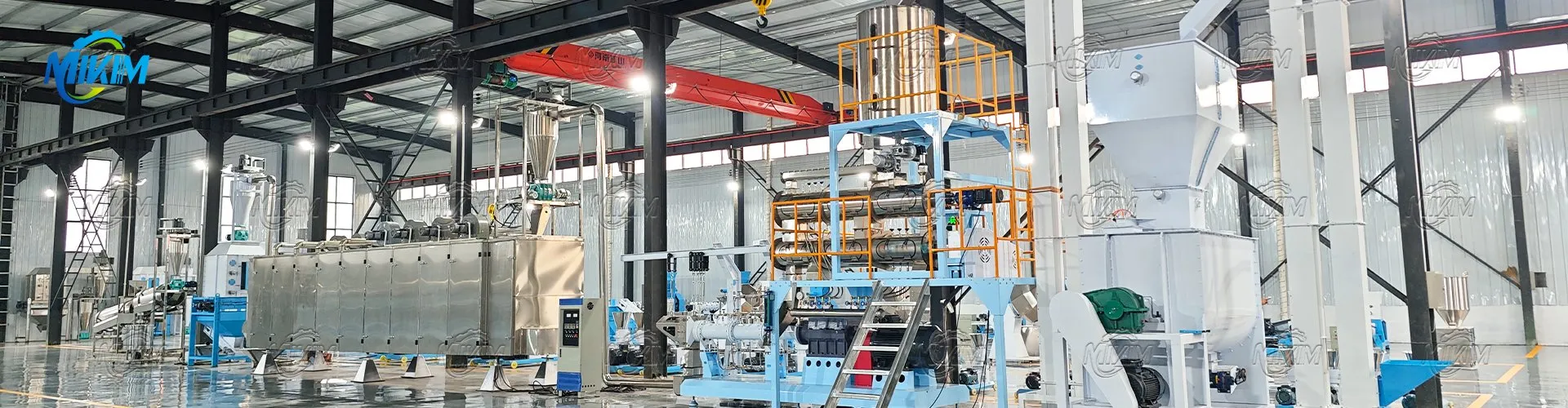
MIKIM is a high-tech enterprise integrating R&D, production, and sales. Its feed extrusion equipment utilizes a high-temperature, high-pressure process, which sterilizes, improves puffing density and digestibility, and saves 8%-15% on feed costs. Pellet diameters are adjustable from 1-16 mm, and it features controllable cutting and floating adjustment to suit the needs of fish, shrimp, crab, and pet food. Core components are sourced from international brands and undergo special treatment, ensuring stability and durability while balancing safety, efficiency, and peace of mind.
Qualifications and Honors

Customer visit

FAQ
1. What is the price of the Poultry Feed Complete Equipment?
The price ranges from approximately $15,000-$42,000
2. Do you provide maintenance services for your customers?
Yes, we offer comprehensive after-sales maintenance services to our customers.