


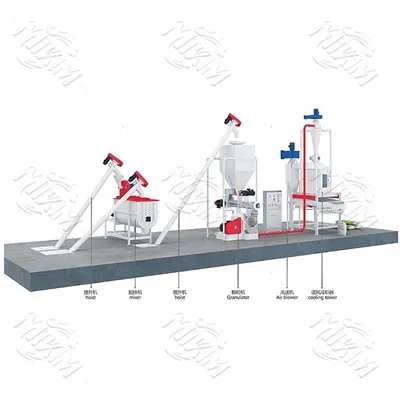
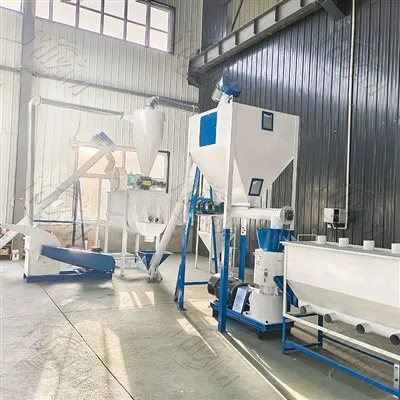
A feed production line is an integrated system designed to produce animal feeds at commercial scales. It comprises various machines and processes, starting with raw material handling, followed by grinding, mixing, pelleting, cooling, and packaging. These operations ensure that the feed is properly processed, has the correct nutritional balance, and meets the physical requirements for animal consumption. The line can be customized based on the type of livestock being fed and the specific nutritional requirements of those animals. Automation and control systems are often employed to maintain consistent quality and optimize production efficiency.
Advantages of Feed Production Line
High-efficiency Production
The feed production line greatly improves production efficiency through automated and mechanized production methods. From the mixing, crushing and granulation of raw materials to the packaging of finished products, the entire production process realizes streamlined operations, thus reducing production time and increasing output.
Product Quality Assurance
Every step of the production line operation has strict quality control standards, from the screening of raw materials to the testing of finished products, ensuring the stability and reliability of feed product quality. This helps improve the growth rate and health of animals, thereby improving breeding efficiency.
Cost Savings
Feed production lines can significantly reduce production costs through centralized procurement, standardized production and reduced waste. At the same time, the use of automated equipment reduces manual input and reduces labor costs.
Reduce Human Errors
Manual operations often have errors and uncertainties, and the automation and intelligence of feed production lines can greatly reduce these errors. Precise metering systems and mixing equipment ensure that the ingredients and proportions of each batch of feed meet standards, thereby improving product stability and consistency.
Flexibility And Scalability
The feed production line is designed to be flexible and can be adjusted and expanded according to market demand and production scale. Whether adding new types of raw materials or expanding production scale, the production line can quickly adapt to meet changing market demands.
Safety And Hygiene
The feed production line strictly abides by food safety and hygiene standards, and ensures the cleanliness and hygiene of the production environment through strict disinfection and cleaning procedures. This helps prevent contamination by microorganisms such as bacteria and viruses and ensures the safety of feed products.






Why Choose Us
Advanced Equipment
A machine, tool or instrument designed with advanced technology and functionality to perform highly specific tasks with greater precision, efficiency and reliability.
High Quality
Our products are manufactured or executed to a very high standard, using the finest materials and manufacturing processes.
Professional Team
Our professional team collaborates and communicates effectively with each other, and is dedicated to delivering high quality results. We are capable of handling complex challenges and projects that require our specialized expertise and experience.
Customized Services
We understand that each customer has unique manufacturing needs. That’s why we offer customization options to cater to your specific requirements.
One-stop Solution
At our manufacturing facilities, we provide a complete package that includes everything required to get you started, including training, installation and support.
24h Online Service
We try and respond to all concerns within 24 hours and our teams are always at your disposal in case of any emergencies.
Types of Feed Production Line
Monogastric Feed Production Lines
These lines are designed for the production of feeds for monogastric animals such as poultry (chickens, turkeys), swine, and some aquatic species like tilapia or catfish. The formulas for these feeds focus on protein sources, vitamins, and minerals suited to their digestive systems. The production line includes equipment for grinding grains, mixing with protein sources and additives, pelleting to the desired hardness, and cooling before packaging.
Ruminant Feed Production Lines
Intended for cattle, sheep, goats, and other ruminants, these lines account for the unique digestion process of these animals. They often incorporate silage and hay as part of the feed mix, along with concentrates. The production process might involve coarse grinding and less pelleting compared to monogastric feeds due to ruminants' ability to chew cud. Nutrient balancing is crucial, focusing on fiber content and energy sources suitable for rumen fermentation.
Aquafeed Production Lines
Specialized for fish and shrimp farming, aquafeed lines produce feeds that are highly digestible and stable in water. These lines usually include moisture-control processes to ensure the pellets do not easily dissolve in water. The formula may include fish meal, soybean meal, and other high-quality proteins, along with additives that promote growth and disease resistance in aquatic organisms.
Layered Poultry Feed Production Lines
These lines are optimized for producing feeds that support egg-laying hens. The formula emphasizes calcium content for strong eggshell formation and a balanced amino acid profile for optimal egg production. The line may have specialized pelleting processes to ensure that the feed is not too hard, which could cause stress to the birds’ gizzards.
Compound Feed Production Lines
These versatile lines produce complete feeds for a variety of animals, often including monogastrics, ruminants, and sometimes pets. Compound feeds are formulated to provide all necessary nutrients in a single feed source. The production process includes careful ingredient selection, precise weighing and mixing, pelleting or extrusion, and appropriate packaging methods.
Custom Feed Production Lines
For specialized farms or those with unique nutritional requirements, custom feed lines allow for the production of specialized feeds. These lines have the flexibility to incorporate unconventional ingredients, tailor nutrient levels precisely, and adapt to small batch sizes. Customization can extend to the type of additives, preservatives, and even novel feed ingredients.
How to Store Feed Production Line
Clean And Dry Environment:The first step is to store the production line in a clean, dry space that is protected from the elements. Moisture can lead to rust and corrosion, particularly affecting metal parts and electrical components. Ensure that the storage area is well-ventilated to prevent any accumulation of humidity.
Proper Space Allocation:Organize the equipment so that there is enough space between individual machines. This prevents damage from contact with other machinery and makes it easier to perform maintenance checks if needed. Use barriers or spacers to keep machinery apart.
Cover Machinery:Protect machinery with suitable covers that are breathable and waterproof. Covers should be durable and fit snugly over the equipment to prevent dust, dirt, and moisture from settling on the surface.
Secure Equipment:Ensure that all moving parts are locked or secured in place to prevent movement during storage. Use tie-downs or straps to secure larger components if necessary.
Disconnect Power And Utilities:Unplug all electrical connections and disconnect any utilities like water or gas supply lines. This reduces the risk of accidents or damage due to leaks or corrosion.
Lubricate Moving Parts:Before covering machinery, apply a thin layer of lubricant to all moving parts. This helps prevent rust and ensures that the machinery will function smoothly once it is back in operation.
Regular Inspection:Even when stored, machinery should be inspected regularly. Check for any signs of wear, corrosion, or pest infestation. Make sure that covers are still in good condition and that the storage space remains clean and dry.
Application of Feed Production Line

Commercial Livestock Farms
The most evident application of feed production lines is on commercial livestock farms where efficiency and economies of scale are paramount. These lines enable farmers to produce large quantities of feeds consistently, maintaining nutritional values and quality control. This is crucial for the health and growth of animals, which directly impacts meat, dairy, and egg production.
Research And Development
Agricultural research institutions utilize feed production lines to develop and test new feed formulas and technologies. Researchers can explore alternative feed ingredients, investigate nutritional effects, and create specialized diets for various animal breeds or life stages. This application fosters innovation and contributes to the advancement of sustainable animal feeding practices.
Nutritional Management
Feed production lines allow for precise nutritional management, which is essential for optimizing animal performance. By controlling the exact composition of feeds, farmers and nutritionists can tailor diets to the specific needs of animals, whether it's for growth, lactation, reproduction, or maintenance. This leads to improved health, better feed conversion ratios, and higher yields.
Custom Feed Blending
Small-scale farmers and specialty producers often require customized feeds that meet the specific needs of their animals. Feed production lines can be adapted to produce small batches of specialized feeds, catering to niche markets such as organic farming, free-range poultry, or exotic pet diets.

Precautions When Using Feed Production Line
Clear Work Area
Ensure that the work area around the production line is clear of debris and obstacles. Keep pathways unobstructed to prevent trips and falls.
Read Instructions
Familiarize yourself with the operational manual before using the equipment. Understand the functions, controls, and emergency procedures.
Startup Procedures
Follow the correct startup procedure to avoid sudden movements that could be dangerous. Gradually increase the speed of the machinery to the desired setting.
Operational Safety
While the machinery is running, maintain a safe distance from moving parts. Avoid making adjustments while the machine is operating. Use tools designed for machine interaction to prevent hand injuries.
Emergency Shutdown
Know the location of the emergency shutdown switches. In case of an emergency, shut down the machinery immediately and safely evacuate the area.
Noise Levels
Be aware of noise levels and take necessary precautions to protect hearing. Prolonged exposure to loud noises can cause permanent hearing loss.
Dust And Air Quality
Operating a feed production line can generate significant dust. Ensure proper ventilation and use dust collection systems to maintain air quality. Regularly clean dust accumulation from machinery and the surrounding area.
Electrical Safety
Do not operate the production line with damaged cords or plugs. Always follow proper lockout/tagout procedures when performing maintenance to prevent accidental startup.
How Do I Choose the Right Feed Production Line
Animal Species And Nutritional Needs
The primary determinant of the required feed production line is the type of animals you are raising. Different species have varying nutritional requirements, and the feed must be formulated accordingly. For instance, ruminants require a different diet than monogastric animals like poultry or swine. Ensure the chosen line can accommodate the specific ingredients and processing methods necessary for the target species.
Scale Of Production
Determine the volume of feed you need to produce regularly. Commercial operations will benefit from larger, automated production lines, while small-scale farmers might opt for more compact, manual systems. Consider future expansion plans and choose a line that offers scalability without significant additional investments down the road.
Quality Control And Safety Standards
Feed contamination and safety are major concerns. Opt for a production line that incorporates quality control measures such as metal detectors, ingredient purity testing, and proper cleaning protocols between batches.
Technology And Automation Level
Modern feed production lines come with advanced automation features that improve accuracy, reduce labor costs, and increase throughput. Evaluate the level of automation you require, balancing initial investment with potential long-term savings. Automated systems can optimize ingredient weighing, mixing, pelleting, and packaging processes.
Ingredient Handling And Storage
Consider the types of raw materials you will be working with and how they are best handled and stored. Some ingredients may require temperature control or protection from moisture and pests. The production line should integrate seamlessly with your ingredient storage facilities to maintain product integrity and minimize wastage.
Customization And Flexibility
Your feed production line should be adaptable to changing market demands and new nutritional discoveries. Look for customizable solutions that can easily adjust to different recipes and batch sizes.
Raw Material Preparation
The process begins with the selection and preparation of raw materials. These include grains, protein sources, minerals, vitamins, and additives. The ingredients must be clean, free of contaminants, and properly stored to maintain quality.
Grinding
Most solid raw materials need to be ground into smaller particles to facilitate even mixing and improve digestibility. Different types of mills, such as hammer mills or roller mills, are used depending on the desired particle size and the nature of the material.
Mixing
The ground ingredients are mixed in a blender to achieve homogeneity. The mixing process should ensure that each batch of feed has the correct proportions of nutrients as per the formulated recipe. Advanced mixing technologies use computer-controlled systems for precise ingredient addition and mixing times.
Pelleting
Many feeds are made into pellets, which are easier to handle, feed, and digest. During pelleting, the mixed mash is passed through a die, where it is pressed and cut into pellets. Heat generated during pelleting can improve feed stability and palatability.
Cooling
Hot pellets need to be cooled to prevent spoilage and preserve nutritional value. A cooler, often a screw conveyor with a water jacket or air-cooled units, is used to drop the pellet temperature to acceptable levels.
Crumbling
Some feeds, particularly those for young animals, might require crumbling to attain specific pellet sizes. A crumbler unit is used to break down large pellets to the desired size without causing excessive fines.
Post-addition of vitamins and other sensitive additives
Vitamins and certain sensitive additives may be added after pelleting to prevent heat damage. This is done carefully to ensure complete and even distribution in the feed.
What Are the Components of Feed Production Line


Ingredient Storage
Before any processing begins, raw materials must be stored properly. This includes silos for grains like corn and soybeans, bins for minerals and vitamins, and containers for premixes. Proper storage ensures ingredient quality and protects against cross-contamination.
Material Receiving And Handling
This stage involves unloading, conveying, and transferring ingredients from storage to the production area. Augers, elevators, and belt conveyors are commonly used to handle bulk materials gently to prevent degradation.
Batch Weighing System
Precision is paramount in feed production. Weighing systems, often automated, ensure accurate measurement of each ingredient according to the specified formulation. Scales and load cells are calibrated for high precision.
Mixing Unit
The mixing unit is the heart of the feed production line, where all weighed ingredients are blended homogeneously. There are two main types of mixers: Vertical mixers for smaller batches and horizontal mixers for larger volumes. Mixing time and intensity depend on the type and quantity of ingredients.
Pelleting Machine
Many feeds are pelleted to enhance palatability, handling, and storage. Pelleting involves passing the mash through a conditioning chamber where it is moistened and possibly heated, followed by compression through a die to form uniform pellets.
Cooler
Hot pellets lose their quality quickly, so a cooler is used to reduce their temperature to near ambient levels. Coolers are usually screw conveyors with air flow that allows for efficient cooling.
Crumbler And/or Mill
For specific applications, pellets may need to be crumbled (broken into smaller pieces) or reground to a powder. Crumbling machines and hammer mills serve these purposes.
Finisher
After cooling, the feed may undergo a finishing process to add a coating or further enhance its texture or flavor. This could include an oil applicator, sugar coating, or other specialized treatments.
Packaging Equipment
Once the feed is processed, it must be packaged to protect it during transport and storage. Bagging machines, either automatic or semi-automatic, fill and seal bags of various sizes. Big bag fillers are also used for bulk distribution.
Control Systems
Modern feed production lines are equipped with advanced control systems that monitor and regulate every step of the process. These systems, often integrated with software, enable real-time adjustments and data logging for traceability and quality assurance.
What Is the Role of the Mixer in a Feed Production Line?
The mixer is one of the most critical components in a feed production line, serving as the central hub where all weighed ingredients are blended into a homogeneous mixture. Its role is not only to combine various components but also to ensure that the final feed meets precise nutritional specifications while maintaining uniformity and quality throughout the batch. In the context of animal nutrition, a well-mixed feed is essential for optimal growth, health, and productivity. If certain ingredients are not evenly distributed, animals may receive inconsistent nutrient intake, leading to suboptimal performance or health issues. The mixer's task is to overcome this challenge by thoroughly incorporating all components to create a single, uniform feed mash. Mixers come in various configurations, primarily vertical and horizontal types, each suited to different production scales and requirements. Vertical mixers are generally used for small to medium-scale operations and are effective for mixing mash feeds. Horizontal mixers, on the other hand, are more versatile and are capable of producing mash, pellet, and crumble feeds, making them suitable for larger-scale operations with diverse product lines.The mixing process itself involves several key steps. First, the ingredients are loaded into the mixer, which then agitates them using paddles or flighting within the chamber. The intensity and duration of mixing depend on the type and quantity of ingredients, as well as the desired characteristics of the final feed. For example, a pelleted feed requires a different mixing approach compared to a mash feed due to the subsequent pelleting process. Mixing quality is assessed based on parameters such as particle size distribution, ingredient distribution, and the absence of clumps or segregation. To achieve the desired mixing quality, operators must carefully monitor and adjust variables such as mix time, speed, and the order in which ingredients are added. Advanced mixers may be equipped with sensors and control systems that automate these adjustments, ensuring consistency and efficiency in the mixing process.
A feed production line operates on a systematic workflow designed to transform raw materials into finished animal feed products that meet specific nutritional requirements. The process is both mechanical and biological in nature, involving the careful manipulation of ingredients and the application of scientific knowledge to produce feed that supports animal health and productivity. Accurate weighing is crucial to ensure that each ingredient is added in the correct proportion according to the formulated recipe. Modern feed production lines use computerized systems to control this process, ensuring consistency and precision across batches. Mixing is a fundamental step where all weighed ingredients are combined thoroughly to create a homogenous mixture. The length and intensity of mixing are determined by the type of ingredients and the desired quality of the final feed. Proper mixing ensures that all animals receive a balanced diet. If the production line includes pelleting, the mash is conditioned by adding steam or water to increase its temperature and moisture content. This conditioning process makes the mash more plastic, allowing it to be easily extruded through the die of the pellet mill. Pelleting is a key step that not only improves the physical characteristics of the feed but also enhances its palatability and stability. As the mash passes through the pellet mill, it is pressed and cut into uniform pellets. The heat generated during pelleting can cause some starches to gelatinize, improving digestibility. Hot pellets need to be cooled promptly to prevent overheating and preserve nutritional quality. A cooling screw conveys the hot pellets, allowing the heat to dissipate as the pellets move along. After pelleting and cooling, certain sensitive ingredients such as vitamins and enzymes are added to the feed. These additions must be carefully controlled because exposure to heat or shear can degrade their efficacy.
Our factory
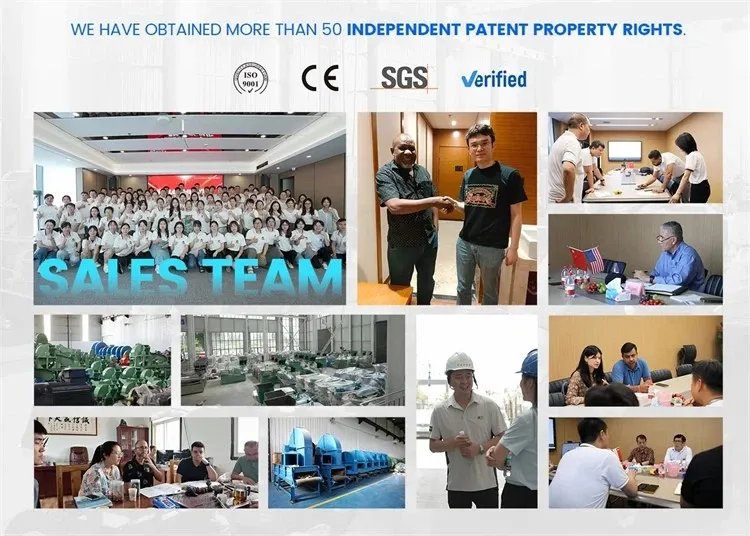
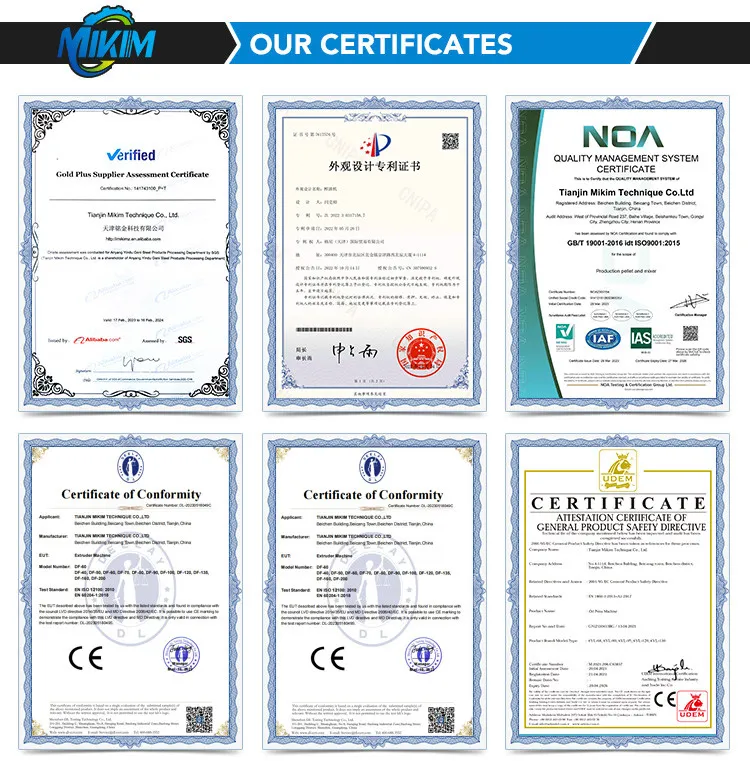
Mikim Machinery is a high-tech enterprise integrating scientific research, design, manufacture, installation and commissioning, and after-sales service. With over 20 years of industry expertise, we specialize in the design and production of feed machinery. Our products have obtained multiple certifications, including CE and ISO certifications. Now we are mainly engaged in two fields: feed pellet machine production line (hammer mill-mixer-conveyor-feed pellet machine-cooling & vibration system-packing and sealing) and feed extruder production line (mixer-twin screw extruder machine-dryer-drum seasoning machine-cooling towers-packing machine).
certificate
FAQ
Q: What is a feed production line?
Q: What is the working principle of a feed production line?
Q: What are the different types of feed production lines?
Q: What are the advantages of using a feed production line?
Q: What materials can be processed using a feed production line?
Q: What factors should be considered when selecting a feed production line?
Q: What is the difference between a grinder and a hammer mill?
Q: What is the role of the mixer in a feed production line?
Q: What is the importance of product quality in animal feed production?
Q: Can a feed production line be used for custom feed formulations?
Q: What safety measures should be taken when operating a feed production line?
Q: Can a feed production line be used for high-protein feed production?
Q: What is the typical lifespan of a feed production line?
Q: Can a feed production line be customized for specific feed types?
Q: Can a feed production line handle different types of materials?
Q: What maintenance is required for a feed production line?
Q: Can a feed production line be used for low-cost feed production?
Q: What is the role of the cooler in a feed production line?
Q: Can a feed production line be used for low-fat feed production?
Q: What is the difference between a laboratory-scale and an industrial-scale feed production line?
We're professional feed production line manufacturers and suppliers in China, specialized in providing high quality customized service. Please feel free to wholesale high-grade feed production line made in China here from our factory.
peanut feed pellet machine, wheat straw feed pellet machine, yoghurt by product feed pellet machine