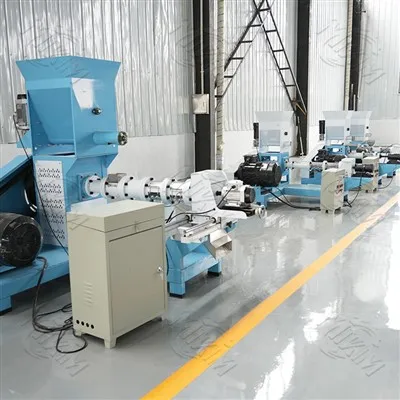
Twin Screw Floating Fish Feed Pellet Extruder Machine

Twin Screw Floating Fish Feed Pellet Extruder Machine suppliers

Twin Screw Floating Fish Feed Pellet Extruder Machine factory

Twin Screw Floating Fish Feed Pellet Extruder Machine best

Twin Screw Floating Fish Feed Pellet Extruder Machine high quality
Twin Screw Floating Fish Feed Pellet Extruder Machine
Capacity:250-6000 kg/h(Customized)
Pellet Size:0.5-10mm
Main Powe:Customized
Raw Materials:Fish meal, soybean meal, shrimp meal, wheat, fish oil, premixes, etc.
Application:Fish, shrimp, cats, dogs, crabs, etc.
Molds: round, triangular, heart-shaped, bone-shaped, etc. (customizable)
MOQ: 1 set
Installation:Factory guidance available
Description
We have two different types of twin-screw floating fish feed extruders: dry and wet. Below are videos of both machines in operation.
800-1000kg/h wet-type floating fish feed pellet processing machine test for Italian customers
I am interested in this product
MIKIM 65 model 150-200 kg/h dry-type pet food extruder machine testing
I am interested in this product
Products Description
dry-type pet food making machine
Product Parameters
|
Model |
Main Power |
Cutting Blade Power |
Cutting Power |
Capacity kg/h |
|
65 |
22kw |
1.5kw |
2.2kw |
150-200 |
|
70 |
30kw |
1.5kw |
2.2kw |
250-300 |
|
75 |
37kw |
1.5kw |
2.2kw |
300-350 |
|
85 |
75kw |
2.2kw |
3.0kw |
600-800 |
Advantages
1. This dry pet food manufacturing process can be used not only to produce specific aquatic feeds such as cat and dog food and fish feed, but also to produce extruded snack foods.
2. Through friction of screw and barrel, the grains are cooked in the extruder. Forming is at the die face cutter. The product shape is determined by a combination of the die aperture, including ball, tube, stick, ring, fruit loop, star, wheel and flower etc.
3. This corn puffing machine is with slight weight, compact structure, easy to be operated.
4. It is a new type and suitable for rice, maize, sorghum, yellow rice, flour and so on.
5. This corn snack food extruder can produce different shapes with different moulds such as cylinder shape, round sphere, millet beautiful form, lotus root shape and various shapes.
6. Final rice or corn puffed produce can be flavored by way of adding food safe additive, such as Sodium cyclamate, salt, spice, or others.


Final product


wet-type fish feed pellet extruder machine
Product Parameters
| Model (Electric) | Capacity (kg/h) | Main power | Cutting blade power | Cutting power | Modulator power |
| 65 | 250-300 | 22KW | 1.5KW | 1.5KW | 3KW |
| 70 | 500-600 | 45KW | 1.5KW | 1.5KW | 3KW |
| 75 | 800-1000 | 55KW | 1.5KW | 1.5KW | 3KW |
| 85 | 1200-1500 | 90KW | 3KW | 2.2KW | 5.5KW |
| 95 | 2000-2500 | 110KW | 3KW | 3KW | 11KW |
| 120 | 3000-4000 | 160KW | 5.5KW | 3KW | 15+7.5KW |
| 136 | 5000-6000 | 200KW | 7.5KW | 5.5KW | 22+7.5KW |
Introduction to wet Type fish feed pellet machines
- The wet-type floating fish feed extruder machine operates through a process of steam conditioning followed by high-temperature, high-pressure extrusion:
- Raw materials first undergo moisture adjustment to achieve an optimal moisture content of 15–30%;
- Inside the extrusion chamber, the materials are subjected to high temperatures (120–180°C) and high pressure;
- As the material is extruded through the die openings, the pressure drops abruptly, causing the moisture to vaporize rapidly and the volume to expand;
- The result is a porous, crispy, and expanded product.
Core Components
- Conditioner: Precisely controls the moisture content and temperature of the raw materials.
- Extrusion Screw: Features a specialized pitch design to ensure thorough mixing of the materials.
- Die: Interchangeable dies with various aperture sizes allow for the production of products in a wide range of specifications.
- Cooling System: Rapidly cools the extruded products.

Why the Modulator Is Essential for Wet Type Fish Feed Extruder Machine Performance?
1. The Role of the Conditioner in Fish Feed Production
- Optimization of Raw Material Pre-treatment:
Precise control of temperature and humidity is applied to raw materials-such as fish meal and soybean meal-to bring them to the optimal state required for the extrusion process (typically: 15–20% moisture content and 80–90°C).
- Promotion of Starch Gelatinization:
Fish feed requires a high degree of starch gelatinization (60–80%); the conditioning process establishes a solid foundation for subsequent extrusion by imparting excellent plasticity and expansion potential to the material.
- Enhanced Water Stability:
By inducing protein denaturation and starch gelatinization, a stable structure is formed, thereby strengthening the stability and structural integrity of the pellets in water (extending their disintegration time).
- Nutrient Protection:
By controlling the conditioning time and temperature, the loss of heat-sensitive nutrients-particularly vitamins and amino acids-is minimized.
2. The Role of the Conditioner in Dog Food Production
- Improved Pelletizing Performance:
Thorough conditioning of raw materials-such as grains and meat by-products-enhances their cohesiveness and flowability, thereby facilitating the compression and molding process.
- Enhanced Digestibility:
Starch gelatinization and protein denaturation render nutrients more readily digestible and absorbable, while simultaneously reducing the activity of anti-nutritional factors.
- Pellet Quality Control:
Regulates pellet hardness, density, and durability; reduces the rate of fines (powdering); and enhances the quality of the finished product.
- Hygiene and Safety Assurance:
High-temperature conditioning (85–95°C) effectively eliminates pathogenic bacteria, thereby improving the hygienic safety of the feed.
Advantages
- High-Fat Formulations: Fat inclusion levels can exceed 20%, with the capability to incorporate 20–30% fresh meat.
- Micro-Pellet Feeds: Capable of producing micro-pellet aquatic feeds with diameters ranging from 0.5 mm to 1.5 mm.
- Density Control: Precise control over feed density to produce floating, sinking, and slow-sinking products.
- Formulation Diversity: Capable of processing high-viscosity, high-moisture, and multi-colored core-filled products.
- Superior Cooking Efficiency and High Product Quality:Achieves a high degree of expansion, produces uniform granules, and yields products with an excellent appearance.
- Self-Cleaning Function:Minimizes material residue, facilitating easy product changeovers.


Final product


Dry vs. Wet Twin-Screw Floating Fish Feed Extruders
| Feature | Dry Twin-Screw Floating Fish Feed Extruder | Wet Twin-Screw Extruder |
| Heat Source | Mechanical Friction (Shear) | External Steam + Friction |
| Pre-conditioning | No | Yes (Advanced Moisture/Heat Treatment) |
| Production Scale | Small to Medium (Farm-scale) | Large Commercial Feed Mills |
| Pellet Floating Time | 1–6 Hours | 12–24+ Hours |
| Operating Cost (OPEX) | Higher (Electricity & Wear) | Lower (Steam Efficiency & Longevity) |
| Nutrient Retention | Standard | Superior (High Starch Gelatinization) |
Read our full guide on [Dry vs. Wet Extrusion Technology].
Dry Type vs Wet Type Twin Screw Floating Fish Food Maker Machine: Structural Component Comparison
| Category | Motor | Screw | Conditioner | Steam Generator | Heating Ring | Belt | Control Box | Cutter | Crane Arm | Material |
| Dry Extruder | ✅ | Two | ❌ | ❌ | ✅ | ✅ | ✅ | ✅ | ❌ | Stainless steel |
| Wet Extruder | ✅ | Two | ✅ | ✅ | ❌ | ✅ | ✅ | ✅ | ✅ | Carbon steel |
PS:Steam generator is optional and sold separately
FAQ
Q1: What is the technical difference between a Dry and Wet Twin screw floating fish feed production machine?
The primary difference is the integration of a steam pre-conditioner.
- Wet Extruders utilize a pre-conditioner to inject steam and water, hydrating the raw materials before they enter the barrel. This "pre-cooking" results in a more stable expansion.
- Dry Extruders generate heat solely through intensive mechanical friction (shear force). While the setup is simpler because it doesn't require a boiler, it puts more thermal stress on the screw components.
Q2: Why is the Wet Twin screw floating fish feed pellet maker machine preferred for professional aquaculture?
For commercial fish farming, the Wet Twin screw floating fish feed pellet mill is the gold standard due to its superior pellet physical properties.
- Maximum Digestibility: It achieves a starch gelatinization rate of >90%. For species like Tilapia or Catfish, this translates to a better FCR (Feed Conversion Ratio).
- Extended Floating Stability: Steam-induced expansion creates a uniform, micro-porous structure. This allows pellets to float for up to 24 hours without losing structural integrity, reducing water pollution.
- Higher Throughput: For the same motor size, the "lubricated" nature of wet material allows for a 20-50% increase in hourly output compared to dry processing.
Q3: Twin-Screw vs. Single-Screw: Why make the switch?
Twin-screw technology provides unmatched versatility for complex, high-protein feed recipes.
- Self-Cleaning Function: The intermeshing screws act as scrapers, wiping the barrel clean automatically. This prevents material stagnation and ensures food safety.
- High-Fat Capability: Twin-screw machines can process recipes with up to 12-15% fat content, whereas single-screw machines often slip or clog at 5%.
- Uniformity: Positive displacement pumping ensures that every pellet-whether 1mm or 10mm-has the exact same density and size.
Q4: Which system offers a better Return on Investment (ROI)?
While a Dry Type floating fish feed pellet extruder machine has a lower CAPEX (initial cost), the Wet Extruder offers a significantly lower TCO (Total Cost of Ownership) for high-volume producers.
- Component Longevity: Dry extrusion causes screws and liners to wear 25-30% faster due to high-friction heat.
- Energy Efficiency: Using a boiler for steam is more cost-effective than using electricity to generate friction.
- Conclusion: If your production target is over 500kg per hour, the Wet system pays for itself within 12-18 months through energy savings and lower spare part replacement costs.
Q5: How does "Pre-conditioning" impact the nutritional value of fish feed?
Pre-conditioning is the critical step that balances pathogen elimination with nutrient protection.
- Bio-Safety: The combination of moisture and thermal energy effectively kills Salmonella and E. coli, making the feed safe for intensive farming.
- Vitamins Preservation: Because the material is pre-heated, it spends less time in the high-pressure "shear zone" of the barrel. This protects heat-sensitive vitamins and amino acids from degradation, ensuring a more nutrient-dense end product.
Q6: Troubleshooting: How to prevent and fix extruder die plugging?
Die plugging is usually a symptom of upstream process inconsistencies. To solve it, follow these industry SOPs:
- Check Particle Size: Raw materials must be pulverized to 60-80 mesh (using a high-speed hammer mill). Large fiber or husk particles are the #1 cause of blockages.
- Monitor Moisture Levels: If the material is too dry, it will "char" and harden. Ensure your moisture content is between 20% and 30% during the extrusion phase.
- Proper Shutdown Procedure: Never stop the machine while it is full of feed. Always flush the barrel with a "spacer" (like ground corn) to clear the die holes before turning off the power.
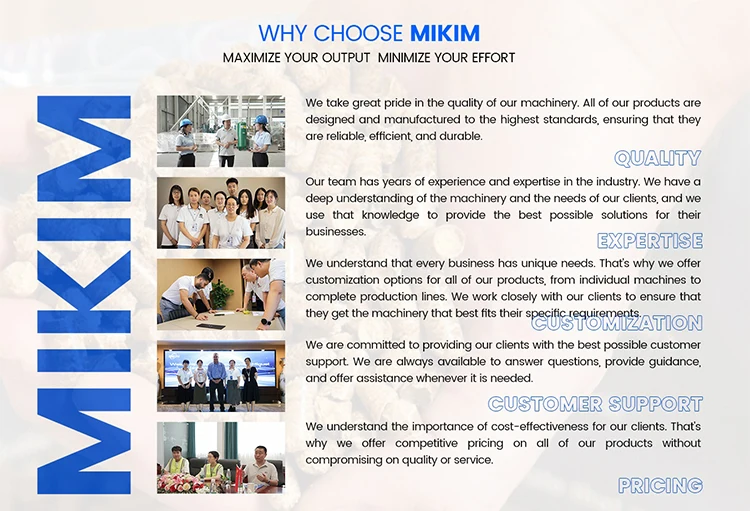
Company Profile



Hot Tags: twin screw floating fish feed pellet extruder machine, China twin screw floating fish feed pellet extruder machine manufacturers, suppliers, factory, aquaculture feed production line, commercial fish pellet processing machine, fish feed manufacturing machine, industrial aquaculture feed making equipment, industrial fish feed extruder, reliable fish pellet making equipment
Send Inquiry
You Might Also Like