

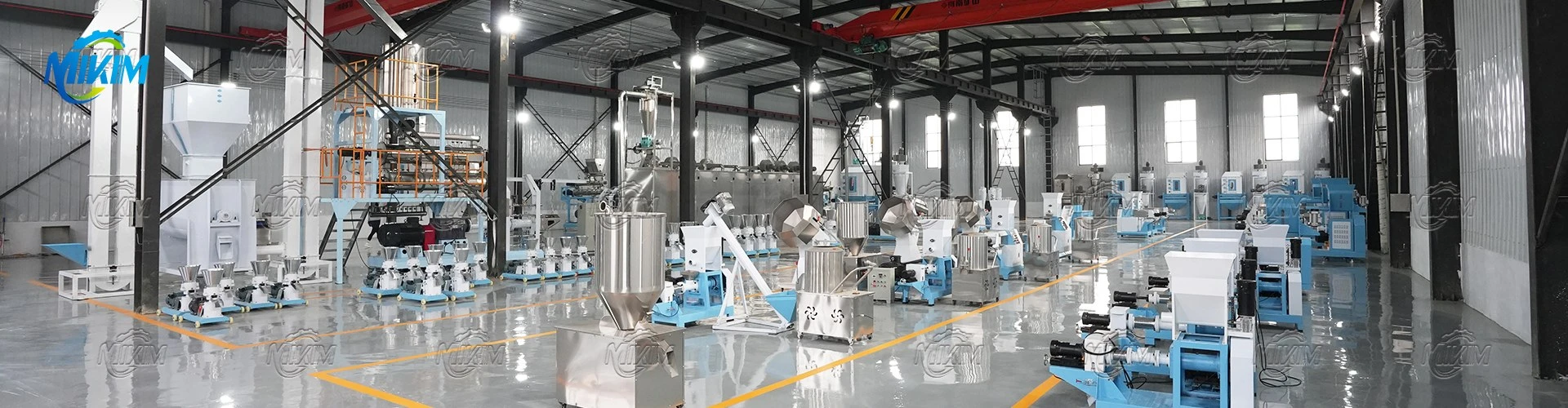


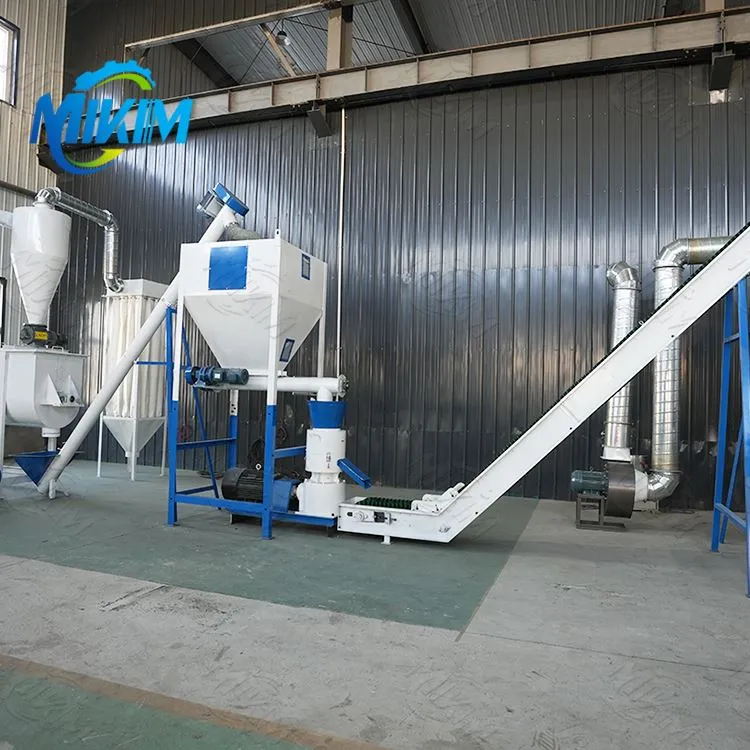


Automatic Feed Production Line
Model: MK-125
Capacity: 80-100 kg/h
Dimension: 110*35*70 cm
Weight: 95 kg
Description
Quick Answer
An automatic feed production line is a PLC-controlled system that grinds, batches, mixes, conditions, pelletizes, cools, and bags feed with minimal labour - from raw grain to finished pellets in one continuous flow. Mikim automatic lines cover 1-20 t/h and hold recipe tolerance batch after batch.
Key Takeaways
- ✓ Stages: grinding, mixing, pelleting, cooling, screening and packing.
- ✓ PLC and touchscreen control the full sequence.
- ✓ Turnkey capacity from 1 t/h to 20 t/h.
- ✓ Layout and utilities - power, steam, dust - are planned before shipment.
On This Page
- What Is an Automatic Feed Production Line?
- What Stages Make Up an Automatic Feed Production Line?
- How to Configure an Automatic Feed Production Line by Capacity
- Automatic Feed Production Line Specs
- Plant Layout and Utility Requirements
- Grinding and Mixing Section of the Line
- Pelletizing, Cooling and Crumbling Section
- Weighing, Bagging and Palletizing Section
- PLC, SCADA and Levels of Automation
- Cost of an Automatic Feed Production Line
- Troubleshooting an Automatic Feed Line
- How Much Automation Does Your Feed Mill Need?
- Matching Line Sections for Steady Throughput
- Quality Control and Traceability in a Feed Line
- Safety and Dust Control on an Automatic Feed Line
- Related Machines for Automatic Feed Production
- Frequently Asked Questions
01What Is an Automatic Feed Production Line?
An automatic feed production line is a turnkey plant that grinds, mixes, pellets, cools and packs feed with one PLC controller - this page keeps its original production-line type. An operator sets the recipe and rate on a touchscreen; conveyors, the ring die feed pellet mill and the packer run in sequence with interlocks that stop upstream if downstream backs up.
Automation trades a bigger upfront cost for steady quality and low labour. For a co-op or commercial mill it is the only way to hold recipe tolerance batch after batch.

Automatic feed production line with PLC control cabinet and ring die mill
02What Stages Make Up an Automatic Feed Production Line?
From raw material to bagged feed1) Grinder reduces grain and meal. 2) Mixer blends with premix. 3) Conditioner steams the mash. 4) Ring die mill pellets it. 5) Cooler drops temperature. 6) Screener removes fines. 7) Packer weighs and bags. Every stage is sequenced by the PLC. |
Why PLC control mattersThe PLC holds dose accuracy, logs each batch, and protects the mill from overload. Ramp-up and clean-down are one-button, which is what keeps a 20 t/h plant running on two shifts with a small crew. |
03How to Configure an Automatic Feed Production Line by Capacity
| Module | Option | Effect |
|---|---|---|
| Grinder | Hammer / roller | Grain vs cake |
| Mixer | Ribbon / paddle | Batch vs continuous |
| Mill | SZLH250-508 | Sets t/h |
| Cooler | Counter-flow | Pellet stability |
| Packer | Manual / auto | Labour per bag |

04Automatic Feed Production Line Specs
| Capacity (t/h) | Mill | Control | Crew | Footprint |
|---|---|---|---|---|
| 1-2 | SZLH250/320 | PLC touch | 1-2 | Small hall |
| 4-6 | SZLH350/400 | PLC touch | 2 | Medium hall |
| 8-12 | SZLH420 | PLC + SCADA | 2-3 | Large hall |
| 15-20 | SZLH508 x2 | PLC + SCADA | 3-4 | Full plant |
Size the mill one step above your target rate. Running an SZLH at 100% nameplate leaves no headroom for a richer, slower-flow ration.
05Plant Layout and Utility Requirements
Plan a vertical flow: intake on top, packing below, so gravity does the conveying.
- • Budget three-phase power for the mill and cooler, and a dust-collection loop on the grinder.
- • If you also run aquafeed, add a floating fish feed extruder cell fed from the same mixer.

Bagged feed output from an automatic feed production line packer
06Grinding and Mixing Section of the Line
Every automatic line starts with particle size and blend accuracy.
- • Hammer mills or roller mills reduce corn, soybean meal and roughage to the target screen, then a twin-shaft mixer blends macro ingredients, premix and oil to a coefficient of variation under 5%.
- • In an automatic line the batching is done by weigh hoppers and a PLC rather than by hand, which is what turns a recipe into a repeatable product.
Get this section right and everything downstream behaves. A mixer that leaves a 10% swing in premix concentration will show up as inconsistent pellets no pellet mill can fix.
07Pelletizing, Cooling and Crumbling Section
The conditioned mash is pressed through a ring die, cut to length, and dropped into a counter-flow cooler that pulls temperature down to within 5 °C of ambient and moisture below 12%. For young stock the line then runs the pellet through a crumbler and a sieve, producing a coarse crumble with the fines screened back to the mill.
Automation keeps this section honest: the PLC holds steam time, feeder rate and cooler air, and alarms when any of them drifts. That consistency is the difference between a line that runs to spec unattended and one that needs an operator standing at the die.
08Weighing, Bagging and Palletizing Section
Finished feed is weighed into 25 kg or 50 kg bags, or diverted to bulk, with an accuracy target of plus or minus 0.5%.
- • An automatic bagger, a sealer and an optional palletizer close the line.
- • Weighing data feeds back to the PLC so every batch is traceable by recipe, time and operator - the record a feed-safety audit asks for first.
Dust control matters here more than anywhere else: bagging is where fines escape, so fit extraction at the filling spout and keep the area dry.
09PLC, SCADA and Levels of Automation
Automation is a ladder, not a switch.
- • Level one is a batching PLC that weighs and sequences the majors.
- • Level two adds recipe memory and changeover automation.
- • Level three links to SCADA so a manager can see throughput, downtime and consumption from an office screen.
- • Buy the level that matches your shift pattern and staff skill - over-automating a one-shift farm mill adds maintenance you cannot support.
Whichever level you choose, insist on open, documented control hardware so a local electrician can service it without a factory visit.
10Cost of an Automatic Feed Production Line
Cost scales with tonnes per hour and with how much of the sequence is automated.
- • A 5 t/h line with batching, pelleting, cooling and semi-automatic bagging sits at one price point; the same tonnes with full SCADA and palletizing can double it.
- • The civil work, silos, power supply and dust extraction are usually a quarter to a third of the total and are the items buyers forget to budget.
Phase the build where you can: start with grind, mix, pellet and cool, and add crumbling, weighing and automation as volume justifies them.
11Troubleshooting an Automatic Feed Line
| Symptom | Likely cause | Fix |
|---|---|---|
| Batch weights off spec | Load cell drift or calibration | Recalibrate weigh hoppers |
| Mill trips on overload | Feeder rate above die capacity | Trim feeder rate in the recipe |
| Cooler output damp | Airflow blocked or bed too deep | Clear the cooler; slow the discharge |
| Line stops on a fault code | Sensor trip or steam fault | Check the alarm log before restarting |
| Cross-batch contamination | Purge skipped at changeover | Enforce the purge step in the PLC recipe |
12How Much Automation Does Your Feed Mill Need?
Automation is bought to solve a specific problem, not as a badge.
- • If your problem is batch accuracy, a weigh-batching PLC is enough.
- • If it is changeover time between rations, add recipe memory.
- • If it is not knowing why a shift under-produced, add SCADA and data logging.
- • Buying all three at once is only right when you already run multiple shifts and multiple recipes.
Rank the problems by the money they cost you each month, then automate the top one first. Most farm mills get the best return from batching accuracy; most commercial mills from changeover speed and traceability.
13Matching Line Sections for Steady Throughput
A feed line runs only as fast as its slowest section, and that section is usually the cooler or the bagger, not the pellet mill.
- • Balance the sections on paper before you buy: a 5 t/h mill feeding a 3 t/h cooler simply makes three tonnes an hour and wastes the mill.
- • Ask the supplier for a section-by-section throughput table and check that every stage is rated above your target.
Buffer bins between grinding, mixing and pelleting let each section run at its own best rate, which is the cheapest way to lift real output without buying a bigger mill.
14Quality Control and Traceability in a Feed Line
An automatic line makes quality control cheap because it can record everything a manual mill forgets.
- • Weigh each batch, log the recipe and the operator, sample the finished pellet for durability and moisture, and keep the record against the batch number.
- • When a customer asks what went into a bag, the answer should take seconds to find.
A feed-safety audit looks for three things first: ingredient traceability, batch records and hygiene. A line with a batching PLC and datalogging already holds two of them, and a written cleaning schedule covers the third.
15Safety and Dust Control on an Automatic Feed Line
Feed dust is the quiet hazard on an automatic line: it is combustible, it is bad to breathe, and it settles on every surface.
- • Fit extraction at the grinder, the pellet mill discharge and the bagging spout; bond and earth all metalwork against static; and keep the control panel in a clean, purged enclosure.
- • Train operators to clear spills immediately and never to blow dust with compressed air, which simply puts it back into the air.
- • A written cleaning rota is the cheapest safety equipment you will ever buy.
16Related Machines for Automatic Feed Production
The line is built around the ring die feed pellet mill; for straw biomass the straw pellet machine cell swaps the die and feeder. A simpler buy without automation is the livestock feed pellet mill.
Further reading: Feedipedia, the FAO-backed feed resource - reference data for feed formulation and quality control
17Frequently Asked Questions
What is included in an automatic feed production line?
Grinder, mixer, conditioner, ring die pellet mill, cooler, screener and packer, all sequenced by one PLC from a touchscreen.
Do I need PLC control for a small plant?
Below 2 t/h a manual line is fine, but PLC pays off from 4 t/h up by holding recipe tolerance and cutting labour.
Can the same line make feed and biomass?
Yes with a die and feeder swap; straw biomass needs the wider bore and forced-feed auger of a straw pellet cell.
How many people run a 20 t/h line?
Three to four on two shifts - the PLC handles ramp-up, interlocks and clean-down.
Why size the mill above target rate?
Running at full nameplate leaves no headroom for a richer, slower-flow ration; one step up keeps uptime.
Get an Automatic Feed Line Quote
Mikim automatic feed production lines are pre-engineered at 1-2 t/h (small mill), 3-5 t/h (mid) and 10-20 t/h (commercial), with 8 stages from receiving to packing and a Siemens PLC control cabinet as standard. Total power 90-650 kW, footprint 200-1,500 m2, installation supervised. Ask for a sized layout in 24 hours.
Request an Automatic Feed Line Layout →Hot Tags
automatic feed production linePLC feed plantturnkey feed production linering die feed pellet millstraw pellet machinelivestock feed pellet millfloating fish feed extruderfeed pellet making line
Our Factory


Hot Tags: automatic feed production line, China automatic feed production line manufacturers, suppliers, factory, rice straw feed pellet machine, feed pellet machine for reptile food, custom made feed pellet machine, cattle feed pellet making machine line, pelletizing machine for feed, animal by product feed pellet machine
Send Inquiry
You Might Also Like


