Ring Die Pellet Machine
✓ 1-20 t/h across feed, biomass and organic fertilizer pelleting.
✓ Ring die wears evenly and holds die bores from 2 mm to 12 mm.
✓ Direct or belt drive, 22-220 kW, alloy or stainless die options.
✓ Choose ring die above roughly 1 t/h; flat die below it.
Description
Quick Answer
A ring die pellet machine forces feed, biomass, or fertilizer material through a rotating ring die to make uniform pellets at 1-20 t/h. It runs continuously with lower wear per ton than flat die mills, making it the standard choice for commercial plants. Mikim SZLH models span 22-220 kW.
On This Page
- What Is a Ring Die Pellet Machine?
- Ring Die vs Flat Die: Which Should You Buy?
- Key Components of an SZLH Ring Die Mill
- SZLH Ring Die Pellet Machine Specs
- Ring Die Applications: Feed, Biomass, Fertilizer
- How to Maintain a Ring Die Pellet Mill
- How to Size an Industrial Ring Die Mill
- Ring Die Mill Throughput vs Die Wear: What Should Buyers Expect?
- What Drives the Price of a Ring Die Pellet Machine?
- Ring Die and Roller Materials - What Lasts
- Commissioning a New Ring Die Mill
- Troubleshooting Ring Die Faults
- Workshop Layout, Power and Foundations
- Choosing a Supplier and After-Sales Support
- Related Ring Die Equipment and Spare Parts
- Frequently Asked Questions
01What Is a Ring Die Pellet Machine?
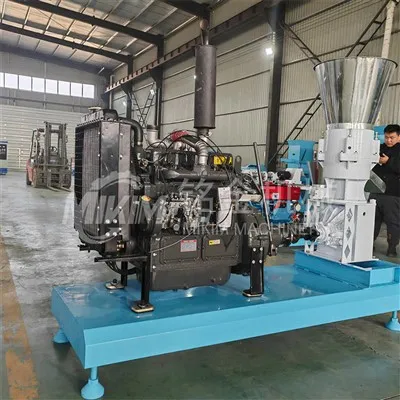
A ring die pellet machine is the workhorse of industrial pelleting: a large rotating ring die with two or three fixed rollers pressing material through its bores.
- • This page previously listed a generic pellet machine; we now specify it as the SZLH ring die series, the same platform behind our sheep, fish and livestock mills.
- • It covers 1-20 t/h across animal feed, wood and straw biomass, and organic fertilizer.
The ring die is the opposite of a flat die.
- • Instead of material sitting on a horizontal plate, it is fed to the centre of a vertical ring and pushed outward.
- • That geometry lets the machine run at throughput a flat die cannot reach, with far lower wear per tonne.

SZLH industrial ring die pellet machine with large ring die and roller assembly
02Ring Die vs Flat Die: Which Should You Buy?
Throughput and wearA flat die tops out near 1 t/h and wears its rollers unevenly. A ring die runs 1-20 t/h and the die wears in a uniform band, so die life per tonne is 2-4x longer. If you pellet for resale or a large herd, the ring die pays back fast. |
Material flexibilityRing dies take abrasives (straw, husk, fertilizer) and sticky mashes (aquafeed, molasses) that clog a flat die. Bore range runs 2-12 mm, so one machine family covers fry feed and 10 mm biomass briquettes. |
03Key Components of an SZLH Ring Die Mill
| Component | What it does | Buyer note |
|---|---|---|
| Ring die | Sets bore and pellet shape | Alloy for feed, stainless for aquafeed |
| Rollers | Force mash through die | 2 or 3, sealed bearings |
| Conditioner | Steams mash before pressing | Single or twin, stainless |
| Drive | Powers the die | Direct for ≤90 kW, belt above |
| Lubrication | Greases rollers | Auto greaser standard on SZLH420+ |
04SZLH Ring Die Pellet Machine Specs
| Model | Capacity (t/h) | Power (kW) | Die bore (mm) | Typical use |
|---|---|---|---|---|
| SZLH250 | 0.6-1 | 22 | 2-8 | Farm / starter |
| SZLH320 | 2-4 | 37 | 2-10 | Feed mill |
| SZLH400 | 6-8 | 90 | 2-12 | Commercial feed |
| SZLH420 | 8-12 | 110 | 2-12 | Feed / biomass |
| SZLH508 | 10-20 | 160-220 | 2-12 | Industrial plant |
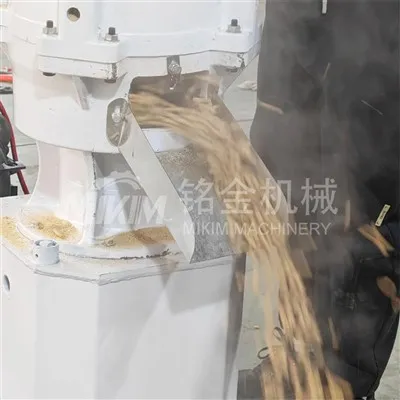
For straw and wood biomass, fit a forced-feed auger and a wider 8-12 mm bore. Feed and biomass share the SZLH frame; only the die and feeder change.
05Ring Die Applications: Feed, Biomass, Fertilizer
The same ring die machine pellets livestock feed, aquafeed, wood sawdust, straw, rice husk and organic fertilizer granules. If your primary output is straw, our straw pellet machine configuration adds the auger and wider die you need.
06How to Maintain a Ring Die Pellet Mill
One SZLH platform serving three materials still needs three habits.
- • For feed, flush the conditioner and keep the die bore on gauge.
- • For straw and husk, blow the auger and magnet daily - metal in residue scores the die in minutes.
- • For fertilizer, rinse the stainless parts after each run so salt does not pit the conditioner.
Die life tracks abrasiveness: a clean feed die lasts 1,000-2,000 tonnes, a straw die half that, a fertilizer die less again. Keep a spare die per material and tag each die with tonnes run so you change on data, not on a breakdown.
07How to Size an Industrial Ring Die Mill
Start from hourly tonnes and bore range, not from price.
- • A 1 t/h custom mill fits an SZLH250; a 10 t/h commercial plant needs SZLH508 with a 160-220 kW drive.
- • Add headroom - running a ring die at 100% nameplate leaves no margin for a richer, slower-flow ration, and you will chase fines all shift.
Pick alloy for feed and stainless for aquafeed and fertilizer; the wrong steel shortens die life and taints product. Choose direct drive at 90 kW and below, belt drive above, and fit the auto-greaser on SZLH420 and up so bearing care never depends on memory.
08Ring Die Mill Throughput vs Die Wear: What Should Buyers Expect?
The ring die's edge over a flat die is cost per tonne, not just capacity. Even wear across the die band and steady conditioning cut fines and power draw, so a well-run SZLH pays back fastest where you pellet continuously rather than in short batches.

09What Drives the Price of a Ring Die Pellet Machine?
Two ring die mills of the same throughput can differ in price by half, and the gap is almost never the motor.
- • It is the die and roller metallurgy, the conditioner design, the gearbox, and whether the frame is built for feed, biomass or fertilizer duty.
- • A fertilizer mill needs stainless contact parts and a heavier drive because urea and ammonium sulphate are corrosive and abrasive; a feed mill can use standard carbon-steel dies and save the difference.
When you compare quotes, ask for die hardness, roller bearing brand, gearbox ratio and frame plate thickness. Those four numbers explain most of the price spread and most of the service life.
10Ring Die and Roller Materials - What Lasts
Dies are cut from alloy steel and case-hardened so the bore keeps its edge as it wears.
- • A good feed die holds 1,000–2,000 tonnes before it needs re-drilling; a fertilizer die under abrasive load may last half that, which is why the die is treated as a consumable and stocked as a spare.
- • Rollers wear on their outer shell and are usually rebuilt rather than replaced.
Cheap dies save money once and then cost it back in fines, downtime and re-drilling. Buy dies from the same maker as the mill so the bore geometry and hardness match the roller the machine was set up around.
11Commissioning a New Ring Die Mill
The first week decides how a ring die mill performs for years.
- • Run the die in gently: start on an oily, low-abrasion mash, keep the load light, and let the bore polish before you push full throughput.
- • Check the roller gap daily during run-in and re-torque the die clamp after the first fifty hours.
Log the baseline: throughput at a known recipe, fines percentage, and motor amps at full load. Every later comparison - a new die, a new ration, a new operator - is measured against that baseline.
12Troubleshooting Ring Die Faults
| Symptom | Likely cause | Fix |
|---|---|---|
| Output falls off | Worn die bore or blunt rollers | Re-drill or replace the die; rebuild rollers |
| Motor overloads | Feed rate too high for the die | Reduce feeder speed; check die condition |
| Pellets crack on cooling | Too much moisture before cooling | Lower mash moisture; lengthen cool time |
| Die clamps loosen | Thermal cycling | Re-torque after run-in and monthly thereafter |
| Uneven roller wear | Feed distributed to one side | Re-centre the distributor and feeder |
13Workshop Layout, Power and Foundations
An industrial ring die mill needs a foundation, not a floor.
- • Cast a reinforced pad sized to the machine's dynamic load, bolt the frame down, and isolate the drive from the building structure so vibration does not crack the slab over time.
- • Leave service clearance on the die-door and gearbox sides.
Match the supply to the motor: SZLH420 and larger usually want a dedicated transformer and a soft starter or VFD. Plan dust extraction at the feeder and bagging points, and keep the control panel in a clean, dry corner away from the steam line.
14Choosing a Supplier and After-Sales Support
A ring die mill is a decade-long purchase, so buy the support as much as the machine.
- • Ask who supplies spare dies and rollers locally, how fast a die can be re-drilled, and whether commissioning and operator training are included.
- • A slightly higher price with a responsive parts channel beats a bargain that idles for a month waiting on a die.
Ask for two references running the same model on a similar material, and call them. Their answers about service and die life will tell you more than any specification sheet.
15Related Ring Die Equipment and Spare Parts
Standalone mills often grow into a feed pellet making line. For species-specific feed, the ring die feed pellet mill and livestock feed pellet mill pages list the matched dies.
Further reading: Feedipedia, the FAO-backed feed resource - ingredient composition data for feed, biomass and by-product recipes; ASABE standards for feed processing machinery - engineering standards behind ring die and roller specifications
16Frequently Asked Questions
What is a ring die pellet machine used for?
Industrial pelleting of animal feed, aquafeed, wood and straw biomass, and organic fertilizer at 1-20 t/h. It is the high-throughput alternative to a flat die press.
Is the SZLH a Richi machine?
This page previously used the Richi name; we supply the SZLH industrial ring die series, the same platform family, specified with model, bore and drive details.
Ring die or flat die for a commercial feed mill?
Ring die. Above 1 t/h it wears slower, runs cooler and supports steam conditioning, cutting cost per tonne.
Can one ring die machine pellet both feed and straw?
Yes. Feed and biomass share the SZLH frame; you change the die bore and add a forced-feed auger for straw.
What power do I need for 10 t/h?
An SZLH508 with a 160-220 kW drive covers 10-20 t/h. Below 8 t/h an SZLH400 at 90 kW is enough.
Get a Ring Die Pellet Machine Quote
Mikim builds ring die pellet machines from 1 t/h to 30 t/h across SZLH320 / 420 / 508 / 658 / 858, with main power from 37 kW to 280 kW for feed, biomass and organic fertilizer. Tell us the raw material, the capacity and the die hole size; we will return a fixed quote in 24 hours.
Request an SZLH Industrial Pellet Mill Quote →Our Factory


Hot Tags: Ring Die Pellet Machine, China Ring Die Pellet Machine manufacturers, suppliers, factory, distributor feed pellet mill, grass pellet mill, graph feed pelletizer, design feed pellet machine, animal pellet machine, information feed pellet mill
Send Inquiry
You Might Also Like