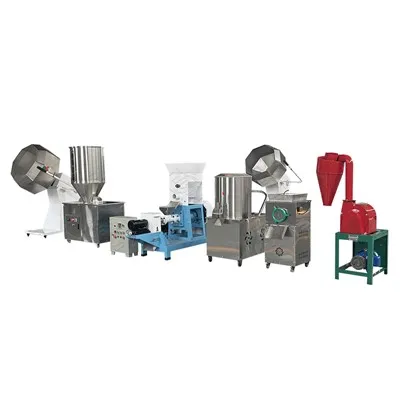
3-4 T/H Aquafeed Production Line
Production Capacity: 3-4 T/H
Pellet Size: 0.5-9 mm
Voltage: 220 V / 380 V / 450 V (Customizable)
Frequency: 50 Hz / 60 Hz (Customizable)
Feed Pellet Type: Floating, Slow-Sinking, and Sinking Feed
Product Type: Dry-Type (Non-Steam) Extruder / Wet-Type (Steam-Assisted) Extruder
Description
This 3–4 T/H Aquafeed Production Line is a complete industrial solution designed for medium-scale aquatic feed manufacturing. It provides an efficient production system for manufacturing nutritionally balanced feed for various aquatic species, including fish, shrimp, and crab.
The production process covers raw material grinding, automatic batching, mixing, twin-screw extrusion, pellet drying, Seasoning, and cooling. A centralized PLC control system ensures precise operation, stable performance, and consistent product quality throughout the entire production process.
The Aquafeed Pellet Extrusion Line can process various raw materials, including fish meal, soybean meal, maize, wheat flour, and rice bran. It produces floating, sinking, and slow-sinking feed pellets ranging from 0.5 mm to 9 mm in diameter. With accurate control of pellet density, water stability, and nutrient retention, this aquafeed production system meets the requirements of modern commercial aquaculture operations.
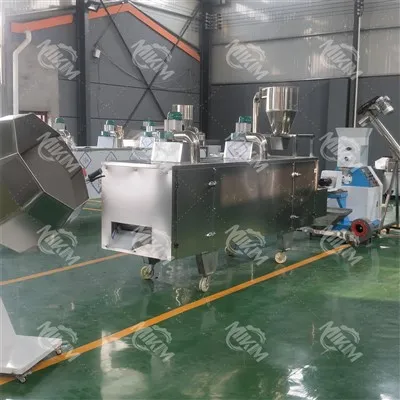
3-4 T/H Aquafeed Production Line test for the middle East customer
1. 3–4 t/h Aquafeed Production Line Plant Technical Specifications
The line comprises 17 integrated processing units. Every machine is manufactured in Mikim's Tianjin facility under ISO 9001 quality management.
|
ITEM |
Reference Photo |
MACHINE NAME |
MACHINE PARAMETER
|
Notes |
| 1 |
|
Water drop crusher |
Main power: 55kw |
1. Teardrop-shaped grinding chamber Improves material flow and grinding efficiency. Compared with conventional chamber designs, production capacity can increase by up to 20%. 2. Wear-resistant serrated inlet plates Increase material impact and shearing while reducing material circulation inside the grinding chamber. 3. Shaft-end air supply system Improves airflow inside the grinding chamber to enhance grinding efficiency and reduce heat buildup. 4. Multiple rotor and screen configurations Different hammer-to-screen clearances and rotor configurations are available for aquaculture feed and livestock feed production. 5. Wear-resistant hammers Manufactured from alloy steel with a tungsten carbide coating to extend service life and reduce replacement frequency. 6. Safety interlock system Prevents operation when the inspection door is open, improving operator safety during maintenance. |
| 2 |
|
Bucket Screw elevator |
Length: 3m Power: 2.2kW Weight: 150kg Dimensions: 3.2 x 0.5 x 0.5 m |
To feed the crushed materials into mixer |
| 3 |
|
U-shaped horizontal mixer |
Output: 1000 kg/batch Power: 7.5 kW Dimensions: 3.2*1.1*2.2 m Weight: 1000kg |
Dry ingredient blending. Achieves a mixing coefficient of variation (CV) of 5%–7%, ensuring consistent ingredient distribution before extrusion. The single-shaft paddle design provides thorough blending of powders, meals, and micro-ingredients including vitamins and mineral premixes. |
| 4 |
|
Bucket elevator |
Power: 2.2kW
|
Transfers the blended dry mix from the mixer to the extruder feed hopper. Constructed from 2 mm steel plate with wear-resistant nylon buckets for continuous, stable material supply to the extrusion stage. |
| 5 |
|
Wet-type Twin-Screw floating fish feed extruder machine
(We also offer dry-type extruders for customers who do not require steam conditioning.)
|
Capacity: 3-4 T/H Main power:55kw Cutter:1.5kw Feeding:1.5kw Conditioner:3kw In total: 61kw
Requires a steam boiler or steam generator. |
1. Steam-assisted extrusion 2. Wide formulation compatibility 3. Consistent pellet quality 4. Stable operation and easy cleaning 5. Long service life 6. Flexible pellet production
|
| 6 |
|
Pneumatic conveyor |
Fan motor power: 2.2 kW |
The pneumatic conveyor uses airflow to transfer feed pellets from the extruder outlet to the dryer inlet as part of the continuous production process. Constructed from stainless steel, it provides reliable material conveying with good corrosion resistance and easy maintenance. |
| 7 |
|
Animal Feed Pellet Drying Machine |
Dryer: 5-tier structure / 8 m Heating power: 45 kW Fan motor power: 2.2 kW × 4 units Conveyor motor power: 3 kW Dimensions: 5.5*1*2 m Weight: 1.5t Material: 304 stainless steel |
The automatic dryer is equipped with a 5-layer, 8 m mesh belt conveyor for continuous pellet drying. Feed pellets move through each layer in sequence, providing sufficient drying time while maintaining a compact machine footprint. The drying temperature is automatically controlled, and the conveyor speed can be adjusted with a variable-frequency drive (VFD) to regulate the drying time according to different production requirements. The multi-layer drying structure and circulating hot air system provide uniform heat distribution, helping achieve consistent moisture reduction throughout the drying process. The dryer is constructed from stainless steel for improved corrosion resistance, hygiene, and long-term durability.
|
| 8 |
|
Pneumatic conveyor |
Fan motor power: 2.2 kW |
Transfers dried pellets from the dryer discharge to the seasoning machine inlet. Constructed from stainless steel to maintain hygiene standards in post-drying handling. |
| 9 |
|
Automatic Octagonal Drum Seasoning Machine |
Power: 1.5kw Weight: 200kg Processing time: 5-8 min/barrel Dimensions: 4.5*0.8*1.6m Material: 304 stainless steel |
1. Uniform coating 2. Automatic operation 3. Stainless steel construction |
| 10 |
|
Oil Sprayer |
Spraying: 0.55kw Heating:3kw Mixing:0.55kw In total:4.1kw |
The oil spraying machine is used to apply oil or other liquid additives evenly to the surface of feed pellets after drying. It integrates automatic oil heating, mixing, and spraying to provide a continuous and controlled coating process while reducing manual operation. The spraying volume can be adjusted according to different feed formulations, helping achieve uniform oil distribution on each pellet. The machine is constructed from stainless steel for improved corrosion resistance, hygiene, and easy cleaning. |
| 11 |
|
Counter flow cooler |
Main Power: 2.2kw |
The counterflow cooler is used to reduce the temperature and moisture content of freshly extruded or pelleted feed to levels suitable for storage and packaging. The counterflow cooling process provides uniform cooling while helping maintain pellet quality and stability. The machine features stable operation, low energy consumption, and easy maintenance. |
| 12 | Conveyor | Main Power: 0.75kw |
To deliver the cooled feed into the conveyor. | |
| 13 |
|
Bucket elevator |
Power: 2.2kW
|
The bucket elevator is 5 m high and is constructed from 2 mm thick steel plate with wear-resistant nylon buckets. It is used to transport raw materials to the hammer mill, providing continuous and stable material conveying during the production process. |
| 14 |
|
Automatic Bag Filling Packing Machine |
Packaging System Packaging Capacity: 200-300 bags/hour Weighing Accuracy: Static: ±0.1% Dynamic: ±0.2% Power Supply:380 V, 50 Hz ±2%, 4.5 kW Compressed Air Supply:0.6-0.8 MPa Compressed Air Consumption:0.2 Nm³/min Quantity:1 unit |
Conveyor Function:Conveying filled bags to the next processing stage. Technical Parameters: Conveyor Length:3000 mm Power Supply:380 V, 50 Hz, 0.37 kW Quantity:1 unit
Bag Sewing System Sewing Machine Model:35-6A / 35-2C Technical Parameters: Maximum Sewing Speed:1,600 stitches/min Stitch Length:6.5-11 mm Stitch Type:Double-thread chain stitch Thread Specification:21S/5 and 21S/3 polyester thread Needle Type:80800, 280-250# Power Supply:380 V, 50 Hz, 0.37 kW Quantity:1 unit
Finish your line with precision. This [Automatic Bag Filling Packing Machine] offers ±0.2% gravimetric accuracy, ensuring every bag is retail-ready and perfectly sealed. |
| 15 |  |
Air compressor |
2.2kw | Used to transfer finished feed pellets to the packaging machine for automatic packaging. |
| 16 |
|
Steam generator |
48kw | The steam boiler supplies steam to the extruder for raw material conditioning before extrusion. |
| 17 |
|
Electric control |
Motor Brand: Chinese Brand or Siemens (Optional) |


2. Production Line Specifications - Commercial & Operational Summary
|
Category |
Specification |
Notes |
|
Total Installed Power |
Approx. 180–200 kW (wet-type)* |
*Varies by optional equipment and motor brand selection. A detailed power schedule is provided with the quotation. |
|
Estimated Energy Consumption |
45–55 kWh per ton of finished feed* |
Based on field data from operating lines. Actual consumption depends on raw material moisture, ambient conditions, and pellet size. |
|
Workshop Space Required |
Approx. 30 m (L) × 18 m (W), ceiling height ≥ 8 m |
Includes equipment footprint plus operator walkways and maintenance access. A detailed 2D layout drawing is included in the quotation package. |
|
Foundation Requirement |
Reinforced concrete floor, load-bearing ≥ 500 kg/m² |
Standard industrial floor. No special foundation pits required for standard configuration. |
|
Operators per Shift |
3–4 persons |
One operator at the PLC station, 2–3 operators for raw material feeding and packaging. Training included. |
|
Water Supply |
Approx. 500–800 L/h (for steam generation and cleaning) |
Clean water source required. |
|
Production Lead Time |
45–60 days from deposit confirmation |
Varies by order volume and optional customization. |
|
Installation & Commissioning |
20–30 days on-site |
Performed by 2 Mikim engineers. Includes mechanical installation, electrical connection, dry-run testing, and production trial. |
|
Operator Training |
3–5 days |
Included with commissioning. Covers daily operation, troubleshooting, maintenance, and safety protocols. |
|
Warranty |
12 months on complete line; 24 months on core components (extruder screws, barrels, gearbox) |
Warranty covers manufacturing defects. Wear parts (hammers, screens, dies, bucket nylon) are consumables and excluded. |
|
Spare Parts |
One set of wear parts included; additional parts shipped within 7 working days |
Mikim maintains a dedicated spare parts inventory for global customers. |
|
Payment Terms |
T/T 30% deposit, 70% before shipment; L/C at sight negotiable for orders above USD 100,000 |
Flexible terms can be discussed based on order volume and buyer relationship. |
|
Shipping |
FOB Tianjin / CIF buyer's port |
Container quantity depends on configuration - typically 2–3 × 40HQ containers. |
3. Working Principle and Process Flow of an Aquafeed Production Line Plant
Material Flow Diagram
Raw Material Intake → Grinding (1) → Elevating (2) → Mixing (3) → Elevating (4) →Extrusion (5) → Pneumatic Conveying (6) → Drying (7) → Pneumatic Conveying (8) →Seasoning (9) + Oil Spraying (10) → Cooling (11) → Conveying (12) → Elevating (13) →Automatic Packing (14) → Finished Product Warehouse
↕ Utilities: Air Compressor (15) + Steam Boiler (16) + PLC Control (17)

We offer two types of extruders: a dry-type (non-steam) extruder and a wet-type (steam-assisted) extruder. The working principles of both types are explained below.
Dry Type fish feed pellet extruder machine


Working Principle of Dry-Type Fish Feed Extruder (non-steam)
1. Frictional Heating and Shearing
After entering the extrusion chamber, the raw material is conveyed forward by a high-speed rotating screw. Strong friction and shear forces are generated between the screw, the barrel, and the material itself. This mechanical action rapidly increases the material temperature to approximately 120°C–160°C within a few seconds.
2. Compression and Plasticization
As the material moves through the barrel, the screw gradually compresses it, causing the pressure inside the extrusion chamber to increase to approximately 3–10 MPa. Under these high-temperature and high-pressure conditions, the material becomes plasticized. During this process, starch is gelatinized, proteins are denatured, and the feed mixture is thoroughly cooked.
3. Instant Expansion
When the material is forced through the die, the pressure drops immediately from high pressure to atmospheric pressure. The moisture trapped inside the material rapidly vaporizes, causing the pellets to expand instantly and form a porous internal structure. This expansion improves pellet buoyancy, digestibility, and water stability.
Wet Type fish feed pellet extruder machine (steam-assisted)


Working Principle of wet Type fish feed production equipment
Stage A - Steam Conditioning
Before entering the extrusion barrel, the blended dry mix passes through a pre-conditioner where saturated steam is injected. The material absorbs moisture until it reaches 20%–30% water content and is uniformly preheated to 70°C–90°C. This partial pre-cooking softens starch granules and protein structures, reducing the mechanical energy required in the extrusion stage and lowering screw and barrel wear.
Stage B - High-Pressure Extrusion & Expansion
The conditioned material enters the intermeshing twin-screw barrel, where it is subjected to controlled temperature (120°C–160°C), pressure (3–10 MPa), and intense shear. Starch undergoes complete gelatinization (≥95%), proteins are denatured, and anti-nutritional factors present in raw soybean meal are deactivated. As the plasticized material is forced through the die plate, the instantaneous pressure drop causes entrapped superheated water to flash-vaporize, expanding the pellet into a porous structure with controlled density. By adjusting moisture, temperature, and screw speed, the operator can produce floating pellets (density <1.0 g/cm³), slow-sinking pellets, or sinking pellets (density >1.0 g/cm³) on the same machine.
|
Feature |
Wet-Type (Steam) |
Dry-Type (Non-Steam) |
|
Starch Gelatinization |
≥95% |
85%–92% |
|
Throughput (same motor size) |
Higher |
Lower |
|
Pellet Water Stability |
>12 hours |
8–12 hours |
|
Formulation Flexibility |
High (high oil, high moisture OK) |
Moderate |
|
Utility Requirement |
Steam boiler required |
No boiler needed |
|
Maintenance Cost |
Lower (less mechanical wear) |
Higher (more friction wear) |
|
Recommended For |
Commercial feed mills, export-quality feed |
Small-medium farms, on-site feed production |
4. Why Choose Mikim for Your Aquafeed Production Line
20 years of industry expertise
With over 20 years of industry expertise, Mikim Machinery has designed and manufactured feed processing equipment exclusively. Unlike general machinery suppliers who treat feed equipment as one of many product lines, feed processing is our sole focus. This specialization means our engineering team understands the nuances that matter: the effect of screw L/D ratio on starch gelatinization, the optimal hammer tip speed for different grain hardness levels, and the cooling airflow rate that prevents pellet cracking.
Global Deployment, Local Support
Our production lines are operating in an increasing number of countries. We have commissioned lines in Cameroon, the United States, Poland, Brazil, South Korea, Zambia, India, and across Southeast Asia. Every installation is performed by Mikim's own engineers - we do not outsource commissioning to third parties. After handover, lifetime technical support is available via WhatsApp, email, and video call, with spare parts dispatched within 7 working days.
Certified Quality Management
Our Tianjin manufacturing facility operates under ISO 9001:2015 quality management. All structural steel is traceable to mill certificates. Electrical components are sourced from Schneider, Siemens, or equivalent tier-1 suppliers. Every extruder undergoes a 4-hour continuous run test before crating. CE certification covers the complete line for EU market access.
Transparent Commercial Terms
We publish price ranges, lead times, and warranty terms on our product pages because we believe informed buyers make better partners. The 3–4 T/H line ranges from USD 55,000 to USD 80,000 depending on configuration (wet/dry type, motor brand, optional equipment). A detailed line-by-line quotation with equipment datasheets is provided within 2 working days of inquiry.
5. Application
Both dry-type and wet-type floating fish food extruder machines are suitable for producing floating and sinking feed pellets for a wide range of aquatic species, including tilapia, grass carp, common carp, crucian carp, catfish, and shrimp. They can also be used to manufacture dry pet food for cats and dogs.
Wet Type floating fish feed pellet extruder machines offer greater formulation flexibility and are particularly suitable for producing high-quality feed for salmon, rainbow trout, eel, sea bass, grouper, turbot, sturgeon, snakehead, crab, various aquatic fry, high-value ornamental fish, and fur animals such as foxes. Their superior cooking performance and starch gelatinization make them ideal for premium aquafeed applications.
Feed pellets produced on this line are suitable for a wide range of commercially farmed aquatic species:
|
Species Category |
Examples |
Recommended Pellet Type |
|
Freshwater Fish |
Tilapia, Carp, Catfish, Grass Carp, Crucian Carp |
Floating / Slow-Sinking |
|
Marine Fish |
Sea Bass, Grouper, Salmon, Trout, Turbot, Sturgeon, Eel, Snakehead |
Slow-Sinking / Sinking |
|
Crustaceans |
Shrimp, Prawn, Crab |
Sinking |
|
Ornamental Fish |
Koi, Goldfish, Tropical Fish |
Floating / Slow-Sinking |
|
Pet Food (Optional) |
Dog, Cat |
Floating / Various Shapes |


6. Final product
We supply a wide range of customized dies for aquatic feed and pet food production. Aquatic feed dies are available with diameters from 0.5 mm to 9 mm for producing fish, shrimp, and crab feed pellets. Pet food dies can be customized into various shapes, including triangle-shaped, bone-shaped, square, heart-shaped, and round pellets.
Pellet Size & Application Matrix
|
Pellet Diameter |
Target Animal Stage |
Pellet Type |
|
0.5 – 1.0 mm |
Fry and larvae |
Slow-sinking / Floating |
|
1.5 – 3.0 mm |
Juvenile fish / small species |
Floating / Slow-sinking |
|
3.0 – 6.0 mm |
Grower stage |
Floating |
|
6.0 – 9.0 mm |
Adult / broodstock |
Floating / Sinking |
Custom die plates are available for pet food shapes including bone, triangle, square, heart, and star profiles.
Pellet Quality Standards Achieved
|
Quality Parameter |
Typical Value |
Test Method |
|
Starch Gelatinization |
≥95% (wet-type) |
Amyloglucosidase method |
|
Water Stability |
>12 hours (floating pellets) |
Static water immersion at 25°C |
|
Pellet Durability Index (PDI) |
≥98% |
Tumbling box test |
|
Bulk Density (Floating) |
0.35–0.55 g/cm³ |
Gravimetric |
|
Bulk Density (Sinking) |
0.55–0.75 g/cm³ |
Gravimetric |
|
Moisture Content (Final) |
8%–10% |
Oven drying at 105°C |


7. Customer Case Studies
Middle East 150–200 kg/h Fish Feed Extruder Production Line with Mixer and Dryer


Download Customer Case Studies
8. FAQ
Q1: What is the price of the 3–4 T/H aquafeed production line?
The complete aquafeed production line ranges from USD 55,000 to USD 80,000 FOB Tianjin, depending on configuration:
●Wet-type vs. dry-type extruder
●Motor brand selection (Chinese standard vs. Siemens)
●Optional equipment (automatic batching system, crumbler, pre-cleaner)
A detailed quotation with line-by-line pricing is provided within 2 working days of receiving your raw material profile and target output specifications.
☆ Contact us for the latest quotation.
Q2. What sizes of fish feed can this Aquafeed Pellet Production Line produce?
The line produces pellets from 0.5 mm to 9.0 mm in diameter by changing the extruder die plate. This covers the full range from fry feed (0.5–1.0 mm) through juvenile (1.5–3.0 mm) to adult grower feed (3.0–9.0 mm). All three buoyancy types - floating, slow-sinking, and sinking - are achievable on the same extruder by adjusting moisture, temperature, and screw speed.
Q3: How do I control the extruder temperature during operation?
Extruder temperature is managed through three interacting variables: feed rate (controlled by the feeder VFD), moisture content (steam injection rate in wet-type / water addition in dry-type), and barrel heating zones (electric heaters with independent temperature controllers). The PLC interface displays real-time temperature at each barrel zone. The operator adjusts setpoints based on the formulation being run. For wet-type extruders, the steam conditioner preheats material to 70°C–90°C before it enters the barrel, reducing the heat input required from friction and barrel heaters.
Q4. What is the difference between a dry-type and wet-type Floating Fish Feed Extruder?
Wet-type (steam-assisted) extruders use a pre-conditioner that injects saturated steam into the material before extrusion. This pre-cooks the starch, increases moisture to 20%–30%, and raises material temperature to 70°C–90°C before it enters the barrel. The result is higher throughput, better starch gelatinization (≥95%), longer pellet water stability (>12 hours), lower mechanical wear on screws and barrels, and the ability to process difficult formulations with high oil or moisture content. Requires a steam boiler.
Dry-type (non-steam) extruders rely entirely on mechanical friction to generate heat - material reaches 120°C–160°C from screw shear alone. They are mechanically simpler, do not require a boiler, and are suitable for operations with limited infrastructure. However, starch gelatinization is lower (85%–92%), throughput is reduced for the same motor size, and screw/barrel wear is higher. Best suited for small-to-medium farms producing feed for their own use.
☆Click to learn more about the differences between dry-type and wet-type extruders.
Q5: What determines whether the pellets float or sink?
Both the extrusion process and the feed formulation contribute to buoyancy. During extrusion, rapid pressure drop at the die exit causes internal moisture to flash-vaporize, creating a porous structure that provides buoyancy - pellets with density below 1.0 g/cm³ will float. The operator can control expansion by adjusting barrel temperature, moisture content, and screw speed. The formulation also matters: higher starch content (≥25%) promotes expansion, while higher fat and protein levels increase density and promote sinking. In practice, floating pellets are produced at higher extrusion temperatures (130°C–160°C) with moderate moisture, while sinking pellets require lower temperatures and higher moisture to suppress expansion.
Q6: Do you offer small floating fish feed extruder machines for trial or small-scale production?
Yes. We manufacture small dry-type single-screw fish feed extruders from 40 kg/h to 800 kg/h in both electric and diesel-powered versions. These are suitable for on-farm feed production, research trials, and market entry testing. Please see our small extruder product pages for specifications.
Q7. Can only electric floating fish feed making machines produce floating pellets?
No. Both our electric and diesel floating fish food pellet extruder machines can produce floating feed pellets with excellent buoyancy. Click here to download the floating performance test report for pellets produced by both types of machines.
Q8: Can this Aquaculture Feed Pellet Production Line produce pet food as well as fish feed?
Yes. The twin-screw extruder can process both aquafeed and dry pet food (dog and cat) formulations. Changing between aquafeed and pet food requires cleaning the line, changing the die, and adjusting extrusion parameters. Custom die plates for pet food shapes (bone, triangle, heart, square) are available. Several of our customers operate mixed aquafeed/pet food lines from a single Mikim installation.
Q9: What is your after-sales support policy?
Every line includes 12 months of full warranty (24 months on core components). Beyond the warranty period, we provide lifetime technical support at no charge - our engineers are available via WhatsApp, email, and video call during Beijing business hours (GMT+8). Spare parts are dispatched within 7 working days from our Tianjin warehouse. For urgent breakdowns, we can arrange an engineer to fly to your site within 5 working days (costs at buyer's expense after the warranty period).
Q10: Can I visit your factory and see a line in operation before ordering?
Yes, welcome to visit our factory. You can see machines under assembly, witness an extruder test run, and inspect finished machines being crated for shipment. We can also arrange visits to operating lines in nearby regions where customers have consented to reference visits. Please contact us at least 2 weeks in advance to arrange a visit schedule.
Our factory

Customer Visit

Qualification Certificate

Delivery & After-Sales Support


Hot Tags: 3-4 t/h aquafeed production line, China 3-4 t/h aquafeed production line manufacturers, suppliers, factory, Fish Feed Machine, fish feed pellet making plant, fish food pellet plant, floating fish feed machine plant, floating fish food production line, pet food production line
Send Inquiry
You Might Also Like