Home -

PROJECT - Fish Feed Projects

 
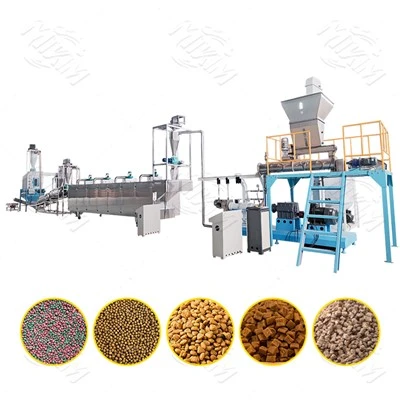
Fish Feed Production Line Projects

Dry-type or wet-type, floating or sinking - the process route decides your feed conversion and your cost per ton, not the machine size on the spec sheet.

Customer records

Fish feed projects tested in our factory

When we design a fish feed plant, that project's own constraints come first - which species, what local raw material, whether steam is available, what your grid can carry. The equipment, the process and the layout follow from those answers, not the other way round. Mikim has spent more than 20 years designing and building feed and aquafeed equipment, and every record below was run on a buyer's own material before the machine shipped.

300-500kg/H Commercial Floating Fish Feed Line For Colombia
Factory test · 2.5 mm · 3.5 t/h

2.5 mm Wet-type Twin-screw Floating Feed Test

A  line ran a 2.5 mm die on a tilapia and catfish formula: pellets held 2.5 ± 0.1 mm, floated at 98.5% after 12 hours, fines stayed at 0.8% and throughput held at 3.5 t/h.

Fishery Feed Production Line
Middle East · 150–200 kg/h

Middle East: 150–200 kg/h Dry-type Line

A compact mixer, extruder and dryer set for a hot-climate buyer. On local wheat bran, maize and fish meal it held 180 kg/h with 99.5% of pellets still floating after 12 hours.

40-300kg/h Floating Fish Feed Production Line For Farm Use
Country: Cameroon · 300–350 kg/h

Cameroon: 300–350 kg/h Dry-type Extruder

Running on cassava meal and palm kernel cake, it held 320 kg/h at a ≥95% floating rate. After 90 days the buyer reported feed cost falling from 850 to 480 CFA per kg.

3-5 Tons Per Hour Wet-Type Twin-Screw Floating Fish Feed Extruder Machine Testing For Cameroon Customers
Customer visit · 300–500 kg/h

Customer Visit: Floating Fish Feed Pellet Making Test

A buyer came to witness the run before committing. Output was recorded at 300–500 kg/h and the floating rate reached up to 90% in the water tank test, with pellets holding shape through the continuous run.

8ce244123462e1cdcc6791ca6bd9252f
Customer visit · Twin-screw

Customer Visit: Twin-screw Floating Fish Food Test

The formula was confirmed with the buyer first, then the full sequence ran in front of him - feeding, extrusion, cutting. Pellets floated immediately and held buoyancy for 12–24 hours without breaking shape.

Customer Visit Twin Screw Floating Fish Food Pellet Maker Machine Test
Customer visit · Wet-type

Wet-type Twin-screw Extruder on Show for Buyers

The visit walked through raw material, steam conditioning, twin-screw extrusion and the float test in sequence. The buyers watched pressure stability inside the barrel and output consistency under continuous load.

200-800 Kg/h Small Floating Fish Feed Pellet Production Line
Country: Zambia · 400 kg/h

Zambia: 400 kg/h Floating Fish Feed Line

A farm-scale line for a buyer moving away from imported compound feed. The pre-shipment test covered start-up checks, extrusion stability, a water tank float test and a continuous run under working load.

Bangladeshi customers visiting the factory to plan a fish feed extruder purchase
Country: Bangladesh

Bangladesh: Fish Feed Extruder Buying Plan

The buyer came to the works and we sized the plan to his real scale - a single extruder for a small producer, supporting units to cut labour cost, or a full line once volumes justify it.

40–2000 Kg/H Fish Feed Extruder Pellet Feed Production Line
Country: Italy

Italy: Wet-type Twin-screw Inspected On Site

Italian buyers inspected the wet-type twin-screw machine with the barrel open and the drive running, checking guarding, noise and the documentation file before any capacity discussion took place.

Capacities

Fish feed line capacities we build and have tested

Our engineers spend their working lives matching a raw material to a route and a drive. Below are the bands we have actually run and recorded - if your target sits between two of them, tell us and we will size the line rather than round you up to the next model.


Position in industry

Where we stand in fish feed equipment

We build dry-type and wet-type aquafeed lines from 120 kg/h to 5–10 t/h, and every one of them is proved on your material before it leaves: a die trial on your own formula, a floating-rate test in our water tank, and an output figure measured against the rated capacity rather than a catalogue number.

Four stages run in the same order on every project - raw material test, process route and equipment list, factory trial before shipment, then installation and operator training on site. You see the result of each stage before the next one begins, so nothing about the line is a surprise after it lands.

 
Coverage

Built, tested and shipped from one factory

Design, fabrication and assembly sit under one roof, so a die, a cutter or a drive specification can be changed inside the factory instead of through a supply chain negotiation. Finished lines are run under power in our workshop, and buyers are welcome to stand beside the machine and watch it before it is crated.

Our order team checks every shipment against the bill of materials item by item, and each module is numbered before crating so the site team can reassemble the line without guesswork. Packing is built for sea freight, not for a warehouse shelf.

After commissioning, spare parts, wear parts and technical support come from the same engineering team that built and tested the line - so the answer to a breakdown comes from someone who has already run your machine.

 
Matching

The right combination for your fish feed line

The right line is the one where grinding fineness, extruder barrel, dryer capacity and cooling stage are sized against each other. A larger extruder bolted onto an undersized dryer does not raise your output - it moves the bottleneck downstream.

That is why every quote starts from a raw material test and a target tonnage, then sizes each stage from the same figure. The equipment list you receive carries the reasoning behind each choice, and the throughput figure you are promised is the one we measured on the trial run.

 
Mikim Machinery

Mikim Machinery

A manufacturer of integrated feed processing equipment - R&D, design, fabrication, trial run and after-sales held by one team. More than 20 years in the industry, CE and ISO certification behind the equipment, and installation with operator training on site for every line we ship.

01

Expertise

Multidisciplinary engineering across aquafeed, livestock feed and pet food - dry-type and wet-type extrusion, drying, oil coating and cooling sized as one system.

02

Quality

In-house design and manufacturing to CE and ISO requirements, with in-process inspection and a verified packing list before anything leaves the works.

03

Experience

Twenty years of diagnosing line bottlenecks on site - aquafeed plants, feed mills and pet food lines - plus a test floor where your material runs through the machine before it ships.

04

Service

On-site installation, commissioning and acceptance, operator training on site and at our workshop, plus spare parts and technical support afterwards.


Contact us
Start your fish feed production line project
Tell us what you farm or sell, the daily tonnage you need and which ingredients are actually available near you. We will come back with a route - dry or wet, floating or sinking - and the capacity band that fits it.
Mobile / WhatsApp / WeChat
+86 199 1372 6062
Email
market@mikimz.com
Address
25th Floor Huafu Commercial Center, Henan, China
What to send us
Three numbers are enough for a first process route.
01
What you grind
The raw material and its moisture, so the die and conditioning are sized correctly.
02
Tons per hour
Your target output, or the band you are aiming at if you are still deciding.
03
Site power supply
Voltage and whether you run on grid, generator or both.
Or write to market@mikimz.com · WhatsApp +86 199 1372 6062