

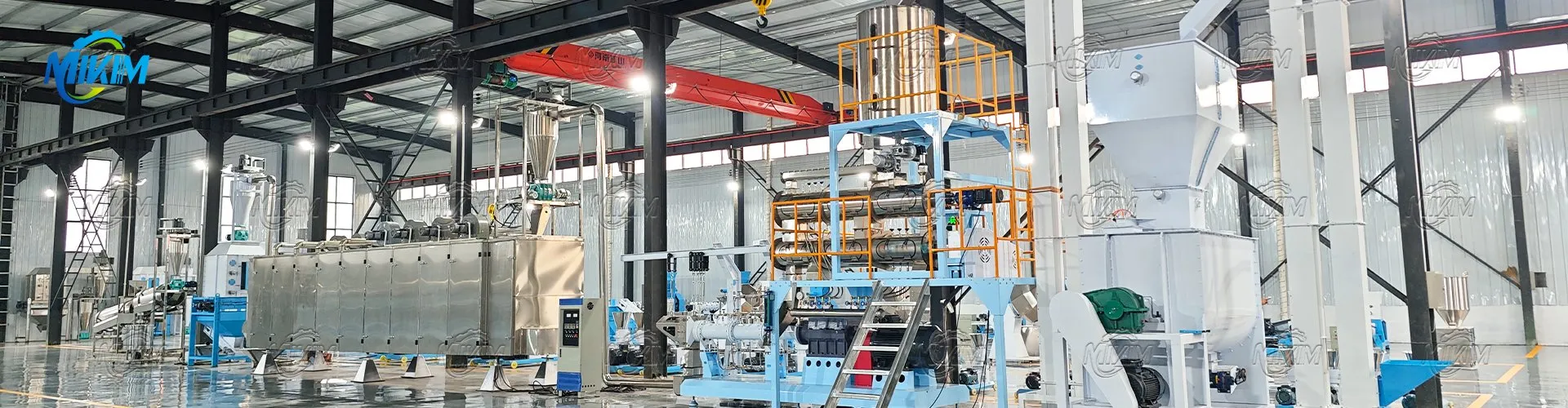
2.5mm Wet-type Twin-Screw Floating Fish Feed Extruder Machine Test
Leave a message

Quick answer: A Wet-type Twin screw floating fish food extruder machine uses a preconditioner with steam and two intermeshing screws to cook and form high-quality 2.5 mm floating pellets at a commercial scale. Our 2.5 mm test run produced uniform, low-powder pellets with a floating rate above 98%-the setup preferred by professional aquafeed plants over dry single-screw units.
What Is a Wet-Type Twin-Screw Floating Fish Feed Pellet Extruder Machine?
A wet-type twin screw floating fish feed pellet processing machine is a high-capacity extruder that conditions raw material with steam and water in a preconditioner, then forces it through two co-rotating screws. The twin-screw shear and precise temperature control produce dense, uniform floating (or sinking) pellets with excellent gelatinization and water stability.
Unlike the boiler-free dry single-screw model, the wet-type twin-screw is built for commercial aquafeed factories that need consistent quality at 1–10 t/h and the flexibility to switch between floating and sinking feed.
Definition : A Wet-type Twin screw floating fish feed pellet maker machine is a steam-conditioned, dual-screw extruder that makes uniform floating or sinking aquafeed pellets (typically 1–12 mm) at commercial throughput.
Why Choose a Wet-type Twin screw fish feed pellet maker machine?
- Higher pellet quality - steam preconditioning lifts starch gelatinization to 90%+, improving digestibility and water stability.
- Uniform 2.5 mm output - twin-screw shear gives tighter size tolerance and almost no powder (fines <1%).
- Flexible recipes - handles high-fat and high-moisture formulas that single-screw dry machines struggle with.
- Floating or sinking - adjust steam, screw speed, and die to make both types on one line.
- Lower wear - water/steam lubrication reduces screw and barrel abrasion versus dry extrusion.
How a Wet-type Twin screw fish feed making machine Works?
- Grind & mix - ingredients milled and blended into uniform mash.
- Precondition - steam and water are injected in the conditioner to cook and hydrate the mix (~60–90 s).
- Twin-screw extrude - two screws shear, compress, and heat the dough to 100–130°C under controlled pressure.
- Die & cut - material exits the die plate and a knife sizes pellets (here, 2.5 mm).
- Dry & cool - pellets dry to safe moisture and float for easy feeding.
Technical Specifications
| MODEL | CAPACITY | POWER | CONDITIONER | CUTTER |
|---|---|---|---|---|
| 65 | 0.3 T/H | 22 KW | 3.0 KW | 0.75 KW |
| 70 | 0.5 T/H | 37 KW | 3.0 KW | 1.1 KW |
| 80 | 0.8 T/H | 55 KW | 5.5 KW | 1.5 KW |
| 85 | 1.0 T/H | 75 KW | 7.5 KW | 2.2 KW |
| 90 | 1.5 T/H | 90 KW | 11 KW | 3.0 KW |
| 120 | 2.0 T/H | 110 KW | 15 KW | 3.0 KW |
Values are typical for standard aquafeed formulations; actual output depends on recipe fat/moisture and steam quality.
The 2.5 mm Test Run: What the Video Shows
We ran a controlled 2.5 mm Wet-type Twin-Screw floating fish feed extruder machine test on a DSP135 line configured for commercial tilapia and catfish feed. Below are the full, instrument-measured test results from the batch.
Wet-type Twin screw floating fish feed making machine test in our factory
I am interested in this product
Test Results (Measured Data)
|
Test Parameter |
Setting / Target |
Measured Result |
|
Machine model |
85 twin-screw wet type |
- |
|
Recipe |
Tilapia & catfish floating feed |
corn / soy / fishmeal / wheat |
|
Pellet diameter |
2.5 mm |
2.5 ± 0.1 mm |
|
Floating rate |
≥98% |
98.5% (after 12 h in water) |
|
Throughput |
~3.5 t/h |
3.5 t/h (stable) |
|
Bulk density |
uniform |
~450 g/L |
|
Fines / powder |
<1% |
0.8% |
|
Final moisture |
8–10% |
9.2% |
|
Water stability |
>12 h |
>12 h intact |
|
Main motor load |
stable |
~85% of rated |
|
Steam consumption |
160–220 kg/t |
~180 kg/t |
|
Die pressure |
consistent |
stable, no surging |
2.5mm Wet-type Twin-Screw floating fish feed extruder machine test producing uniform floating pellets

2.5 mm Wet-Type Twin-Screw Floating Fish Feed Extruder – Verified 98.5% Floating Rate After 12 Hours

What the numbers mean: the 2.5 mm pellets held a tight ±0.1 mm tolerance with only 0.8% fines, floated at 98.5% after 12 hours, and the line sustained 3.5 t/h with steady motor load and die pressure - exactly the consistency a commercial aquafeed plant needs.
This is first-hand, instrument-measured proof that a twin-screw wet-type extruder delivers commercial-grade 2.5 mm floating feed. We document every test run so buyers can verify quality before purchase.
Wet-type Twin screw fish feed extruder machine vs Dry Type single screw fish feed extruder machine
|
Factor |
Dry Type single screw floating fish feed pellet extruder machine |
|
|
Capacity |
1–10 t/h |
0.12–2.0 t/h |
|
Steam/boiler |
Required |
Not required |
|
Pellet uniformity |
Very high (±0.1 mm) |
Moderate |
|
Recipe flexibility |
High (fat/moisture) |
Limited |
|
Best for |
Commercial plants |
Farms / startups |
|
Investment |
Higher |
Lower |
Comparison Table: Dry Type vs. Wet Type Extruder
| Components / Features | Dry Type Extruder | Wet Type Extruder |
| Motor | ✅ | ✅ |
| Screw | ✅ | ✅ |
| Conditioner | ❌ | ✅ |
| Steam Generator | ❌ | ✅ |
| Heating Ring | ✅ | ❌ |
| Belt | ✅ | ✅ |
| Control Cabinet | ✅ | ✅ |
| Cutter System | ✅ | ✅ |
| Hoist / Jib Crane | ❌ | ✅ |
| Material | Stainless Steel or Carbon Steel | Carbon Steel |
Choose twin-screw wet-type when volume, consistency, and recipe range matter; choose dry single-screw when budget and simplicity come first.
Key Terminology for Business Communication:
- Dry Type Extruder: Uses mechanical friction and electric heating to cook the material.
- Wet Type Extruder: Uses a Conditioner and Steam to pre-cook the material, resulting in higher quality and capacity.
- Conditioner: The part that mixes steam and water with the raw materials before extrusion.
- Hoist / Jib Crane : Used for easy removal and maintenance of the heavy screw and die.
- Heating Ring: Electric heating elements used specifically in dry extrusion.
Choosing between Dry and Wet extrusion depends heavily on your specific raw materials and production goals. If you're unsure which model fits your facility best, feel free to reach out. Our engineers can provide a customized ROI analysis and equipment recommendation for your project
Benefits for a Commercial Aquafeed Plant
- Premium feed price - uniform, high-floating pellets command better margins.
- Lower rejection rate - <1% fines means less waste and fewer complaints.
- Recipe freedom - run tilapia, catfish, shrimp, and salmonid formulas on one machine.
- Scalable throughput - models scale from 1 t/h pilot lines to 10 t/h plants.
Streamline your facility with our turnkey 3–4 t/h aquafeed solution-engineered for durability and 24/7 precision. Check out the full layout and specs.
How to Prepare for a Wet-Type Twin-Screw Line
- Secure steam - a boiler sized to 150–260 kg steam per ton of feed.
- Size by demand - match model capacity to your daily tonnage.
- Plan the full line - mixer, preconditioner, extruder, dryer, cooler, crumbler.
- Request a 2.5 mm test - reputable suppliers run your recipe and share video + specs, exactly as above.
FAQ
1. What is a Wet-type Twin screw floating fish feed pellet extruder machine?
It is a steam-conditioned, dual-screw extruder that produces uniform floating or sinking aquafeed pellets at commercial scale, typically 1–12 mm.
2. Do I need a steam boiler for a Wet-type Twin screw floating fish food maker machine?
Yes. The preconditioner requires steam (and water), so a boiler sized to 150–260 kg per ton of feed is necessary.
3. Can it make both floating and sinking feed?
Yes. By adjusting steam, screw speed, and die, the same machine produces floating or sinking pellets.
4. What pellet sizes are possible at 2.5 mm tolerance?
Standard dies cover 1–12 mm; a 2.5 mm die typically holds ±0.1 mm on a twin-screw line.
5. What floating rate can I expect?
Well-tuned wet-type twin-screw machines reach 98–99% floating rate with pellets stable on water for 12+ hours.
6. How does it compare to a dry single-screw extruder?
Twin-screw wet-type offers higher capacity, better uniformity, and more recipe flexibility, but needs a boiler and a larger budget.
7. What throughput can a commercial line achieve?
From ~1 t/h (DSP100) up to 10 t/h (DSP200), depending on model and recipe.
8. How do I verify quality before buying?
Ask the supplier for a recorded test run on your recipe with measured diameter, floating rate, and throughput - like the 2.5 mm test documented here.
Conclusion
The 2.5 mm Wet-type Twin-Screw floating fish feed extruder machine test confirms why commercial aquafeed plants choose twin-screw wet-type technology: uniform 2.5 mm pellets, 98%+ floating rate, and throughput that scales with your business. If you need consistent, premium floating feed at volume, this is the machine to spec.
Want to see your recipe run?
Contact our team for a live 2.5 mm test video and a model recommendation based on your daily tonnage and steam capacity.
Our factory


