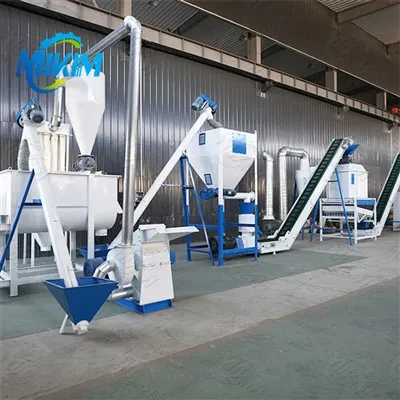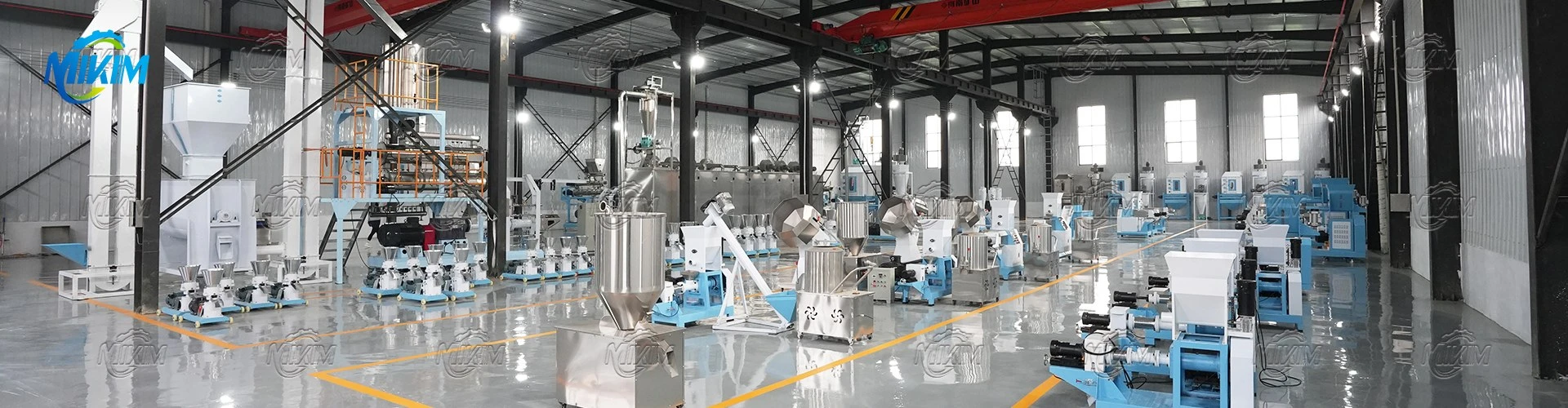


1-2t/h Poultry Animal Feed Production Line
Thisfeed production line is suitable for small/medium commerical feed factory,big farm.
Capacity:1-2t/h
Power:68.5kw
Size:12*4*9m
Workers requirments:2-3 people
Shipment requirments:40ft container
Description
Quick answer: A 1-2t/h poultry animal feed production line is a complete pelletizing plant that turns raw grain into bagged poultry pellets in one continuous chain: intake, grinding, mixing, pelleting, cooling, crumbling, screening and packing. It runs with 2-3 operators, makes pellets from 1-12 mm, and is offered in a compact single-level or a two-level layout.
- Eight working stages: intake hoist, crusher, mixer, pellet mill, cooler, crumbler, screener, and finished silo with blower.
- Option 1 draws 62.5 kW on a compact 10 x 3 x 6 m footprint and ships in a 20 ft container; Option 2 draws 65.5 kW on a 12 x 4 x 8 m two-level footprint and ships in a 40 ft container.
- Ring dies cover 3-15 mm, with 6, 8, 10 and 12 mm dies standard, so the finished pellet range runs from 1-12 mm.
- Meal must be ground to a powder and held between 12% and 20% moisture before pelleting.
- Weighing, feeding and bagging are automatic, so 2-3 people run the whole shift.
What Does a Complete 1-2 t/h Poultry Feed Production Line Include?
A 1-2 t/h poultry feed production line is a train of machines sized to pass one to two tonnes of finished pellets an hour with no stage starved and none overloaded. Because each unit feeds the next, the slowest one sets the real output, which is why a complete poultry feed plant is quoted stage by stage rather than by a single headline number.

The full machine chain from intake to bagging
Material arrives as grain or meal and leaves as sealed bags. In between, the animal feed pellet line performs eight jobs in a fixed order: intake and lifting, grinding to a powder, mixing into a uniform batch, pelleting in the ring-die mill, cooling the hot pellets, crumbling for young birds, screening out fines and oversize, and weighing and closing each bag. Table 1 shows how the units are matched.
Table 1. Stage-by-stage equipment check list for the 1-2 t/h animal feed pellet line
| Stage | Core machine | Typical model band | Drive rating | Rated output |
|---|---|---|---|---|
| 1. Intake and lifting | Screw conveyor or bucket elevator | KWX50YP / KWX75YP | 1.5 kW / 3 kW | 0-1000 kg/h / 0-2000 kg/h |
| 2. Grinding | Water-drop hammer mill | SFSP56X36 / SFSP56X40 | 22 kW / 37 kW | 3-4 t/h / 5-6 t/h |
| 3. Mixing | Vertical or horizontal mixer | KW-500 vertical / KW-1000 horizontal | 3 kW / 11 kW | 1000 kg/h / 4000 kg/h |
| 4. Pelleting | Ring-die pellet mill | SZLH-250, with SZLH-320 and SZLH-350 as upgrades | 22 kW main drive + 0.75 kW feeder + 1.1 kW conditioner | 1-2 t/h |
| 5. Cooling | Horizontal cooler or counterflow cooler | GMC-LQSF50 / NKSL11x11 | 0.75 kW + 2.2 kW fan / 5.5 kW + 2.1 kW fan | 250-350 kg/h / 1000-3000 kg/h |
| 6. Crumbling | Roller crumbler | LG-15x80 class | matched to the pellet mill drive | 1-3 t/h, crumbles down to 0.6-1.5 mm or 1-2.5 mm |
| 7. Screening | Grading screener | to be confirmed against the factory technical confirmation sheet | - | matched to line output |
| 8. Bagging | Automatic quantitative packer | DCS-Z-W-50 | 4.5 kW | 200-300 bags/h, static +/-0.1%, dynamic +/-0.2% |
Note two entries. The hammer mill is deliberately larger than the press, because grinding has to stay ahead of pelleting. And the packer is rated in bags per hour, so compare that against the bag weight you sell.

If you already know your building, share your capacity and site plan with our engineers and we will confirm the machine list against it. Growers starting below one tonne an hour usually begin on the smallest ring-die frame; farms weighing one press against a full plant often look first at a poultry feed pelletizing line for farms.
Option 1 compact single-level versus Option 2 two-level
Both layouts run the same process with the same crew. Option 1 keeps every machine on one slab, which suits an existing shed or a rented yard, while Option 2 stacks grinding and mixing above pelleting and cooling for a site where land is tight but headroom is available.
Products Description
MIKIM poultry feed production line can be used to process poultry feed pellets for chicken, duck, goose, pigeon, bird, turkey, etc. From raw materials to feed, we provide a full set of feed production process solutions and are responsible for all stages of poultry feed production line project design, budget, poultry feed manufacturing equipment and material procurement, construction, trial operation and acceptance.
How Is a 1-2 t/h Line Laid Out on Site: Option 1 or Option 2?
Both layouts deliver the same 1-2 t/h poultry feed production line, so the choice is about your building rather than the process. A small poultry feed production line at this capacity usually has to fit an existing site rather than a greenfield plot.
Footprint, container and power for each option
Table 2. Two standard layouts for a 1-2 t/h poultry feed production line
| Item | Option 1 | Option 2 |
|---|---|---|
| Layout form | Compact single level | Two-level arrangement with maintenance platform and stairs |
| Total connected load | 62.5 kW | 65.5 kW |
| Footprint | 10 x 3 x 6 m | 12 x 4 x 8 m |
| Container fit | 20 ft | 40 ft |
| Operators per shift | 2-3 | 2-3 |
| Pellet range | 1-12 mm | 1-12 mm |
| Best suited to | existing sheds, rented yards, sites where a single slab is cheapest | sites with limited land but usable headroom |
Connected load is published as two standard options rather than one figure, because the final total depends on the auxiliaries you add. Layout and connected load are confirmed against the factory technical confirmation sheet for your selected option.
When the two-level layout pays off
Option 2 exists because land is often scarcer and dearer than height. Lifting grinding and mixing onto an upper level and letting material fall into pelleting and cooling below saves several metres of floor length, at the cost of a building with headroom plus a maintenance platform and stairs.
If your yard is generous and flat, Option 1 is the simpler build. If the building is long and narrow, the two-level arrangement usually earns its keep. The layout also sets the container plan, and for a wider view of how a feed pelletizing unit is assembled on site, see the quotation drawings.
Why Is a Ring Die Pellet Mill the Right Anchor at 1-2 t/h?
Matching ring-die output to 1-2 t/h
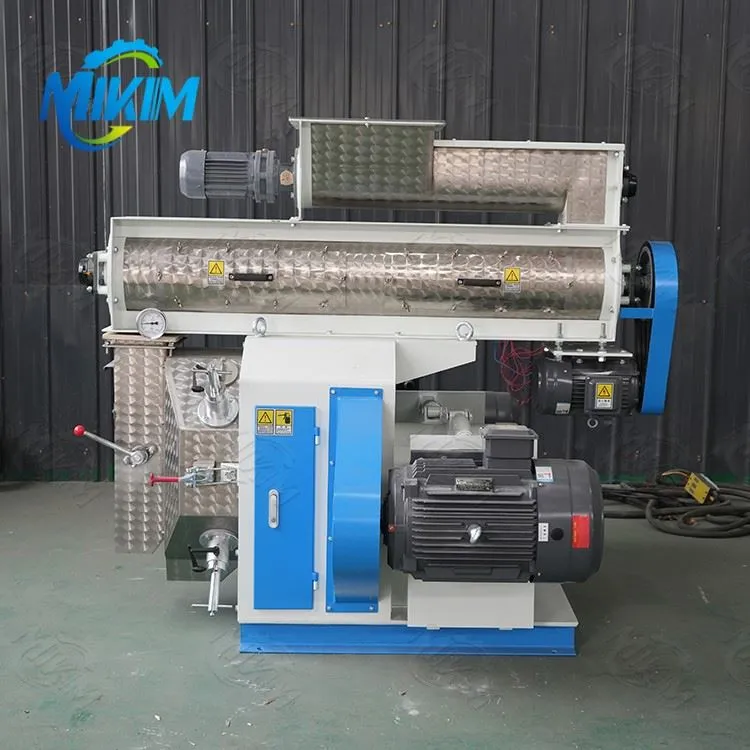
The pellet mill sets the rhythm of the plant: everything upstream is sized to keep it fed, everything downstream to keep up with it. At this step the ring-die machine is rated 1-2 t/h on a 22 kW main drive, with a 0.75 kW feeder and a 1.1 kW conditioner, measuring 1.70 x 0.65 x 1.75 m and weighing 715 kg.
The family continues upward at 2-4 t/h on 37 kW, 2-6 t/h on 55 kW and 4-12 t/h on 110 kW, with only the frame, the drive and the die diameter changing.
Dies, lubrication and feed conditioning
The ring die presses pellets from 3-15 mm, with 6, 8, 10 and 12 mm dies supplied as standard. Rollers push conditioned meal through the holes and knives cut each pellet to length, and lubrication on this frame is fully automatic.
Two conditions decide how well the die performs: the meal must be ground to a powder, because coarse particles block the holes, and it must sit between 12% and 20% moisture at the conditioner. Drier meal crumbles and wears the die, while wetter meal smears, blocks the holes and loads the cooler.

For the smallest farms a flat-die machine rated 400-500 kg/h on a 15 kW motor, with pellet diameter adjustable from 2-8 mm, covers a daily requirement measured in hundreds of kilograms. For the wider range behind this page, see our ring die feed pellet machine section.

| Capacity | 1-2t/h |
| Power | 62.5kW (Option 1) / 65.5kW (Option 2) |
| Range of application | Suitable for small/medium commerical feed factory,big farm |
| Size | 10*3*6m (Option 1) / 12*4*8m (Option 2) |
| Workers requirments | 2-3 people |
| Shipment requirments | 20ft container (Option 1) / 40ft container (Option 2) |
| Product advantages | Stable output, high efficiency,continuous work, labor saving,can pack directly,pellet size could be chosen from 1-12mm |

Feed pellet production line advantages
Improve production efficiency: The poultry feed production line adopts automated production equipment to achieve a continuous and efficient production process. Compared with traditional manual operations, the automated production line not only reduces manpower input and labor intensity, but also greatly improves production efficiency and meets the needs of large-scale farmers.
Ensure product quality: In the production process of poultry feed, it is necessary to strictly control the screening, crushing, mixing, granulation and other links of raw materials to ensure the nutritional content and quality of the products. The poultry feed production line ensures that the quality of each batch of products is consistent through precise metering systems and strict quality control standards to meet the nutritional needs of farmed animals at different stages.
Reduce production costs: The poultry feed production line adopts advanced production processes and technologies to achieve efficient use of raw materials and reduce waste. At the same time, the operation and maintenance costs of the automated production line are relatively low, which helps to reduce the overall production costs and improve the profitability of the enterprise.
Each part

hoist
The spiral elevator can transport feed pellets. It is clean, sanitary, easy to operate, strong and reliable.

mixer
The mixer is mainly used to mix feed raw materials, highly mixed without residue, mixed evenly, can help to make more nutritious feed pellets.

granulator
The pellet feed processed by the feed pellet machine has a higher density and hardness, which can avoid feed deterioration and mold caused by improper feeding, thus ensuring the quality of feed.

cooler
Counterflow coolers are mainly used for feed cooling production lines with large feeds. The material is cooled in layers from bottom to top by the inhaled air. The air intake area is large, the cooling effect is good and the effect is significant.

crusher
Used to crush feed particles. Compact structure, uniform crushing, low noise, reliable operation, more uniform particle size of finished products, high efficiency.

Bucket Elevator
Used for transportation of various raw materials and large production lines, with high strength, easy maintenance and good sealing performance.

packer
The device mainly consists of three parts: automatic weighing and packaging machine, conveying device and sewing device. It is mainly suitable for quantitative packaging of granular and granular powder mixed materials.

air blower
The air conveyor can transport the finished pellets to the dryer in an enclosed and pollution-free environment, making the pellets safer.
If you want to start a new poultry feed production line for your poultry feed mill or poultry farm, you should pay attention to the following main processes:
Determine the scale of the poultry feed processing plant.
Control mode selection (degree of automation of the poultry feed plant).
Poultry feed production plant structure selection.
Plan the general site plan of the poultry feed plant.
Therefore, if you want to build an efficient, high-quality and high-return poultry feed production line, please feel free to contact MIKIM, you will definitely get a satisfactory answer.
The configuration of the poultry feed production line is carefully designed according to the on-site survey or the actual requirements of the customer, which fully reflects the rationality, effectiveness, applicability, large output, low wear and tear, and low operating cost of establishing a poultry feed production line.
According to different process requirements, various types of poultry feed machinery are combined to meet the different poultry feed manufacturing process requirements of customers.
How Do You Match Pellet Size to Poultry Type and Age?
Crumbles for chicks versus pellets for layers and broilers
Pellet size is the most visible quality signal your customers judge, and the easiest specification to change, because it is set by the die and the crumbler rather than by the plant structure. The line produces 1-12 mm pellets and the crumbler breaks them down to 0.6-1.5 mm or 1-2.5 mm for young stock. On a chicken feed production line, that flexibility decides how many customers one plant serves.
Very young birds get crumbles, because a whole pellet is too large to swallow and a powder creates waste, while growing birds take whole pellets. The exact figure for each bird type and week of age is confirmed against the factory technical confirmation sheet, and technically the change is only a die swap and a crumbler setting.
What Raw Material, Grinding and Moisture Conditions Does the Line Need?
Grinding to powder with a hammer mill
Raw material handling decides how well the poultry feed pellet production line performs downstream. The line accepts the usual poultry ration ingredients, including maize, wheat, soybean meal and bran, all reduced to a powder before pelleting, and the drive size sets throughput: 22 kW handles 3-4 t/h and 37 kW handles 5-6 t/h, leaving headroom above a 1-2 t/h press. A water-drop grinding chamber moves 10%-30% more material per kilowatt than a plain chamber, and the screen mesh you fit is confirmed against the factory technical confirmation sheet.
Reference: FAO poultry production guidance
Keeping moisture inside the 12%-20% window
The ring die wants meal between 12% and 20% water content at the inlet. Too dry and the meal will not bind, so pellets arrive crumbly and the die wears quickly; too wet and the meal smears, the holes block and the cooler works harder. The conditioner lifts a dry mix into the window and the cooler brings the finished pellet down to a stable level, measured on cooled pellets at the bag. For grain-based lines the same rules apply, and our grain feed pelleting production line page explains what changes.
What Total Power and Labor Does a 1-2 t/h Line Require?
Option 1 and Option 2 power at breaker level
Total connected load is 62.5 kW for Option 1 and 65.5 kW for Option 2, those being the two figures to hand your electrical contractor; the difference comes from the extra conveying and structural equipment in the two-level arrangement, not from the process. The largest loads are the pellet mill main drive and the hammer mill, with auxiliaries such as a 4.5 kW packer or a 5.5 kW cooler plus a 2.1 kW fan. Breaker and cable sizing follows the final configuration list rather than a simple sum.
Staffing for 2-3 operators
The plant runs with 2-3 people per shift: one on intake and grinding, one on pelleting and cooling, one on bagging and despatch. Weighing, feeding, pellet cutting and bag filling are controlled from the panel, so the headcount stops growing with output. The same crew that runs a 1-2 ton per hour poultry feed line can often run a larger one later; our poultry feed pellet equipment guide covers the machine-by-machine selection in more depth.
How Should You Plan Shipping: 20ft or 40ft and What Ships Out?
Container fit for each option
Option 1 is planned around a 20 ft container and Option 2 around a 40 ft container; a 200-800 kg/h commercial feed line also ships in a 40 ft container, so packing follows machine count and platform steel rather than tonnage. What ships out is the equipment package: the machines in the stage table above, connecting conveyors, the control panel, the dies you specify and the erection hardware, with structural steel, platform and stairs travelling with the two-level option. Stuffing sequence and transit bracing follow the final layout drawing.
On commercial terms we quote the machine supply and the turnkey scope separately. The turnkey scope adds site supervision, installation, commissioning, trial production and operator training, while machine-only supply leaves erection to your contractor; payment terms follow the project schedule and delivery milestones in the confirmed contract.
How Do You Scale From 1-2 t/h to 3-5 t/h Later?
What carries over and what changes
Growers who buy a 1-2 t/h line usually know demand may grow, so the useful question is what survives an upgrade. The intake, grinding, mixing, conveying and finished-silo sections all carry over because they already have headroom above the press, and the bottleneck moves to pelleting and cooling, exactly where you want it. A 3-5 t/h line needs 178.5 kW of installed power and ships in a 40 ft container, adding screening plus a closed return loop so off-spec pellets return to the press rather than to waste.
Stepping the ring die mill up the ladder
Design the building and the bins for the larger plant from day one, then step the press upward when the order book justifies it: the ring-die family moves from 1-2 t/h on 22 kW, to 2-4 t/h on 37 kW, to 2-6 t/h on 55 kW, and on to 4-12 t/h on 110 kW, keeping the same operating logic. For the wider plant families behind this page, see our feed processing machinery production line overview and the large scale farming pellet production lines guide.
Ask for a machine-only or turnkey quotation and tell us the tonnage you expect in year one and year three; we will size the plant for the second number and quote the machine list for the first.
FAQ:
Q1: What equipment is included in a 1-2 t/h animal feed production line?
A: Eight stages make up the chain: intake and lifting, grinding, mixing, pelleting, cooling, crumbling, screening and bagging, with a finished silo and blower at the back end. Concretely that means a screw conveyor or bucket elevator, a water-drop hammer mill, a mixer, a ring-die pellet mill, a cooler, a roller crumbler, a grading screener and an automatic quantitative packer.
Q2: How much floor space does a 1-2 t/h poultry and livestock feed production line need?
A: It depends on the layout. A compact single-level arrangement occupies a footprint of roughly 10 x 3 x 6 m, while a two-level arrangement occupies roughly 12 x 4 x 8 m using vertical space instead of extra floor length. Both cover the machine train only, so allow extra room for raw material storage, a bagging area and vehicle access.
Q3: Which ring die pellet mill powers a 1-2 t/h poultry and animal feed production line?
A: At this capacity the press is rated 1-2 t/h on a 22 kW main drive, with a 0.75 kW feeder and a 1.1 kW conditioner, measuring 1.70 x 0.65 x 1.75 m and weighing 715 kg. If you want headroom for growth, the next frames in the same family are rated 2-4 t/h on 37 kW and 2-6 t/h on 55 kW.
Q4: What pellet sizes can a 1-2 t/h animal feed pelleting line produce for chickens?
A: The line makes pellets from 1-12 mm, the ring die presses from 3-15 mm, and 6, 8, 10 and 12 mm dies are supplied as standard. A roller crumbler can then break whole pellets down to 0.6-1.5 mm or 1-2.5 mm for very young birds, so changing size is a die and crumbler setting change.
Q5: What raw material moisture is needed for poultry feed pelleting?
A: The meal should enter the conditioner between 12% and 20% moisture. Below that range the pellets come out crumbly and the die wears faster; above it the meal smears, the die holes block and the cooler works much harder. The conditioner adjusts moisture upward and the cooler brings the finished pellet back to a stable level.
Q6: How many workers are needed to run a 1-2 t/h automated feed production line equipment?
A: Two to three people per shift are enough, because weighing, feeding, pellet cutting and bag filling are controlled from the panel. A typical arrangement is one operator on intake and grinding, one on pelleting and cooling, and one on bagging and despatch.
Qualifications and Honors


Hot Tags: 1-2t/h poultry animal feed production line, China 1-2t/h poultry animal feed production line manufacturers, suppliers, factory, heavy duty feed pellet machine, traditional feed pellet machine, rotary feed pellet machine, wood chip feed pellet machine, feed pellet machine for wildlife rehabilitation, feed pellet machine consulting service
Send Inquiry
You Might Also Like