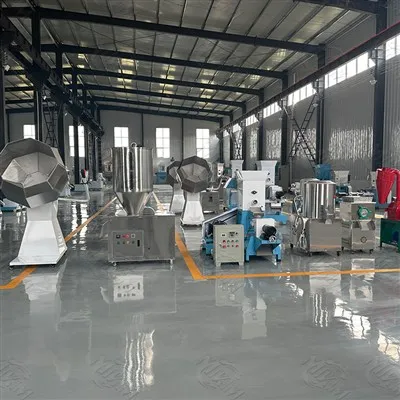
What is the structure of an aquatic extruded feed pellet mill?
Leave a message
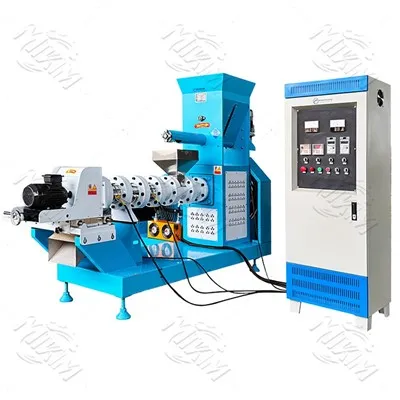
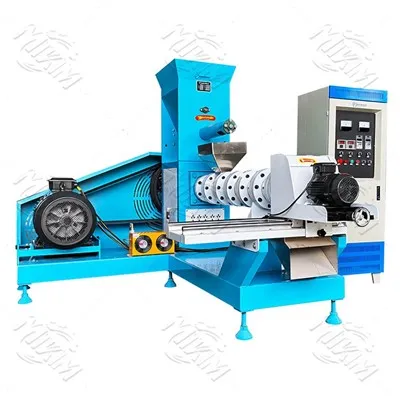
The fish food pellet making machine is specifically designed for aquatic animal feed. Its structure is optimized based on a general pellet mill, and its core consists of seven major components: a feeding system, a conditioning system, an extrusion system, a pelleting system, a cooling system, a transmission system, and a control system. Each component is tailored to the specific requirements of fish and shrimp feed.
The feeding system is the equipment's "raw material inlet," consisting of a hopper, a feeding screw, and an electromagnetic vibrator. The hopper capacity is typically 50-100L, with a polished stainless steel inner wall to prevent raw material adhesion, making it particularly suitable for processing hygroscopic raw materials commonly used in fish and shrimp feed, such as fishmeal and shrimp meal. The feeding screw features a variable diameter design, with the pitch gradually decreasing from the inlet to the outlet, ensuring uniform feeding and preventing particle density differences due to uneven feeding. The electromagnetic vibrator is installed at the bottom of the hopper, using 50Hz high-frequency vibration to prevent "bridging" between fishmeal and starch mixtures, ensuring continuous and stable feeding.
The conditioning system is crucial for nutrient lock-in, consisting of a conditioner, a steam interface, and a stirring paddle. Fish and shrimp feed requires high retention of heat-sensitive nutrients (such as vitamins and amino acids). The conditioner employs a double-jacketed design. The inner layer introduces low-pressure steam (0.2-0.3 MPa), while the outer layer uses circulating water for temperature control, precisely maintaining the raw material temperature between 85-95℃ to prevent nutrient damage from high temperatures. The mixing paddles are arranged in a spiral pattern, with rotation speed adjustable via a frequency converter (typically 30-50 rpm), ensuring thorough mixing of the raw materials and steam, uniformly raising the moisture content to 16%-18% to prepare for subsequent extrusion. This gentle conditioning method also reduces the oxidative loss of oils in the fish and shrimp feed.
The extrusion system is the "core power source" of the equipment, consisting of the extrusion chamber, main shaft, and screw sleeve. This is the biggest difference between a fish food pellet machine and a regular pellet mill. The extrusion chamber uses a split design, with wear-resistant alloy bushings embedded in the inner wall. Bushings of different wear levels can be replaced according to the hardness of the fish and shrimp feed; for example, bushings with a hardness of HRC60 or higher are selected when producing shrimp feed to extend their service life. The screw sleeve mounted on the main shaft adopts a variable diameter and variable pitch structure. From the feeding section to the discharging section, the inner diameter of the screw sleeve gradually decreases, creating a high-pressure environment of 5-8 MPa. Combined with a temperature of 120-140℃, this fully gelatinizes the starch in the raw materials, forming a dense network structure, which is crucial for the foam resistance of fish and shrimp feed. The main shaft speed can be adjusted within the range of 100-300 r/min. When producing fish feed, the speed is adjusted to 200 r/min, and when producing shrimp feed, it is increased to 250 r/min. The particle density is controlled by adjusting the degree of expansion.
The pelleting system determines the "particle shape" and consists of a die head, cutter, and adjustment device. The die head adopts a circular array hole design. The hole diameter can be changed according to the size of the fish and shrimp. A hole diameter of 1.0-1.5 mm is used for juvenile shrimp feed, while a hole diameter of 2.5-3.0 mm is used for adult fish feed. The inner wall of the holes is polished to reduce the resistance of the pellet discharge. The cutter is made of high-speed steel and driven by a servo motor with its speed synchronized with the spindle speed (ratio 1:5), ensuring uniform particle length (typically 2-3 times the aperture diameter). An adjustment device precisely controls the gap between the cutter and the die head (0.1-0.3mm), preventing excessive gaps that could cause burrs on the particles and affect fish and shrimp feeding.
The cooling system is responsible for stabilizing the particle structure. It uses a counter-flow cooler; the expanded, high-temperature particles (80-90℃) enter from the top, while cold air blows upwards from the bottom. After 3-5 minutes of cooling, the particle temperature is reduced to room temperature ±2℃, and the moisture content is reduced to 12%-13%. The screen inside the cooler uses a 30-mesh stainless steel mesh to prevent the loss of fine particles, which is especially important for high-priced fish and shrimp feed.
The transmission and control systems of the fish meal making machine ensure smooth operation. The transmission system uses a geared motor and synchronous belt drive, which is quieter than chain drives (≤75 decibels), suitable for the quiet environment of aquaculture workshops, and also simplifies maintenance. The control system uses a touch screen and can display parameters such as temperature, pressure, and rotation speed of various parts in real time. It has preset multiple production modes such as fish feed, shrimp feed, and crab feed, and even beginners can quickly get started.
Related equipment


about Us
Customer visit

Certificate of Honor

FAQ
1. What is the price of the floating fish feed equipment?
The price ranges from approximately $4,500-$35,000
2. Do you provide maintenance services for your customers?
Yes, we offer comprehensive after-sales maintenance services to our customers.