

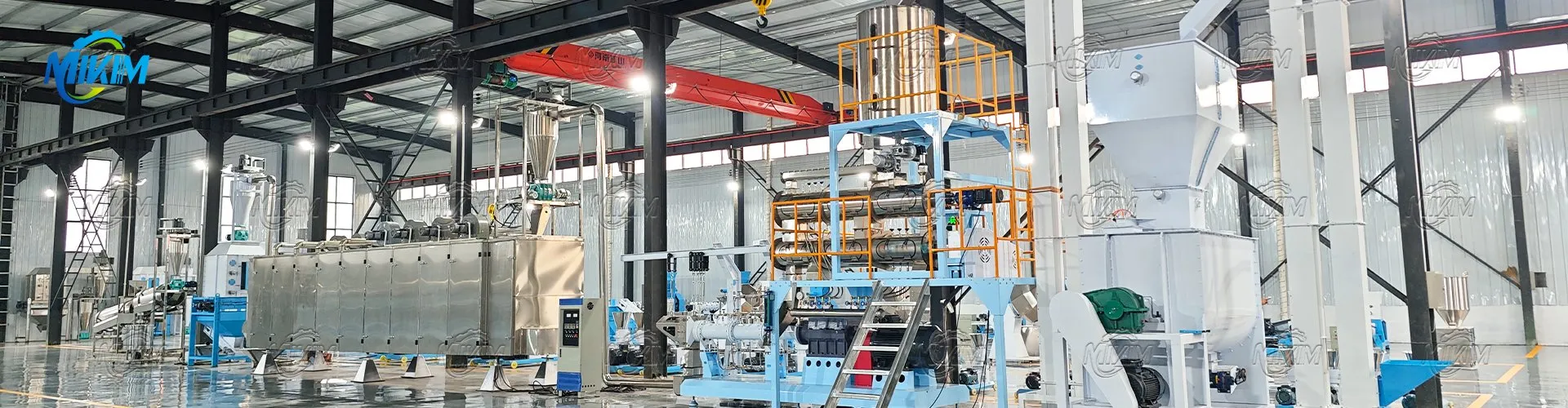
How Much Do You Know About The Process Flow Of A Floating Fish Feed Production Line?
Leave a message
When people mention fish feed processing lines, most only know the simple process of "crushing and pelleting," unaware that aquatic fish and shrimp feed production lines incorporate numerous "customized" designs. Fish and shrimp feed needs to remain in water for at least 30 minutes without disintegrating, and high temperatures must be avoided to prevent damage to the active ingredients in the fishmeal. This necessitates a more refined production line process, primarily encompassing five core stages: raw material pretreatment, precise ingredient formulation, conditioning and extrusion, drying and cooling, and screening and packaging. Each stage has strict parameter control standards.
Raw material pretreatment is the first line of defense for fish and shrimp feed quality. The biggest difference between this and ordinary feed production lines lies in "double impurity removal" and "ultra-fine grinding." Fish and shrimp feed raw materials mainly consist of fishmeal, shrimp meal, and soybean meal. Fishmeal easily contains shell fragments and metal impurities. Therefore, the raw materials first pass through a vibrating screen (1mm screen diameter) to remove particulate impurities, and then pass through a permanent magnet cylinder to adsorb metal foreign objects, ensuring an impurity removal rate of over 99%. The grinding process requires an ultrafine grinder to grind the raw materials to 80-100 mesh, 30%-40% finer than poultry feed. This improves the feed's digestibility and absorption rate, making it especially suitable for juvenile fish and shrimp fry.
Precise ingredient formulation and conditioning/expansion are key to the feed's foam resistance. The ingredient formulation process uses a fully automated electronic system, controlling the weighing error of trace components such as fishmeal and premixes within ±0.1%, preventing nutritional imbalances that could negatively impact fish and shrimp growth. The conditioning process is a feature of the fish and shrimp feed production line, employing a twin-shaft steam conditioner to control the raw material temperature at 95-100℃ and humidity at 16%-18%, ensuring full starch gelatinization without damaging heat-sensitive nutrients. The extruder uses a twin-screw model with an extrusion pressure of 12-15MPa. This high temperature and pressure create a dense network structure in the feed, the core of its foam resistance-the gelatinized starch firmly encapsulates the protein, preventing it from disintegrating upon contact with water.
The subsequent drying and cooling processes are also "tailor-made." Freshly extruded feed reaches temperatures above 80℃ and needs to be dried in stages using a rotary drum dryer: 70℃ in the feeding zone, 85℃ in the middle zone, and 65℃ in the discharge zone, precisely controlling the moisture content to 12%-13%. Too high a moisture content easily leads to mold growth, while too low a moisture content makes the feed brittle. Cooling is achieved using a counter-current cooler, lowering the feed to room temperature within 15 minutes to prevent sudden temperature drops that could cause pellet cracking. Finally, broken particles are removed by a vibrating grading screen, and the feed is automatically packaged in 20kg bags. The entire production line is equipped with an online moisture analyzer and particle size analyzer, with sampling and testing every 30 minutes to ensure consistent product quality.
Why choose us?
The MIKIM extruder is constructed entirely of food-grade 304 stainless steel, fully complying with food processing hygiene standards. It is corrosion-resistant, easy to clean, and eliminates potential contamination at the source. The core screw is made of high-quality alloy steel through special heat treatment, offering outstanding wear resistance and corrosion resistance. Combined with its integrated structural design, this significantly extends its service life. The entire machine has passed CE and ISO international authoritative certifications, aligning with global quality standards and ensuring safer and more reliable processing.
Our equipment


Our Services
We offer:
One-Year Whole Machine Warranty Service
On-site Installation, Commissioning, and Technical Guidance
24/7 Online Technical Support
Qualifications and Honors

Customer visit

FAQ
1. What is the price of the fish food processing line?
The price ranges from approximately $3,500-$50,000
2. How do you deliver to customers?
MIKIM Machinery's machinery delivery follows a complete process of "customized preparation - safe and fast delivery - precise handover - after-sales extension", with 3-day fast delivery, multi-layer protective packaging, global logistics tracking and 1-year warranty + on-site technical service to ensure that the equipment is delivered efficiently and in good condition and put into use smoothly.


