

Reasons Why The Fish Feed Making Machine Is Not Pelleting
Leave a message
The screw speed of the fish feed pellet machine is generally adjustable between 150-300r/min. Too high speed will cause the raw materials to pass through the die too quickly, and the bonding time is insufficient, resulting in difficulty in pelletizing; too low speed will reduce the production efficiency and easily cause the raw materials to accumulate in the machine. For fish feed with high starch content (such as common carp feed), the screw speed can be set to 220-250r/min to ensure sufficient extrusion and bonding; for fish feed with high protein content (such as prawn feed), the speed should be reduced to 180-220r/min to avoid excessive shear destroying the protein structure and affecting the bonding performance. The Fujian aquatic feed factory initially set the screw speed to 280r/min, which was too high. After adjusting it to 200r/min, the pelletizing effect was significantly improved.
Die temperature control directly affects the starch gelatinization rate. The suitable die temperature for fish feed pelletizing is 85-105℃. The starch gelatinization rate is low when the temperature is too low, and the raw materials lack viscosity; when the temperature is too high, the raw materials are easy to carbonize and lose nutrients. The newly bought pellet machine should preheat the die before use, and the preheating time is generally 10-15 minutes. During the operation, the temperature should be adjusted according to the raw material formula. For example, when producing tilapia feed with high corn content, the die temperature can be set to 100-105℃ to improve the starch gelatinization rate; when producing catfish feed with high fish meal content, the temperature can be reduced to 85-90℃ to protect the active ingredients in the fish meal.
Feed rate and die compression ratio should be matched. The feed rate should be adjusted according to the screw speed and die size. The feed rate is too high, which will cause the machine to be overloaded and the raw materials cannot be fully processed; the feed rate is too low, which will cause the machine to run idly and affect the pelletizing effect. It is recommended to use a frequency conversion feeder to realize the stepless adjustment of the feed rate. The die compression ratio is also an important factor. The suitable compression ratio for fish feed is 1:8-1:12. If the compression ratio is too small, the pellets are loose; if it is too large, the extrusion resistance is too high and the pelletizing is difficult. For the newly bought pellet machine, if the die is not suitable for the fish feed formula, it is necessary to replace the die with the corresponding compression ratio in time.
Why choose us?
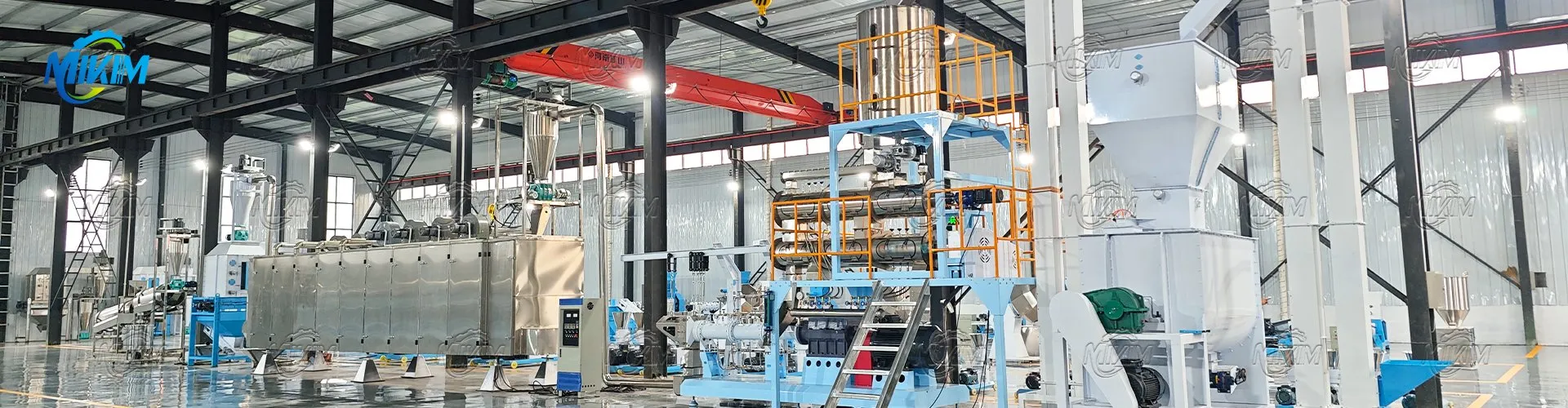
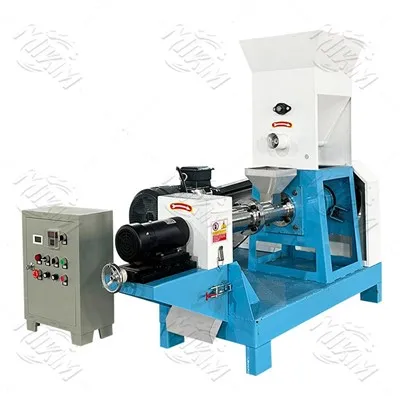
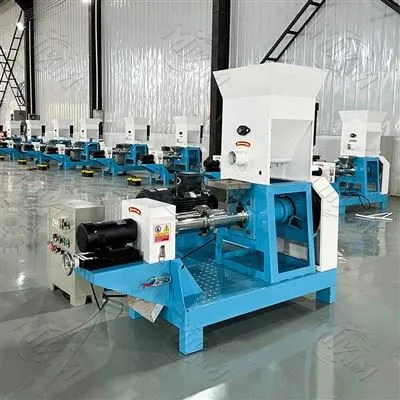
The MIKIM extruder is constructed entirely of food-grade 304 stainless steel, fully complying with food processing hygiene standards. It is corrosion-resistant, easy to clean, and eliminates potential contamination at the source. The core screw is made of high-quality alloy steel through special heat treatment, offering outstanding wear resistance and corrosion resistance. Combined with its integrated structural design, this significantly extends its service life. The entire machine has passed CE and ISO international authoritative certifications, aligning with global quality standards and ensuring safer and more reliable processing.
Our equipment


Our Services
We offer:
One-Year Whole Machine Warranty Service
On-site Installation, Commissioning, and Technical Guidance
24/7 Online Technical Support
Qualifications and Honors

Customer visit


