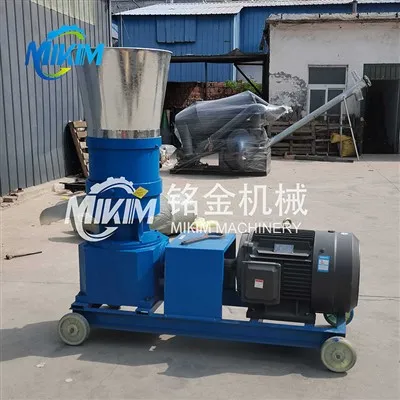
Could wrong extrusion settings lead to feed spraying in the fish feed pellet machine?
Leave a message
The temperature, pressure, and rotation speed of a fish pellet machine directly affect the state of the raw material. If the temperature is too low, the raw material will be too stiff to be extruded; if the rotation speed is too high, the raw material will not be able to keep up, both of which will lead to material spraying. Many people adjust the parameters based on intuition, such as setting a temperature or rotation speed arbitrarily, but the material spraying problem remains unresolved.
Why is the feed being sprayed if the temperature is unsuitable?
1.The barrel temperature is too low (more than 50°C below the set value): The raw material cannot be fully softened and gelatinized in the barrel (it becomes as hard as dough), the screw cannot push it, and it piles up at the feed inlet and sprays out; for example, making floating feed requires 120-130°C, but the actual temperature is only 80°C, making the raw material as hard as a rock.
Solution: Check if the heating element is broken; replace it if it is. If the heating is normal but the temperature cannot reach the set value, the insulation layer may be damaged. Wrap a layer of insulation cotton around the outside of the barrel to reduce heat loss. After ensuring that the temperature of each section reaches the set value, keep it warm for another 10 minutes before feeding.
2. Temperature too high (above the set value of 30℃): The raw material is too thin or too sticky, like "thin porridge," sticking to the screw and unable to be fed forward. Instead, it is "thrown" back to the feed inlet by the screw. It can also cause the raw material to over-expand, becoming too light and floating out of the feed inlet. Solution: Reduce the power supply to the heating elements (for example, adjust the three heating elements from full power to two full power and one half power), or slow down the screw speed to shorten the residence time of the raw material in the barrel and lower the temperature.
Why is material spraying out when the screw speed is inappropriate?
1. Screw speed too high (more than 20% above rated speed): If the screw rotates too fast, the material enters the barrel and hasn't had time to soften and compress before being "rushed" forward, resulting in material stagnation and spraying. For example, if the machine's rated speed is 300 rpm, setting it to 360 rpm will easily cause material spraying. Solution: Slow down the frequency converter to reduce the speed to the rated range (e.g., 250-300 rpm). Once the material can be extruded smoothly, fine-tune it as needed (adjusting by 10-20 rpm each time).
2. Screw speed too slow (below 50% of rated speed): The screw rotates too slowly, causing the raw material to remain in the barrel for too long, becoming too hard from repeated compression. This prevents further material from being pushed forward and causes it to spray out of the feed inlet. Solution: Increase the screw speed appropriately (e.g., from 150 rpm to 220 rpm) to allow the raw material to be fed forward in time. Simultaneously observe the extruded product; if it is too loose, slightly slow down the speed again.
Why is the material spraying out if the pressure is inappropriate?
The pressure in the extruder die head is too low (e.g., below 0.8 MPa). The raw material cannot be fully compressed and comes out too loosely from the die head. Subsequent material is compressed too quickly and sprays out from the feed inlet. Solution: Replace with a die head with a smaller orifice (e.g., replace an 8mm die head with a 6mm one), or slow down the feeding speed to increase the pressure inside the barrel (ideally, the pressure should be stable between 1.0-1.2 MPa).


Why Choose Us
MIKIM boasts extensive experience in poultry feed pellet production lines, significantly reducing the incidence of poultry diseases. Its equipment is not only widely used across various industries domestically but also exported to Southeast Asia, Europe, Africa, and South America, earning a high reputation internationally. This global presence not only demonstrates the adaptability and competitiveness of its products, but also demonstrates the company's experience in adapting to diverse market standards and logistics conditions, enabling it to provide a stable supply chain for its overseas customers. Whether serving large domestic farms or cross-border feed companies, MIKIM can leverage its global service network to ensure a consistent, high-quality experience.
For more information on process flow design, equipment layout, factory construction plans, individual equipment pricing, or turnkey project proposals, please feel free to contact us!!!