How Does the Production Environment Affect floating fish feed making machines?
Leave a message
content
Negative Impacts and Countermeasures of High-Temperature Environments. When the ambient temperature exceeds 35℃, it poses multiple challenges to small fish feed pellet making machines: First, the increased heat dissipation pressure on the equipment makes the cooling systems of the drive motor and extrusion chamber prone to overload, leading to increased motor temperature, unstable speed, and in severe cases, overload tripping. Second, the temperature control accuracy of the extrusion chamber becomes uncontrolled; the original operating temperature of 120-160℃ for the extruder will experience a "cumulative effect" due to the high ambient temperature, resulting in over-expansion of the raw materials, making the pellets brittle and reducing their water resistance. Third, the hydraulic system (equipped in some small fish food making machines) experiences increased oil temperature, decreased hydraulic oil viscosity, and reduced sealing performance, making it prone to oil leakage. Countermeasures require a two-pronged approach: In terms of environmental control, install industrial air conditioning or forced ventilation equipment to ensure the temperature in the production workshop is controlled at 25-30℃, and add cooling fans around the motor and extrusion chamber to enhance local heat dissipation. In terms of equipment operation, appropriately reduce the screw speed (e.g., from 350r/min to 320r/min) to reduce frictional heat generation, or extend the intermittent operation time of the equipment to avoid continuous high-temperature operation.
Hazards and Protection in High Humidity Environments. When the relative humidity exceeds 75%, the impact on fish feed production equipment is mainly reflected in three aspects: First, raw materials absorb moisture and deteriorate. Raw materials such as corn and soybean meal easily absorb moisture (exceeding 14%) in high humidity environments. After entering the extruder, they will stick to the screw, causing feed blockage. At the same time, moldy raw materials will lead to off-odors and nutrient loss in the feed. Second, metal parts of the equipment will rust. Core components such as screws, extrusion chambers, and dies are mostly made of steel. When exposed to high humidity for a long time, the surface anti-rust layer is prone to failure, resulting in rust spots, accelerated wear, and shortened service life. Third, electrical system failures will occur. Excessive humidity will cause components in the electrical control cabinet to become damp, leading to problems such as short circuits and poor contact, affecting the accuracy of equipment parameter control. Protective measures must consider both raw material storage and equipment protection: The raw material storage area should be isolated from the production area, and dehumidifiers should be installed to control humidity below 60%. Moisture content should be tested again before raw materials are fed in. Regarding equipment, core components should be thoroughly cleaned after each day's production, and food-grade rust-preventive oil should be applied. Electrical control cabinets should be equipped with desiccants and temperature and humidity monitors, with immediate alarms triggered if humidity levels exceed limits. For example, in coastal aquaculture farms, installing dehumidifiers in both the production workshop and raw material warehouse can effectively control environmental humidity between 55% and 65%, preventing raw materials from absorbing moisture and equipment from corroding.
The impact and countermeasures of low-temperature, dry environments. In northern winters, when the ambient temperature is below 5℃ and the humidity is below 30%, the operation of automatic fish food making equipment will also be affected: Firstly, the raw materials lose moisture too quickly, and if the moisture content is below 10%, insufficient frictional heat will result in incomplete melting of the raw materials upon entering the extruder, leading to insufficient extrusion and hard pellets. Secondly, the lubrication effect of the equipment's transmission components will decrease. Low temperatures will cause the lubricating oil viscosity to increase, increasing the rotational resistance of screw bearings and motor bearings, thus accelerating component wear. Thirdly, condensation is prone to occur in the pipes. In low-temperature environments, condensation is likely to occur in the steam pipes of the wet extruder, and condensate entering the raw materials will cause uneven moisture distribution, affecting the extrusion effect. Countermeasures: Install humidification equipment in the raw material storage area to stabilize the raw material moisture content at 12%-14%; preheat the equipment before starting by running it unloaded for 5-10 minutes to raise the component temperature, and simultaneously replace the lubricating oil with a low-temperature compatible type; wrap the steam pipes with insulation cotton to reduce heat loss and condensation. For example, when producing floating feed for sea bass in northern winters, preheating the equipment 10 minutes in advance and controlling the raw material moisture content to 13% can ensure an extrusion uniformity of over 95%.
Related equipment

about Us
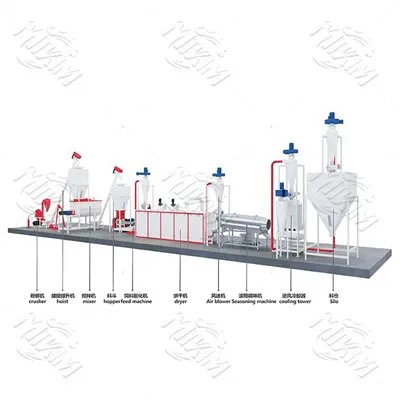
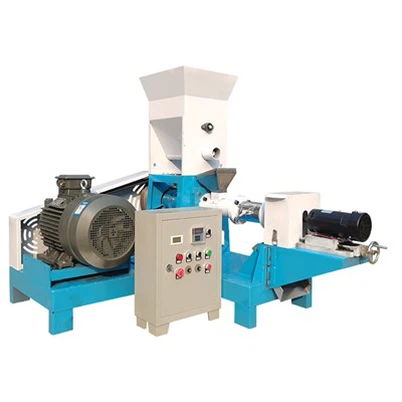
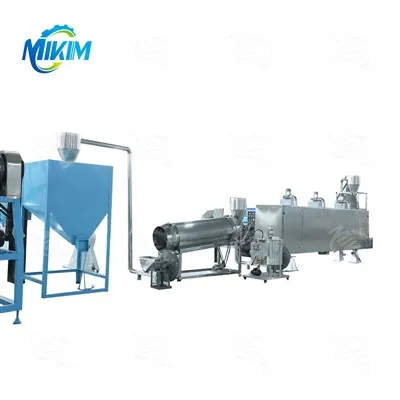
MIKIM's fish feed pellet production lines and supporting machinery offer excellent value for money. Not only are they affordable, eliminating middlemen markups and allowing small and medium-sized enterprises (SMEs) and fish farmers to purchase complete sets of equipment at reasonable costs, but they also boast exceptional efficiency. The fully automated process, from raw material crushing and precise ingredient mixing to extrusion pelleting and maturation, is completed in one continuous flow. This results in high starch gelatinization rates and uniform pellet formation, significantly improving production efficiency and feed quality, truly achieving "low cost, high output." Choosing a MIKIM fish feed pellet production line means enjoying comprehensive pre-sales and after-sales service, including 24-hour online customer support, a one-year warranty on the entire machine, professional on-site installation, commissioning, and maintenance, and a stable supply of spare parts. Customers can buy with confidence and use with peace of mind, with both excellent value and service quality!!!
Customer visit

Certificate of Honor

FAQ
1. What is the price of the fish pellet making machine?
The price ranges from approximately $1,500-$55,000
2. Do you provide maintenance services for your customers?
Yes, we offer comprehensive after-sales maintenance services to our customers.
If you would like to learn more about MIKIM machinery, please contact us. We offer one-stop service and welcome your inquiries!!!