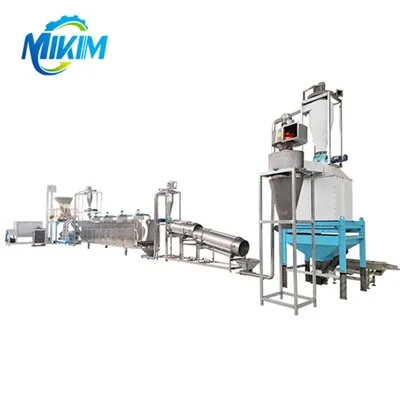
How to enhance the production line for fish and shrimp puffed pellets
Leave a message
First, upgrade the screw structure of the extruder. Traditional fish and shrimp extrusion production lines mostly use single-stage screws, resulting in uneven residence time of the raw material within the machine, with some areas over-cooked and others under-cooked. The improved design uses a three-stage screw: the first stage transports the raw material, the second stage applies high-pressure extrusion, and the third stage precisely controls temperature for cooking. This ensures the raw material is evenly heated and pressurized within the machine, increasing the cooking rate from 75% to over 90%. Furthermore, a wear-resistant coating, such as tungsten carbide, is applied to the screw surface to reduce wear from the raw material, extend equipment life, and prevent metal debris from contaminating the feed.
Second, optimize the matching of extrusion pressure and temperature. Fish and shrimp feed needs to remain submerged in water for 3-5 minutes without disintegrating, requiring precise matching of pressure and temperature during extrusion. The production line will be equipped with an "intelligent pressure and temperature control system" to adjust parameters for different fish and shrimp species. For example, when making carp feed, the extruder pressure will be adjusted to 4 MPa and the temperature controlled at 115℃ to ensure full starch gelatinization and a more compact pellet structure. When making shrimp feed, the pressure will be reduced to 3 MPa and the temperature raised to 120℃ to ensure fine and easily digestible pellets. The system will also be able to monitor in real time, automatically adjusting the screw speed or steam supply if the pressure or temperature deviates from the set values to ensure consistent feed quality for each batch.
Finally, a "secondary curing" stage will be added. Traditional production lines only have one extrusion and curing stage, which does not completely destroy anti-nutritional factors in the raw materials (such as trypsin inhibitors in soybean meal). The improved system will add a "curing tank" at the extruder outlet. After extrusion, the feed will be kept warm in the tank for 30 seconds at a temperature of 110℃ to further destroy anti-nutritional factors, increasing the digestibility of fish and shrimp by about 15%. Furthermore, secondary curing will make the feed more aromatic, attracting fish and shrimp to actively feed and reducing feed residue.


about Us
Customer visit

Certificate of Honor

FAQ
1. What is the price of the floating fish feed extruder production line?
The price ranges from approximately $15,000-$49,000
2. Do you provide maintenance services for your customers?
Yes, we offer comprehensive after-sales maintenance services to our customers.