


How to replace the equipment on the production line for processing buoyant fish feed pellets?
Leave a message
Many people believe that "processing floating and sinking materials is as simple as changing the mold," but after buying a floating material mold, the material still sinks to the bottom; or when using a sinking material production line to process floating materials, the machine gets clogged. In fact, processing floating and sinking materials is not as simple as changing the mold - the selection of extruders and pellet mills, the adjustment of temperature and pressure, and even the raw material pretreatment equipment all need to be changed. If one step is wrong, the material will not be qualified.
Core equipment selection
Floating fish feed: Requires an extrusion production line.
1. Floating feed needs to generate gas. Ordinary pellet mills lack sufficient temperature and pressure to produce bubbles. A production line with an extrusion function is necessary. The core equipment is a twin-screw extruder (which produces more uniform gas and more stable buoyancy than a single-screw extruder).
2. Supporting equipment: A dryer (to control raw material moisture content at 12%-14%), a fine pulverizer (to pulverize raw materials to 80-100 mesh for more complete starch gelatinization), and a cooler (to fix the bubbles and prevent them from bursting due to rapid cooling).

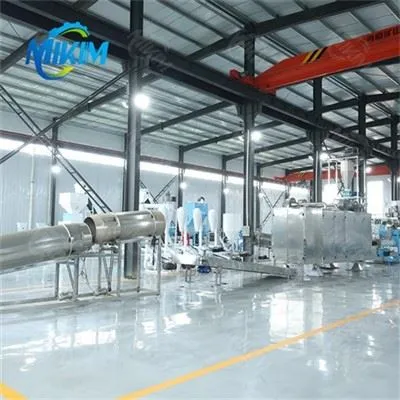


Sinking fish feed: A regular pelleting production line is sufficient.
1. Sinking feed needs to be compacted. An extrusion function is not required. A ring die pellet mill (high pressure, able to compact the raw materials) is sufficient, and the cost is 30%-50% lower than an extrusion production line.
2. Supporting equipment: A coarse pulverizer is needed (the raw material should be pulverized to 40-60 mesh; pulverizing it too finely can cause air to get trapped), a mixer (to ensure the high-protein raw material is uniform and avoid uneven particle density), and a cooler (to quickly cool down the material and prevent the particles from absorbing moisture and becoming lighter).



Equipment parameter adjustment
Temperature Adjustment: High Temperature for Floating Material, Low Temperature for Sinking Material
1. Floating Material: The extruder barrel has a 3-section temperature control: the first section is 80-100℃ (raw material preheating), the middle section is 120-140℃ (starch gelatinization), and the last section is 140-160℃ (sufficient gas production). If the temperature is too low (below 120℃), the starch gelatinization is insufficient, the gas production is low, and the material will sink.
2. Sinking Material: The pellet mill barrel temperature is controlled at 60-80℃, just enough to soften the raw material (for example, fishmeal is easier to compact after softening), without allowing the starch to gelatinize and produce gas. If the temperature is too high (above 90℃), the raw material will produce slight gas, and the material may float, becoming a "semi-floating, semi-sinking material".
Pressure Adjustment: Medium pressure for floating material, high pressure for settling material
1. Floating material: Extruder screw pressure controlled at 3-5 MPa (too high pressure will break air bubbles, too low pressure will cause large air bubbles to easily enter water); if the material has poor buoyancy, slightly lower the pressure (e.g., from 5 MPa to 4 MPa) to increase air production.
2. Settling material: Pelletizer roller pressure controlled at 8-12 MPa (more than twice that of floating material) to squeeze out all the air from the raw material; if the material is still floating, increase the pressure (e.g., from 10 MPa to 12 MPa) to compact the pellets more.
Mold Adjustment: For floating material, use a large aperture + thin mold; for sinking material, use a small aperture + thick mold.
1. Floating material: Mold aperture 3-8mm (depending on fish size), mold thickness 15-20mm (a thin mold allows for rapid extrusion of the material, resulting in a sudden drop in pressure and easier bubble formation); if the aperture is too small (less than 2mm), bubbles are easily burst, and the material will sink.
2. Sinking material: Mold aperture 1-5mm, mold thickness 25-30mm (a thick mold allows the material to stay in the mold longer, resulting in more compaction); if the thickness is too thin (less than 20mm), the material is not compacted, easily trapping air, and the material will float.


about Us
MIKIM boasts extensive experience in poultry feed pellet production lines, significantly reducing the incidence of poultry diseases. Its equipment is not only widely used across various industries domestically but also exported to Southeast Asia, Europe, Africa, and South America, earning a high reputation internationally. This global presence not only demonstrates the adaptability and competitiveness of its products, but also demonstrates the company's experience in adapting to diverse market standards and logistics conditions, enabling it to provide a stable supply chain for its overseas customers. Whether serving large domestic farms or cross-border feed companies, MIKIM can leverage its global service network to ensure a consistent, high-quality experience.
For more information on process flow design, equipment layout, factory construction plans, individual equipment pricing, or turnkey project proposals, please feel free to contact us!!!

FAQ
1. What is the price of the fish feed pellet production line?
The price ranges from approximately $10,000-$36,000
2. Do you provide maintenance services for your customers?
Yes, we offer comprehensive after-sales maintenance services to our customers.


