


Description
Quick answer: An extrusion granulator is a dry, screw-type machine that cooks blended aquafeed by friction and shapes it through a changeable die, so one fish feed extrusion granulator turns meal into floating or sinking pellets without a steam boiler.
- The working chain is short: a screw feeder, a heated barrel, a changeable die and a rotary cutter that trims the strand to length.
- Die aperture sets pellet size and fish fit, and the small-pellet aquafeed market runs on 1.2 mm, 1.0 mm, 0.8 mm and 0.6 mm dies.
- The four frames in our dry single-screw range carry dia. 100, 120, 135 and 160 mm screws on 37, 55, 75 and 90 kW main drives.
- A dry aquafeed extrusion granulator needs no steam boiler, which suits farms, small plants and full commercial lines alike.
- Capacity, die set and drive power follow your feed type, to be confirmed against the factory technical confirmation sheet.
What Is an Extrusion Granulator and How Does It Work?
Extrusion granulation versus compression granulation
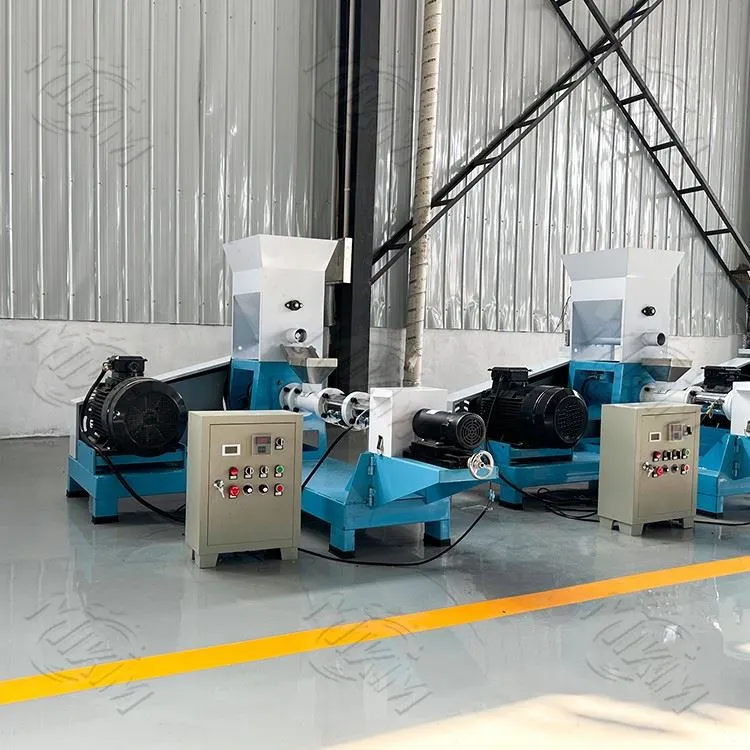
An extrusion granulator is a screw-type machine. It cooks and shapes aquafeed in one continuous pass: blended material travels along a turning screw, the shear and friction inside the barrel raise its temperature, and the softened mass is pressed through a die and trimmed to length. Because the heat comes from the working screw itself, the process needs no external steam source.
Reference: research on extrusion process control
That is the line between extrusion granulation and compression granulation. A compression press squeezes dry powder into a shape without cooking it, while an extrusion granulator cooks the material first and then expands it through the die. For an aquaculture feed extrusion machine, that cooked-and-expanded pellet is what holds together in water and carries more nutrition per bite. To compare machine types, start from the fish feed extruder machine range, then look at the wider extruder machine range for the dry and wet options.


The screw, barrel, die and cutter chain
An extrusion granulator machine is best read as a short chain of parts, each with one job:
- Feeding system - a screw feeder meters blended meal into the barrel at a steady rate.
- Screw and barrel - the screw conveys, shears and heats the material; our screws use alloy steel with a special heat treatment for wear and corrosion resistance.
- Die - a changeable plate at the outlet sets pellet diameter and shape, so one extrusion granulator for fish feed covers several pellet sizes.
- Rotary cutter - a cutter at the outlet chops the emerging strand, and its speed can be tuned to trim pellet length.


Products Description
Extruded aquatic feed is gradually gaining market favor with its high feed intake rate, high conversion rate and environmental protection characteristics. With the continuous advancement of extrusion technology, more and more manufacturers have begun to use extruders to directly produce small-particle aquatic feed. The mold aperture is usually 1.2mm, 1.0mm and 0.8mm, and some manufacturers have even required the production of extruded particles with an aperture of 0.6mm.
Which Die Aperture Fits Which Fish Species and Growth Stage?
Matching 1.2 mm, 1.0 mm and 0.8 mm dies to fry and fingerlings
Die aperture is the first decision a fish feed buyer makes on an extrusion granulator, because pellet diameter has to match the mouth of the fish. The small-pellet aquafeed market runs on four apertures - 1.2 mm, 1.0 mm, 0.8 mm and 0.6 mm - and each suits a different point in the growth curve. For a fish feed extruder, the rule is simple: the smaller the fish, the smaller the aperture.
This is where a multi-species farm feels the squeeze, because fry and grow-out fish need very different pellet diameters. The practical answer is a die set on one frame: a farm that also needs pellets from about 3 mm up to 8 mm for larger species covers that range with extra die plates rather than a second machine. Confirm the exact size steps for your species against the factory technical confirmation sheet.
Table 1. Die aperture and the fish it suits - a starting guide, confirmed on sample.
| Die aperture | Pellet role | Typical fish group and stage (indicative) | Running note |
|---|---|---|---|
| 1.2 mm | standard small floating or slow-sinking pellet | fingerlings and larger fry of most farmed species | the most requested small-aquafeed size |
| 1.0 mm | small transition pellet | fingerlings moving toward grow-out | a bridge between starter and grow-out feed |
| 0.8 mm | starter pellet | fry to small fingerlings | needs a finer grind upstream |
| 0.6 mm | fine starter pellet | the earliest fry stage | the finest aperture and the tightest process control |
The table is a guide only. The exact aperture for a named species and stage is set at trial run and to be confirmed against the factory technical confirmation sheet.
When a 0.6 mm die is worth it
A 0.6 mm die is the finest option and the one buyers hesitate over most. It earns its place only when you really do feed the earliest fry, because the tighter aperture demands a finer grind, a more even blend and more careful drying. If your smallest fish sit above the fry stage, a 0.8 mm die covers the job with far less fuss, so treat 0.6 mm as a specialist tool for a fry hatchery rather than a default for a grow-out farm.
Product Parameters
| Model | 100 | 120 | 135 | 160 |
| Power | 37KW | 55KW | 75KW | 90KW |
| Yield | 500 | 600-700 | 800-900 | 1000-1200 |
| Weight | 1500KG | 1800KG | 2000KG | 2500KG |
| Size(mm) | 2000*2800*1200 | 2200*2900*1200 | 2200*3100*1370 | 2300*3150*1380 |

Although the small particles processed by technology have the advantages of convenient production and relatively low cost, their high formula cost, high powder content, poor stability in water and large amount of return materials make people more inclined to use extruders for direct production. The small particles extruded by the extruder not only have low formula cost, low powder content, good stability in water and beautiful appearance, but also are equipped with a variable frequency speed-adjusting rotary cutting device at the discharge port, which can flexibly adjust the blade rotation speed, thereby accurately controlling the cutting speed and length.
With the vigorous development of my country's economy, the demand for extruded feed for various pets such as fish and shrimp has increased sharply, and the market has shown a trend of commercialization and scale. This feed is made of corn, soybeans, etc., and after direct expansion, it can produce feed products with various shapes, unique taste, rich nutrition and delicate texture. As a device specially designed for pet food production, the feed extruder can not only produce a variety of flower-shaped feeds, but also customize molds according to customer needs to meet personalized feeding needs.
How Do Screw Diameter and Drive Power Set Extrusion Granulator Output?
Reading the screw dia. ladder across the dry single-screw range
Screw diameter is the number that sets how much material an extrusion granulator can move, and the main drive scales with it. In our dry single-screw range the ladder runs in four matched rungs: a dia. 100 mm screw on a 37 kW main drive, then dia. 120 mm on 55 kW, dia. 135 mm on 75 kW, and dia. 160 mm on 90 kW. A larger screw gives a longer working helix and more shear, so it moves more material and cooks it harder.
Table 2. Screw diameter and drive data for the four dry single-screw frames.
| Model | Main drive (kW) | Feeder (kW) | Cutter (kW) |
|---|---|---|---|
| 100 | 37 | 1.5 | 1.5 |
| 120 | 55 | 1.5 | 1.5 |
| 135 | 75 | 1.5 | 2.2 |
| 160 | 90 | 2.2 | 2.2 |
The four frames step up in throughput as screw diameter grows; the rated capacity of the frame you choose is confirmed for your own feed and die against the factory technical confirmation sheet. Output is quoted on finished pellets, so plan against a trial run on your own recipe. For bigger throughput beyond this ladder, see the large fish feed extruder page.
Main motor versus feed and cutter power
The main drive does the heavy work; the feeder and the cutter are small loads, but they must be matched to the frame. Across the four frames the feeder runs 1.5 kW and steps up to 2.2 kW on the largest frame, while the cutter rises from 1.5 kW to 2.2 kW from the dia. 135 mm frame upward. Size a site on all three - main drive plus feeder plus cutter - and then add the conveying and cooling loads around the extruder.
How Much Power Does an Extrusion Granulator Use per Ton of Feed?
Main-motor versus auxiliary loads
Per-tonne power comes from two groups of loads. The main motor is the big one and it runs continuously; the auxiliaries - feeder, cutter, conveying and cooling - are smaller but run at the same time, so they belong in the same sum. On the largest frame in the wider range, a dia. 200 mm unit, the feeder and cutter draw 3.0 kW each on top of a 132 kW main drive.
Estimating kWh per tonne from rated power
The quick estimate is a division: kWh per tonne is roughly the main-motor rating in kW multiplied by running hours, divided by tonnes produced. Take the dia. 200 mm frame rated 132 kW at 1800-2000 kg/h: at full load the main motor alone works out at about 66-73 kWh per tonne. Treat that as indicative, not a promise - it ignores part-load running and leaves out the auxiliaries. Real consumption moves with the raw material, the moisture and the die, so the number to plan your electrics on is to be confirmed against the factory technical confirmation sheet.
Working out the load for your site? Send your target tonnes per hour and your feed type, and we will size the main drive, feeder, cutter and surrounding loads into one connected-power list. Talk to an engineer about your extrusion duty.
Which Extrusion Granulator Configuration Suits Which Aquafeed Type?
Dry single screw for standard floating feed
The dry single-screw frame is the workhorse for standard floating feed. It needs no steam boiler, it starts from meal that is already ground and blended, and it handles the usual farm and plant recipes for fish, shrimp, dog and cat feed. A floating fish feed extruder machine of this type covers most day-to-day aquafeed demand at low running cost.

Twin screw for high-fat and high-meat recipes
When the recipe turns oily or sticky, the screw count matters. A Dry Type Twin-Screw floating fish feed extruder machine frame carries two intermeshing screws with self-cleaning action and higher conveying efficiency, which keeps a high-fat, high-meat or otherwise sticky blend moving instead of clogging, and it produces a wider spread of pellet sizes and shapes. Where the brief calls for a wet process - floating fish feed with strong water stability, sinking shrimp feed, micro pellets around dia. 0.5-1.5 mm, or high-fat feed with 11-13% added fat - a wet extruder with steam conditioning is the right tool. Wet single-screw frames add a steam conditioner for premium aquafeed and pet food. See the aquafeed expander and the aquaculture and pet feed extruder pages for how these configurations sit side by side, then match the frame to your recipe rather than to pellet size alone.

How Does an Extrusion Granulator Relate to a Full Fish Feed Pellet Line?
What sits upstream and downstream of the extruder
An extrusion granulator is one station in a line, not the whole line. On a 200-800 kg/h aquatic and pet feed line the chain runs crusher, conveyor, feeder, grinder-extruder, dryer, micro mill, cooler and finished-feed bin, with 86-152 kW behind it, a 25 x 3 x 6 m footprint, and a 40 ft container to ship it. Upstream of the extruder the job is grinding and metering; downstream it is drying, cooling and handling, and those stations set the pace the extruder can run at. For that layout, see the aquatic feed extruder line and the automatic fish feed pellet production machine pages.


When a single granulator is enough
A single granulator stands on its own when the batch is small, the ground meal arrives ready, and the drying happens outside the machine. A farm that buys pre-ground and blended meal, runs one shift, and dries pellets on a sun pad does not need a complete line yet. The simple four-machine start-up set - crusher, mixer, dryer and finished-feed bin - draws 16-68 kW, fits a 5 x 2 x 3 m area and runs with 1-2 people. Add the rest and the station count, the connected power and the container size step up together, which is where the cost of a full fish feed extrusion line really sits.
How Fine Should Raw Material Be Ground Before Granulation?
Hammer mill options upstream of the extruder
Fine, even grinding is what lets a small die run clean, so the hammer mill upstream of the extruder is not an afterthought. Two water-drop mills cover most needs: a 22 kW unit at 3-4 t/h with a footprint around 1430 x 860 x 1000 mm, and a 37 kW unit at 5-6 t/h for higher intake. A water-drop chamber lifts grinding efficiency by roughly 10%-30% against a plain chamber, which matters when the smallest dies need the finest grind. The usual aquafeed base - corn, soybean meal and fish meal - is ground before blending, and a finer grind goes with a finer die. The screen size and target particle size for a given pellet are to be confirmed against the factory technical confirmation sheet.
Reference: feed ingredient composition database
What Maintenance and Wear Parts Does an Extrusion Granulator Need?
Screw, barrel and die wear
The screw, the barrel and the die take the wear in any extrusion granulator. Our screws are alloy steel with a special heat treatment for wear and corrosion resistance, but the screw and die still wear against the abrasive meal, and the tighter a die runs the faster it wears. Hold one spare die in your main pellet size, one spare cutter, and the belts and seals for your frame, so a worn part never stops a shift. The replacement interval follows your raw material and running hours, so treat the schedule as to be confirmed against the factory technical confirmation sheet.
Daily cleaning of the discharge and cutter
Most day-to-day trouble starts at the outlet. At the end of a run, clear the die face and the discharge so dried material cannot set hard overnight, wipe the cutter, and check the blade for a chipped edge before the next start. A clean discharge and a sharp cutter keep pellet length steady, which is the one quality point a buyer notices first. Log running hours as you go - that log turns the wear schedule into a real plan.
Ready to match a granulator to your feed? Send your species, target pellet size and tonnes per hour, and our engineers will recommend a frame, a die set and the drive power behind it. Request an extrusion granulator recommendation.
FAQ: Extrusion Granulator Dies, Power and Feed Types
Q1: What is the difference between an extrusion granulator and an ordinary pellet mill?
A: An extrusion granulator cooks the material with screw friction and expands it through a die, so it needs no steam boiler and makes floating or sinking aquafeed. An ordinary pellet mill presses dry powder into a dense pellet without cooking it, which suits grain and poultry feed more than aquafeed.
Q2: Which die aperture should I choose for young fish and fry?
A: Start from 0.6 mm or 0.8 mm for the earliest fry and 1.0 mm to 1.2 mm for fingerlings, then check the pellet against the mouth of your fish. A multi-species site should hold a die set, not one die, and confirm the exact sizes for your species against the factory technical confirmation sheet.
Q3: What screw diameter do I need for a given output of fish feed?
A: Screw diameter and main drive move together: dia. 100 mm on 37 kW, dia. 120 mm on 55 kW, dia. 135 mm on 75 kW and dia. 160 mm on 90 kW. Pick the frame from your target tonnes per hour and your feed type, and confirm the capacity for your recipe against the factory technical confirmation sheet.
Q4: Does an extrusion granulator need a steam boiler?
A: A dry extrusion granulator needs no steam boiler - the heat comes from screw shear and friction. Only a wet extruder, used for premium aquafeed and pet food, adds a steam conditioner, and there the boiler is a separate item.
Q5: How much mains power does an extrusion granulator draw?
A: Add the main drive, the feeder and the cutter, then allow for conveying and cooling. On the four frames the main drives are 37, 55, 75 and 90 kW, with the feeder and cutter adding up to 2.2 kW each. The installed load for your site is to be confirmed against the factory technical confirmation sheet.
Q6: How often should the screw, barrel and die be replaced?
A: The interval depends on your raw material, your running hours and how tight your die runs, so there is no single answer. Hold one spare die and one spare cutter in stock, log your hours, and set the replacement schedule against the factory technical confirmation sheet.
Qualifications and Honors

Customer visit

Hot Tags: extrusion granulator, China extrusion granulator manufacturers, suppliers, factory, automatic fish feed making machine, industrial fish feed production machine, automatic aquaculture feed forming machine, aquaculture feed extrusion machine, fish pellet extrusion line, fish feed extrusion line
Send Inquiry
You Might Also Like

