


What are the differences between a Single-Screw fish feed pellet extruder and a Twin-Screwfish feed pellet making machine?
Leave a message
Floating fish feed extrusion is mainly divided into single-screw extrusion and twin-screw extrusion-this is a core classification based on the extruder screw configuration, directly affecting processing efficiency, feed quality, and application scenarios. The following is a brief introduction to their working principles, characteristics, and application examples:
1. Single-Screw Extrusion
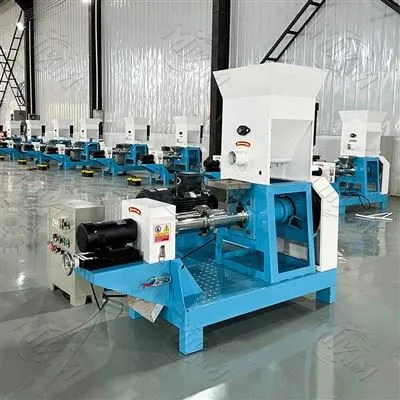
Working Principle: Relies on a single rotating screw within a fixed barrel. Mixed powdery raw materials (protein sources, starch, additives) are conveyed forward by the screw's spiral flights. Friction between the screw, barrel, and material generates heat (100-120°C) and pressure (3-6 MPa), softening the material, inducing partial starch gelatinization, and creating expansion when exiting the die.
Core Traits: Simple structure, low equipment cost, and easy operation/maintenance. Suitable for small-scale production with low investment. However, mixing uniformity and shear force are limited-starch gelatinization degree (60-75%) is relatively low, leading to feed with moderate floatability and water stability. It handles simple formulas well but struggles with high liquid content or complex additives.
Applications: Ideal for small feed workshops, individual farmers, or basic fish feed production (e.g., common carp, tilapia feed). Suitable for formulas with fewer ingredients and no strict requirements for nutritional uniformity.
2. Twin-Screw Extrusion
Working Principle: Uses two intermeshing screws (co-rotating or counter-rotating) in a shared barrel. The screws rotate synchronously to intensely knead, mix, and shear materials. The intermeshing design ensures uniform heat (110-130°C) and pressure (5-10 MPa) distribution, achieving high starch gelatinization (≥85%) and thorough ingredient integration. When exiting the die, the material expands rapidly to form a porous structure.
Core Traits: Superior mixing efficiency, strong shear force, and high production capacity (2-5 times that of single-screw extrusion). It can handle complex formulas (high liquid content, multiple additives like fish oil, probiotics) and produce feed with consistent floatability, water stability, and nutritional uniformity. However, the equipment is more complex, costly, and requires professional maintenance.
Applications: Preferred for large-scale feed factories and high-value fish feed production (e.g., salmon, shrimp, ornamental fish feed). Suitable for intensive aquaculture that demands strict quality control, as well as multi-species feed production with frequent formula adjustments.
Key Distinction Summary
Single-screw extrusion is a cost-effective choice for small-scale, basic feed production, while twin-screw extrusion excels in large-scale, high-quality feed manufacturing with complex formulas. The two types differ in mixing intensity, processing stability, and feed quality, enabling aquaculture practitioners to select based on production scale, budget, and feed performance requirements.
Related equipment



about Us
MIKIM's fish feed pellet production lines and supporting machinery offer excellent value for money. Not only are they affordable, eliminating middlemen markups and allowing small and medium-sized enterprises (SMEs) and fish farmers to purchase complete sets of equipment at reasonable costs, but they also boast exceptional efficiency. The fully automated process, from raw material crushing and precise ingredient mixing to extrusion pelleting and maturation, is completed in one continuous flow. This results in high starch gelatinization rates and uniform pellet formation, significantly improving production efficiency and feed quality, truly achieving "low cost, high output." Choosing a MIKIM fish feed pellet production line means enjoying comprehensive pre-sales and after-sales service, including 24-hour online customer support, a one-year warranty on the entire machine, professional on-site installation, commissioning, and maintenance, and a stable supply of spare parts. Customers can buy with confidence and use with peace of mind, with both excellent value and service quality!
Customer visit

Certificate of Honor

FAQ
1. What is the price of the floating fish feed machine?
The price ranges from approximately $3,500-$55,000
2. Do you provide maintenance services for your customers?
Yes, we offer comprehensive after-sales maintenance services to our customers.
If you would like to learn more about MIKIM machinery, please contact us. We offer one-stop service and welcome your inquiries!!!


