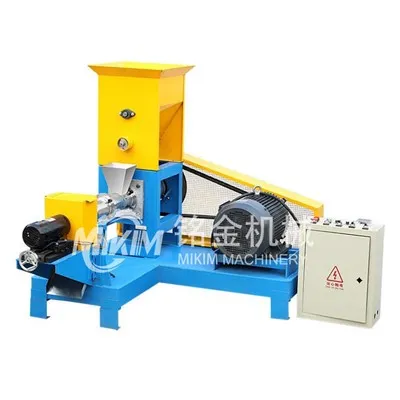
What are the two types of fish feed pellet extruders?
Leave a message
Fish feed pellet making machines are primarily categorized into single-screw extruders and twin-screw extruders based on screw configuration. These two types differ significantly in structure, working principles, and performance, catering to diverse production scales and feed quality requirements. Here's a concise breakdown:
1. Single-Screw Extruders
Structure & Working Principle: Features a single rotating screw within a cylindrical barrel. Raw materials are conveyed, compressed, and sheared by the screw's spiral flights as they move toward the die. Friction between the screw, barrel, and material generates heat (100-120°C) and pressure (3-6 MPa), enabling starch gelatinization and expansion.
Core Characteristics: Simple structure, small footprint, and low cost (ideal for small-scale production). Easy to operate and maintain, with straightforward parameter adjustments (screw speed, die temperature). However, mixing uniformity and shear force are limited-starch gelatinization degree (60-75%) is lower than twin-screw models.
Applications: Suitable for small feed workshops, individual farmers, or low-cost production of basic floating/sinking feed (e.g., tilapia, carp feed). Best for formulas with simple raw material combinations (fewer additives or liquid ingredients).
2. Twin-Screw Extruders
Structure & Working Principle: Equipped with two intermeshing screws (co-rotating or counter-rotating) in a single barrel. The screws rotate synchronously to convey, mix, and shear materials with higher intensity. The intermeshing design enhances kneading, ensuring uniform heat/moisture distribution. Operating temperatures reach 110-130°C and pressure 5-10 MPa, achieving gelatinization degrees ≥85%.
Core Characteristics: Superior mixing efficiency, strong shear force, and high production capacity (2-5x that of single-screw models). Can handle complex formulas (high liquid content, multiple additives like fish oil, probiotics) and produce high-quality feed with consistent floatability and water stability. However, it has a more complex structure, higher cost, and requires professional maintenance.
Applications: Preferred for large-scale feed factories and intensive aquaculture. Ideal for high-value feed (e.g., salmon, shrimp, ornamental fish feed) that demands strict nutritional uniformity and processing stability. Suitable for multi-species feed production with frequent formula switches.
Key Selection Criteria
Choose single-screw extruders for small-scale, low-budget operations with simple feed needs. Opt for twin-screw extruders for large-scale, high-quality production, especially when processing complex formulas or high-value aquatic feed. Both types rely on Fish Feed Extruder machines expansion to produce buoyant or dense pellets, with twin-screw models offering greater process control and product consistency.
Related equipment


about Us
MIKIM's fish feed pellet production lines and supporting machinery offer excellent value for money. Not only are they affordable, eliminating middlemen markups and allowing small and medium-sized enterprises (SMEs) and fish farmers to purchase complete sets of equipment at reasonable costs, but they also boast exceptional efficiency. The fully automated process, from raw material crushing and precise ingredient mixing to extrusion pelleting and maturation, is completed in one continuous flow. This results in high starch gelatinization rates and uniform pellet formation, significantly improving production efficiency and feed quality, truly achieving "low cost, high output." Choosing a MIKIM fish feed pellet production line means enjoying comprehensive pre-sales and after-sales service, including 24-hour online customer support, a one-year warranty on the entire machine, professional on-site installation, commissioning, and maintenance, and a stable supply of spare parts. Customers can buy with confidence and use with peace of mind, with both excellent value and service quality!
Customer visit

Certificate of Honor

FAQ
1. What is the price of the fish food making machine?
The price ranges from approximately $3,500-$55,000
2. Do you provide maintenance services for your customers?
Yes, we offer comprehensive after-sales maintenance services to our customers.
If you would like to learn more about MIKIM machinery, please contact us. We offer one-stop service and welcome your inquiries!!!