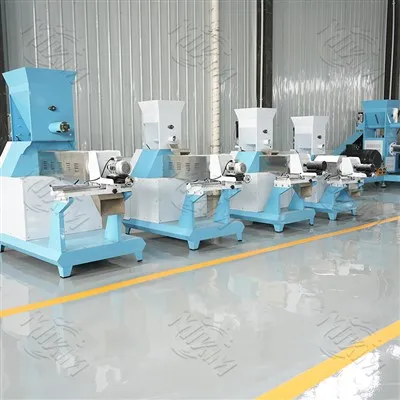
How a Floating Fish Extruder Machine Works: Preconditioning, Extrusion, Expansion and Drying
Leave a message
Working Principle Overview
A floating fish extruder machine produces buoyant, nutritionally balanced feed through a sequence of high-temperature, high-pressure extrusion steps. The mechanism relies on three physical effects working together: mechanical shear from the rotating screw, thermal processing from injected steam and friction heat, and controlled expansion as the material leaves the die. Feed texture and floatability are the result of how those three effects are balanced, not of any single setting.
Step One: Feeding and Preconditioning
Mixed powdery raw materials, meaning protein sources, starch and additives, are conveyed into a preconditioner by a screw feeder. Steam or water is injected to bring the material to 16-18% moisture and 85-95 °C. The aim of this step is to soften the particles and start starch gelatinisation before the material reaches the barrel, which improves both extrusion efficiency and digestibility. Residence time in the preconditioner is usually 2-5 minutes so that heat and moisture penetrate the particle evenly; a short, uneven conditioning step is the most common cause of variable bulk density.
Step Two: Extrusion in the Barrel
The conditioned material enters the barrel, where a rotating screw, either single or twin, conveys it forward against increasing pressure. Friction between the screw, the barrel and the material generates intense shear and additional heat, which breaks down the remaining starch granules and denatures the protein. Starch gelatinisation of 85-95% is the working target for floating grades, and the material leaves the die under the residual pressure built up along the screw.
| Stage | Typical value | Effect on the product |
|---|---|---|
| Inlet moisture | 16-18% | Controls gelatinisation and skin formation |
| Conditioning temperature | 85-95 °C | Starts gelatinisation, improves digestibility |
| Barrel pressure | 3-10 MPa | Sets expansion at the die |
| Barrel temperature | 110-130 °C | Completes cooking without scorching |
| Starch gelatinisation | 85-95% | Pellet strength and water stability |
Step Three: Die Forming and Cutting
At the die, the pressurised material passes through tapered holes and expands as the pressure drops, which is what creates the porous, low-density structure that makes the pellet float. Die hole diameter sets the nominal pellet size, the die thickness and taper set the degree of expansion, and the rotating cutter sets pellet length. Adjusting the cutter speed and the gap to the die face is the normal way to change length without changing the die; a dull blade tears the pellet end and produces fines that the dryer then has to handle.
Step Four: Drying, Fat Coating and Cooling
Expanded pellets leave the die at high moisture and must be dried, normally in a counter-flow dryer that removes 8-12 percentage points of water and brings the product to 8-10% final moisture. Fat is applied after drying, either by spraying or under vacuum, because oil added before drying would oxidise and would also reduce the expansion achieved at the die. Cooling follows, bringing the pellet core to within 5 °C of ambient before bagging, which prevents condensation inside the bag during storage and transport.
How Buoyancy Is Actually Achieved
Floatability is a bulk density property. The expanded, porous structure produced by the pressure drop at the die keeps bulk density low enough for the pellet to stay on the surface, while a dense pressed pellet sinks. Bulk density is therefore the practical control figure on the line: it is checked on a fixed volume sample each shift, and it moves with moisture, barrel temperature, screw speed, die taper and cutter setting. When a line drifts from floating to slow-sinking, the cause is almost always one of those five variables rather than worn raw material. Finished feed is released against the usual analytical suite, with moisture by ISO 6496, crude protein by ISO 5983-2 using the nitrogen factor 6.25, crude fat by ISO 6492, crude ash by ISO 5984 at 550 °C and crude fibre by ISO 6865, sampled under GB/T 14699.1 and controlled for hygiene under GB 13078-2017. Durability is measured with the tumbling test in ASABE S269.4, and drive motors should be rated for continuous duty to IEC 60034-1.
Frequently Asked Questions
Q: What makes a pellet float rather than sink?
A: The expansion that occurs when pressurised material leaves the die creates a porous, low-density structure; bulk density is the property that decides whether the pellet floats.
Q: What moisture and temperature should the material have before extrusion?
A: 16-18% moisture and 85-95 °C after preconditioning, with a residence time of 2-5 minutes so that heat and water penetrate the particle evenly.
Q: What barrel pressure and temperature are normal?
A: 3-10 MPa and 110-130 °C, with starch gelatinisation reaching 85-95% for floating grades.
Q: Why is fat added after drying instead of before?
A: Oil added before drying oxidises during the drying step and interferes with the expansion at the die; post-dry coating protects the oil and preserves buoyancy.
Q: How is pellet length adjusted?
A: By cutter speed and the gap between the blade and the die face, with the blade kept sharp so that the pellet ends are cut rather than torn.
Q: How is the finished floating feed verified?
A: By bulk density checks each shift and by moisture determination under ISO 6496, with durability measured by the ASABE S269.4 tumbling test and hygiene controlled under GB 13078-2017.