What Are the Main Functions of a pet food processing machine?
Leave a message
content
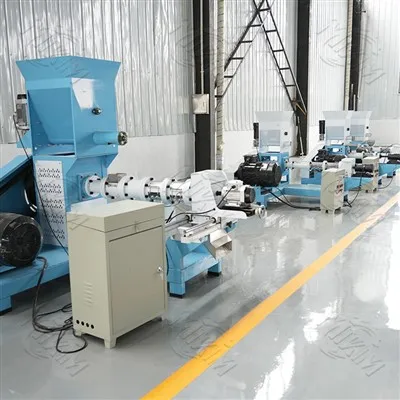
The working principle and implementation process of the core extrusion function. The extrusion function of the dog food production machine relies on the core logic of "mechanical extrusion - frictional heat generation - instantaneous pressure release": After the powdered raw materials (corn, soybean meal, fish meal, etc.) enter the extrusion chamber, they move forward continuously under the spiral push of the screw. The gap between the screw edge and the inner wall of the extrusion chamber gradually narrows, forming a strong extrusion and shearing action. At the same time, the friction between the raw materials and the screw and the extrusion chamber generates a large amount of heat, causing the temperature inside the extrusion chamber to rise to 120-160℃ and the pressure to reach 3-6MPa. When the high-temperature and high-pressure raw material mixture is instantly discharged into the normal pressure environment through the small hole of the die head, the moisture inside the raw materials rapidly vaporizes and expands, causing the feed particles to form a porous and loose structure, completing the extrusion process. Different types of dog food processing machines achieve this function in slightly different ways: single-screw fish feed processing machines rely entirely on frictional heating, have a simple structure, and are suitable for small to medium-scale production; twin-screw pet pellet making machines enhance the extrusion and shearing effect through the meshing of two screws, and can be combined with a steam heating system for precise temperature control, resulting in more stable extrusion effects, making them suitable for large-scale, high-quality feed production.
The extrusion function is the core value of fish feed. This core function directly determines the basic quality of fish feed, bringing three core values: First, it changes the physical form of the feed, transforming loose powdery raw materials into granules, preventing feed from disintegrating in water and reducing waste. Granular feed is also easier for fish to eat, improving feeding efficiency. Second, it improves feed digestibility and absorption. The high-temperature, high-pressure environment fully gelatinizes the starch in the raw materials (gelatinization degree increases from 30% to over 80%) and denatures the proteins, making them easier for fish to digest and absorb. For example, the digestibility of unexpanded corn starch is only about 60%, but after extrusion, it can be increased to over 95%. Third, it reduces feed density, allowing for the production of sinking, floating, or semi-floating pellets according to aquaculture needs, adapting to the feeding habits of different fish species (e.g., bass prefer floating feed, grass carp prefer sinking feed). For example, a small fish farm used a single-screw extruder to produce sinking feed for carp. The extruded feed pellets had a water resistance of over 8 hours, the feed waste rate decreased from 20% to 5%, and the carp growth rate increased by 15%.
Control and optimization of the extrusion function. The puffing effect of a fish feed making machine can be precisely optimized through parameter adjustment to suit different feed requirements: Adjusting the screw speed (200-400 r/min) results in higher frictional heat and higher puffing degree, suitable for producing floating feed; lower speed results in lower puffing degree, suitable for producing sinking feed; adjusting the die orifice diameter (1-5 mm) results in higher extrusion pressure and more significant puffing effect; controlling the raw material moisture content (10%-14%) results in lower extrusion pressure and insufficient puffing, while lower moisture content makes the pellets too hard, affecting palatability. For example, when producing grass carp feed, adjusting the screw speed to 320 r/min, selecting a die orifice diameter of 4 mm, and controlling the raw material moisture content to 12% can produce sinking pellets with moderate puffing and high compactness; when producing sea bass floating feed, increasing the speed to 380 r/min and selecting a die orifice diameter of 2.5 mm can achieve high puffing degree and a buoyancy rate of over 98%.
Related equipment


about Us
MIKIM's fish feed pellet production lines and supporting machinery offer excellent value for money. Not only are they affordable, eliminating middlemen markups and allowing small and medium-sized enterprises (SMEs) and fish farmers to purchase complete sets of equipment at reasonable costs, but they also boast exceptional efficiency. The fully automated process, from raw material crushing and precise ingredient mixing to extrusion pelleting and maturation, is completed in one continuous flow. This results in high starch gelatinization rates and uniform pellet formation, significantly improving production efficiency and feed quality, truly achieving "low cost, high output." Choosing a MIKIM fish feed pellet production line means enjoying comprehensive pre-sales and after-sales service, including 24-hour online customer support, a one-year warranty on the entire machine, professional on-site installation, commissioning, and maintenance, and a stable supply of spare parts. Customers can buy with confidence and use with peace of mind, with both excellent value and service quality!!!
Customer visit

Certificate of Honor

FAQ
1. What is the price of the fish feed extruder machine?
The price ranges from approximately $1,500-$55,000
2. Do you provide maintenance services for your customers?
Yes, we offer comprehensive after-sales maintenance services to our customers.
If you would like to learn more about MIKIM machinery, please contact us. We offer one-stop service and welcome your inquiries!!!