


What causes uneven particle size in the Agricultural Poultry Feed Production Line?
Leave a message
Many feed mills have found that even with equipment in good working order, the produced pellets still exhibit uneven size. For example, after changing batches of corn, the breakage rate increased from 5% to 15%; adding a high proportion of bran significantly increased the proportion of coarse pellets. This is closely related to the particle size, moisture content, and mixing uniformity of the raw materials. If the characteristics of the raw materials do not meet production requirements, even the most sophisticated equipment will struggle to produce uniform pellets.
Problem Causes and Solutions
1.Excessive variation in particle size of crushed raw materials.
Cause: The crusher screen is damaged (e.g., holes larger than 4mm) or the crushing hammers are worn (with blunt cutting edges). This results in uneven particle size distribution after crushing-coarse particles (diameters exceeding 3mm) account for over 20%, while fine powder (diameters less than 0.5mm) accounts for over 15%. Coarse particles experience high resistance during extrusion in the ring die, easily forming "hard core particles" or clogging the die holes. Fine powder, however, is less viscous and easily crushed, resulting in a mixed particle size distribution.
Solution: Inspect the crusher screen; replace it immediately if damaged (select the screen size according to particle size, such as a 2.5-3mm screen for 4mm particles); replace worn crushing hammers (replace if the hammer blade thickness exceeds 2mm), ensuring the gap between the hammers and the screen is ≤1mm; install a grading screen after the crusher to return coarse particles (over 3mm) to the crusher for secondary crushing, ensuring uniform particle size after raw material crushing (coarse particles ≤5%, fine powder ≤10%).
2.Excessive fluctuations in raw material moisture content
Reasons: Different batches of raw materials have different moisture content (e.g., one batch of corn has 12% moisture content, while another has 18%); raw materials absorb moisture during storage (e.g., during the rainy season in the south, the moisture content of bran rises from 13% to 16%), resulting in some raw materials having excessively high moisture content (over 17%) and some having excessively low moisture content (below 12%); high-moisture raw materials tend to adhere to the ring die holes, forming coarse particles or clogging the die holes, while low-moisture raw materials, due to insufficient viscosity, are easily broken into fragments after extrusion, with significant differences in particle size.
Solution: Before raw materials are put into storage, the moisture content of each batch should be tested with a rapid moisture meter. Raw materials with a moisture content exceeding 16% should be dried to 14-16% using a dryer (temperature 60-70℃). Place desiccant (such as silica gel desiccant, 50kg per 100㎡ of raw material warehouse) in the raw material warehouse and install temperature and humidity sensors to monitor the humidity in the warehouse in real time (controlling it below 60%). Before mixing, raw materials with different moisture contents should be mixed in proportion (e.g., 12% moisture corn and 18% moisture corn mixed in a 1:1 ratio) to ensure that the moisture content of the mixed raw materials is stabilized at 14-15%.
3.Insufficient Raw Material Mixing Uniformity
Causes: The mixer speed is too low (less than 25 rpm) or the mixing time is too short (less than 3 minutes), resulting in uneven distribution of starch, protein, fiber, and other components in the raw materials. Areas where high-fiber raw materials (such as bran) aggregate due to insufficient viscosity easily produce crumbs, while areas where high-protein raw materials (such as fish meal) aggregate due to excessive viscosity easily form coarse pellets. Dead spots in the mixer (such as residual raw materials in corners) prevent adequate mixing of some raw materials, resulting in large variations in pellet size.
Solution: Adjust the mixer speed to 30-35 rpm and extend the mixing time to 4-5 minutes (adjust based on the total amount of raw materials, 5 minutes per ton of raw materials). Install agitators (such as twin-screw impellers) in the mixer to reduce dead spots and ensure uniform mixing (measure the crude protein content of the mixed raw materials to a coefficient of variation of ≤5%). After mixing, take multiple samples (e.g., from 5 different locations) to test for moisture and composition, ensuring that the variation between samples is ≤1% before feeding them to the pellet mill.


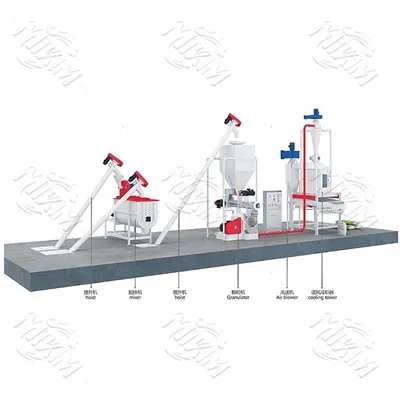

Why Choose Us
MIKIM boasts extensive experience in poultry feed pellet production lines, significantly reducing the incidence of poultry diseases. Its equipment is not only widely used across various industries domestically but also exported to Southeast Asia, Europe, Africa, and South America, earning a high reputation internationally. This global presence not only demonstrates the adaptability and competitiveness of its products, but also demonstrates the company's experience in adapting to diverse market standards and logistics conditions, enabling it to provide a stable supply chain for its overseas customers. Whether serving large domestic farms or cross-border feed companies, MIKIM can leverage its global service network to ensure a consistent, high-quality experience.
For more information on process flow design, equipment layout, factory construction plans, individual equipment pricing, or turnkey project proposals, please feel free to contact us!!!

FAQ
1. What is the price of the agricultural feed production line?
The price ranges from approximately $8,000-$34,000
2. Do you provide maintenance services for your customers?
Yes, we offer comprehensive after-sales maintenance services to our customers.


