What fish feed pellet extruder should I choose?
Leave a message
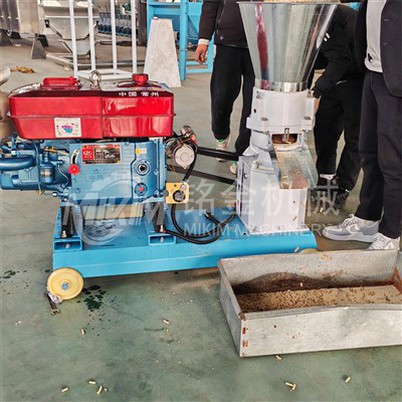
Fish and shrimp live in aquatic environments, and their feed must simultaneously meet three major requirements: "water-resistant and non-soluble, nutrient retention, and pellet size appropriateness." This dictates that the selection of a floating feed extruder machine must focus on core dimensions such as the extrusion system, die structure, and temperature control accuracy. Specifically, this can be approached from the following three aspects:
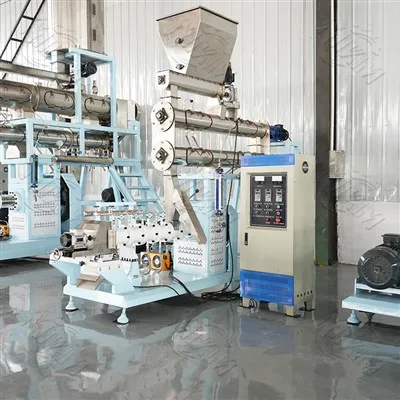
First, prioritize twin-screw extruders over single-screw machines. The twin-screw structure generates a strong extrusion effect through counter-rotation, which can thoroughly mix fishmeal, shrimp meal, and starch-based raw materials, achieving a starch gelatinization degree of over 85% and forming a dense network structure. This is crucial for improving the water resistance of the pellets. Single-screw pellet machines, due to their weak mixing and extrusion capabilities, result in insufficient starch gelatinization, and the produced pellets are prone to disintegration in water. For crustaceans such as whiteleg shrimp and river crabs, it is recommended to use a twin-screw extruder with a screw diameter of 120-150mm and a stable extrusion pressure of 5-8MPa to ensure compact pellets. For fish such as grass carp and bass, the screw diameter can be reduced to 100-120mm, with the pressure controlled at 3-5MPa, balancing foaming resistance and palatability.
Secondly, pay attention to the precise matching of the die head and the cutter. The size of the fish and shrimp feed pellets must match the mouth diameter of the fish and shrimp. The aperture diameter for juvenile shrimp feed should be 1.0-1.5mm, while that for adult fish feed should be 2.5-3.0mm. This requires the floating fish feed extruder die head to support quick replacement, and the die holes to adopt a circular array design with polished inner walls (roughness Ra≤0.8μm) to reduce pellet discharge resistance. The cutter should be driven by a servo motor, linked to the spindle speed (ratio 1:5), ensuring that the pellet length is 2-3 times the aperture diameter, avoiding excessively long or short pellets that may affect feeding. Some high-end aquatic pellet mills are equipped with adjustable die temperature, using electric heating to maintain the die temperature at 100-120℃, further improving pellet forming stability. This type of equipment is particularly suitable for producing high-moisture fish and shrimp feed.
Finally, a temperature control and cooling system is indispensable. Fish meal and shrimp meal in fish and shrimp feed contain a large amount of heat-sensitive nutrients (such as amino acids and vitamins). The pellet mill needs precise temperature control capabilities to keep the extrusion chamber temperature between 120-140℃ to prevent high temperatures from destroying nutrients. A counter-flow cooler is recommended for the cooling system, cooling the high-temperature extruded pellets (80-90℃) to room temperature ±2℃ within 3-5 minutes, while simultaneously reducing the moisture content to 12%-13% to prevent moisture absorption and mold growth. Furthermore, the screw feed extruder must be equipped with dustproof and corrosion-resistant designs. Fish and shrimp feed raw materials easily absorb moisture and produce salt; the machine body is made of 304 stainless steel to prevent rust and extend its service life.
Related equipment


about Us
Customer visit

Certificate of Honor

FAQ
1. What is the price of the floating fish feed machine?
The price ranges from approximately $4,500-$35,000
2. Do you provide maintenance services for your customers?
Yes, we offer comprehensive after-sales maintenance services to our customers.