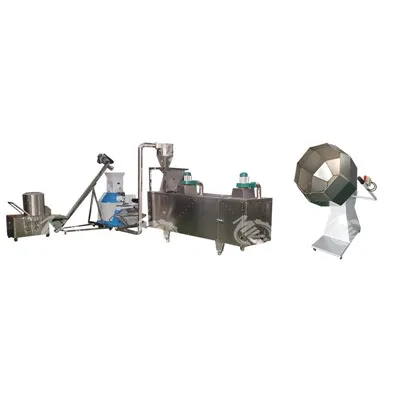
What is the difference between sinking fish feed pellets and floating fish feed pellets?
Leave a message
1. Core Property & Production Principle
Floating Feed: Produced via high-temperature extrusion, forming a porous internal structure (density ≤1 g/cm³) that enables buoyancy. It remains afloat for 12-24 hours, with high starch gelatinization (≥85%) ensuring water stability.
Sinking Feed: Made by direct compression (no extrusion expansion) with a dense texture (density >1 g/cm³). It sinks quickly to the bottom, relying on binders for basic water resistance (usually <8 hours).
2. Target Fish Species
Floating Feed: Ideal for surface/mid-water feeders like tilapia, salmon, koi, and sea bass. It aligns with their natural foraging habits, allowing easy intake monitoring.
Sinking Feed: Designed for bottom-feeders such as catfish, crucian carp, eels, and shrimp. It reaches the foraging zone of these species without waste from floating unused feed.
3. Nutritional Utilization & Water Quality
Floating Feed: Extrusion denatures anti-nutritional factors and improves nutrient digestibility (feed conversion rate, FCR, 1.2-1.8). Low waste reduces ammonia nitrogen pollution.
Sinking Feed: No high-temperature processing leads to lower starch gelatinization and digestibility (FCR 1.8-2.5). Unconsumed feed decomposes at the bottom, easily deteriorating water quality.
4. Practical Application & Cost
Floating Feed: Facilitates real-time intake observation, avoids overfeeding, and suits intensive systems (net cages, RAS). Higher production costs due to extrusion equipment.
Sinking Feed: Hard to monitor intake, risk of overfeeding. Simple production (compression molding) lowers costs, ideal for small-scale pond farming of bottom-feeders.
Key Selection Criterion
Choose based on fish feeding habits: floating feed for surface/mid-water species (efficiency + water protection); sinking feed for bottom-dwellers (targeted feeding). For polyculture, a mix can balance needs while prioritizing water quality.
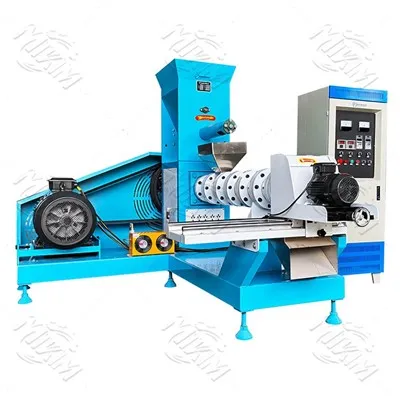
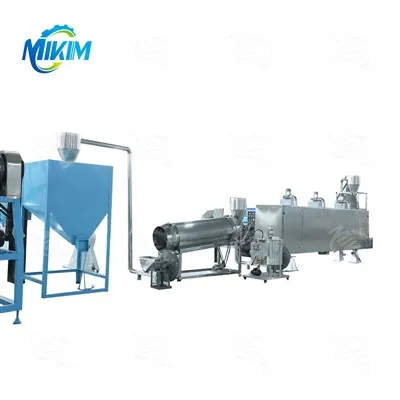
Related equipment


about Us
MIKIM's fish feed pellet production lines and supporting machinery offer excellent value for money. Not only are they affordable, eliminating middlemen markups and allowing small and medium-sized enterprises (SMEs) and fish farmers to purchase complete sets of equipment at reasonable costs, but they also boast exceptional efficiency. The fully automated process, from raw material crushing and precise ingredient mixing to extrusion pelleting and maturation, is completed in one continuous flow. This results in high starch gelatinization rates and uniform pellet formation, significantly improving production efficiency and feed quality, truly achieving "low cost, high output." Choosing a MIKIM fish feed pellet production line means enjoying comprehensive pre-sales and after-sales service, including 24-hour online customer support, a one-year warranty on the entire machine, professional on-site installation, commissioning, and maintenance, and a stable supply of spare parts. Customers can buy with confidence and use with peace of mind, with both excellent value and service quality!
Customer visit

Certificate of Honor

FAQ
1. What is the price of the fish feed making machine?
The price ranges from approximately $3,500-$55,000
2. Do you provide maintenance services for your customers?
Yes, we offer comprehensive after-sales maintenance services to our customers.
If you would like to learn more about MIKIM machinery, please contact us. We offer one-stop service and welcome your inquiries!!!