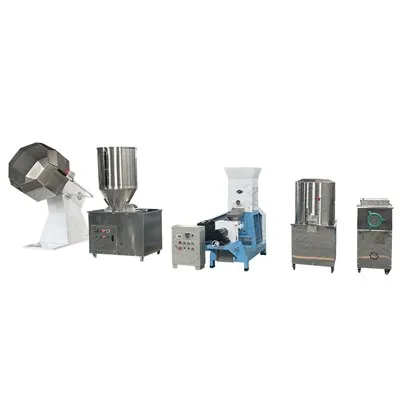
What is the order of adding materials to the feed pellet machine?
Leave a message
The correct order of adding materials to the feed pellet machine should be to add the component with a large proportion first or add most of it into the machine, and then add a small amount and trace components on it; among various materials, the component with large particle size is generally added to the mixer first, and the component with small particle size is added later; when the relative density difference between the materials is large, the material with small relative density is generally added first, and the material with large relative density is added later.
For fixed container mixers, the mixer should be started before adding materials to prevent full-load startup, and the material should be unloaded before stopping; while the rotating container mixer should be added before starting, stopped first, and then unloaded; for V-type mixers, the materials should be fed from two feed ports when adding materials.

| Model | Capacity | Power | Dimension | Weight |
| 125 | 80-100kg/h | 3kw | 110*35*70 cm | 95 kg |
| 150 | 120-150kg/h | 4kw | 115*35*80cm | 100 kg |
| 210 | 200-300kg/h | 7.5kw | 115*45*95cm | 300 kg |
| 260 | 500-600kg/h | 15kw | 138*46*100cm | 350 kg |
| 300 | 700-800kg/h | 22kw | 130*53*105cm | 600 kg |
| 360 | 900-1000kg/h | 22kw | 160*67*150cm | 800 kg |
| 400 | 1200-1500kg/h | 30kw | 160*68*145cm | 1200 kg |
Generally, the horizontal ribbon spiral mixer mixes for 2 to 6 minutes per batch, and the vertical mixer needs to mix for 15 to 20 minutes. Note that the mixing time should not be too short or too long.
Secondly, the moisture content of the particles must also meet the standard, control the appropriate amount of steam, and the temperature of the pellets during bagging should not be higher than the ambient temperature by 7 to 8°C.
High temperature has some positive effects on crude fiber and starch in feed, but has adverse effects on heat-insensitive nutrients such as vitamins, antibiotics, and synthetic amino acids. Therefore, the proportion of those heat-insensitive nutrients should be appropriately increased in the formula of pellet feed to make up for the loss.