

How To Judge If The Screw Of An Automatic Fish Food Making Equipment Is Worn?
Leave a message
A sudden drop in output is the most direct signal of screw wear in a fish pellet making machine. The normal capacity of a small fish feed extruder is 5-10 kg/h. If, without changes to the raw material formula, moisture content, and processing parameters, the output suddenly drops by more than 20% and remains stable, it is highly likely due to screw wear. This is because after the screw wears, the screw height decreases, reducing its ability to push raw materials and decreasing the amount of material passing through the die per unit time. For example, a small-scale fish farmer using an 8 kg/h capacity Small Fish Feed Extruder Machine to process grass carp feed, who previously produced 16 kg of feed in 2 hours per day, has recently only been able to produce about 12 kg in the same amount of time. After ruling out issues with raw materials and parameters, screw wear can be preliminarily identified.
Abnormally high energy consumption is an important auxiliary indicator of screw wear. The power of a small fish feed maker machine is typically 2.2-7.5 kW, and normally processing 1 jin (500g) of feed consumes approximately 0.5 kWh. If the current during equipment operation is found to be significantly higher than normal, exceeding the normal value by more than 30%, and power consumption is significantly increased (e.g., processing 1 jin of feed requires more than 0.7 kWh), while output does not increase, this is a typical sign of screw wear. Because after the screw wears, the gap between it and the extrusion chamber increases, resulting in increased material leakage. The motor needs to consume more energy to maintain normal extrusion pressure and speed to ensure the puffing processing requirements are met. Fish farmers can quickly determine if energy consumption is abnormal by observing the electricity meter data and the equipment's current meter readings, comparing them with initial usage data.
Uncontrolled processing parameters can also reflect screw wear. During processing, the temperature is usually set at 120-140℃ and the pressure at 3-5 MPa. If, during production, it is necessary to continuously increase the temperature and pressure to achieve the original puffing effect, and the parameters fluctuate frequently (e.g., the pressure fluctuates repeatedly between 2-6 MPa), this is a signal of screw wear. This is because screw wear causes unstable residence time of the material in the extrusion chamber, resulting in some material not being fully puffed. This needs to be compensated for by increasing the temperature and pressure, but the increased gap makes it difficult to stabilize the pressure.
Why choose us?
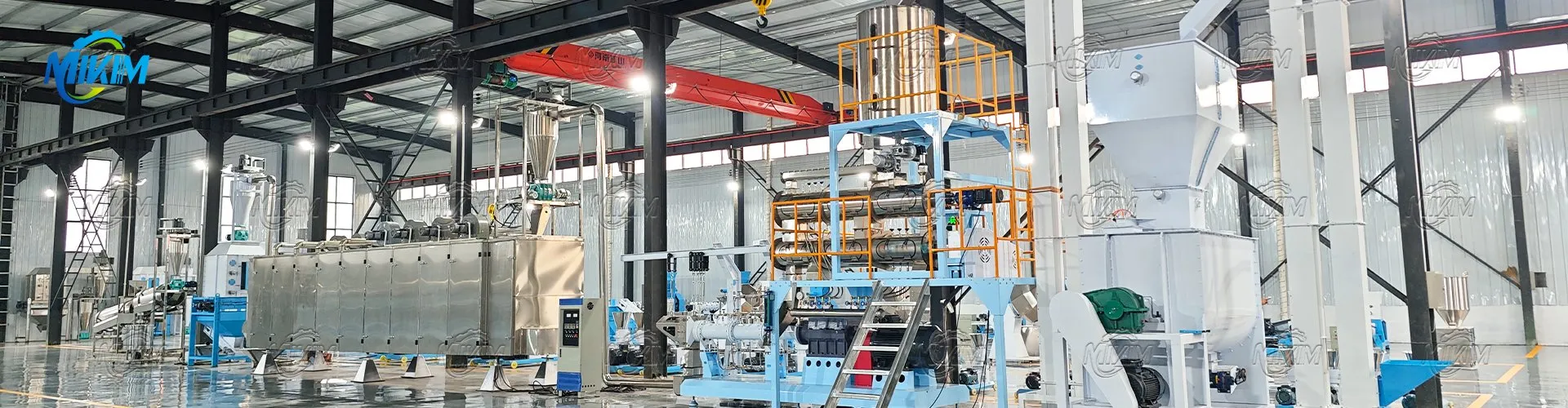
The MIKIM's floating fish feed extruder machine is constructed entirely of food-grade 304 stainless steel, fully complying with food processing hygiene standards. It is corrosion-resistant, easy to clean, and eliminates potential contamination at the source. The core screw is made of high-quality alloy steel through special heat treatment, offering outstanding wear resistance and corrosion resistance. Combined with its integrated structural design, this significantly extends its service life. The entire machine has passed CE and ISO international authoritative certifications, aligning with global quality standards and ensuring safer and more reliable processing.
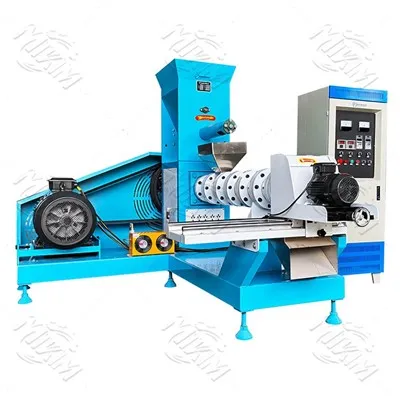
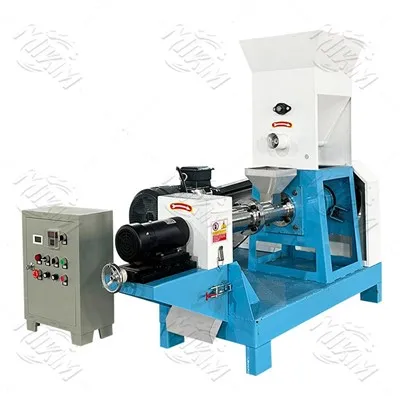
Our equipment


Our Services
We offer:
One-Year Whole Machine Warranty Service
On-site Installation, Commissioning, and Technical Guidance
24/7 Online Technical Support
Qualifications and Honors

Customer visit

FAQ
1. What is the price of the small fish feed pellet making machine?
The price ranges from approximately $1,500-$50,000
2. How do you deliver to customers?
MIKIM Machinery's machinery delivery follows a complete process of "customized preparation - safe and fast delivery - precise handover - after-sales extension", with 3-day fast delivery, multi-layer protective packaging, global logistics tracking and 1-year warranty + on-site technical service to ensure that the equipment is delivered efficiently and in good condition and put into use smoothly.


