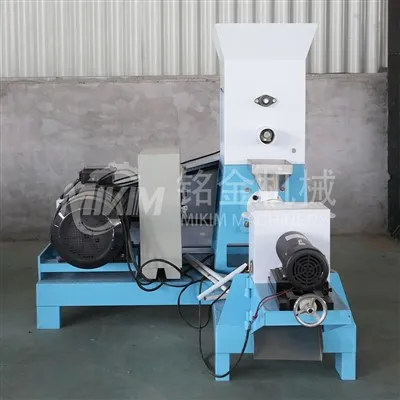
Ring Die Feed Pellet Mill for Livestock Farms: SZLH Series Specs
Leave a message

What a Ring Die Feed Pellet Mill Does on a Livestock Farm
A ring die feed pellet mill is special processing equipment for high-fibre feed raw materials such as bran, straw powder, and forage powder. Rather than relying on motor power alone, it reaches efficient pelleting by optimising the ring die compression ratio and the roller pressure, which is what makes fibrous material form a durable pellet. The product family covers agricultural-waste pelleting across straw, forage, and husk categories, so a livestock farm can process its main fibrous raw materials on one machine instead of buying separate equipment for each category.
How Conditioning and Die Compression Ratio Affect Pellet Quality
Feed material enters the conditioning chamber, where steam softens the fibre and partially gelatinises the starch, and is then distributed evenly across the ring die. The rollers press the material through the die holes, and the compression ratio of the die determines pellet density and hardness. For fibrous materials the ratio is critical: too low a ratio gives loose, dusty pellets that break up in handling, while too high a ratio overloads the machine and wears the die quickly. Steam quality matters as much as the die itself, because insufficient conditioning leaves the fibre stiff and raises the load on the main drive.
SZLH Series Specifications
The table below lists the main parameters of five typical SZLH series models.
| Model | Capacity (t/h) | Main power (kW) | Conditioner power (kW) | Feeder power (kW) | Pellet size (mm) |
|---|---|---|---|---|---|
| SZLH250 | 1-2 | 22 | 1.5 | 0.55 | 1.0-12.0 |
| SZLH320 | 3-5 | 37 | 2.2 | 1.5 | 1.0-12.0 |
| SZLH350 | 5-8 | 55 | 3.0 | 1.5 | 1.0-12.0 |
| SZLH420 | 10-12 | 110 | 7.5 | 2.2 | 1.0-12.0 |
| SZLH508 | 12-18 | 132 | 11 | 2.2 | 1.0-12.0 |
Supplementary Performance Data
The following operating figures apply to the standard range.
Common pellet diameters: 2, 3, 4, 4.5, 5, 6, 8, and 10 mm
Pellet shaping rate: at least 95%
Pellet stability in water: 20 minutes or more
Noise: within 86 dB(A) for standard models and within 90 dB(A) for larger models
Roller working temperature: no more than 85 degrees Celsius
Recommended steam working pressure: 0.1-0.4 MPa at a steam temperature of 130-150 degrees Celsius
Water stability is the figure that matters most where pellets are fed in damp conditions, while the shaping rate indicates how much fines and dust have to be returned to the process.
Key Design Advantages and Model Selection
The mill uses a gear direct-connection drive for high transmission efficiency. The full stainless steel feeder has a variable-pitch, anti-bridging structure with electromagnetic converter control, which keeps feeding even and clog-free. The stainless steel conditioner sprays steam axially, extending conditioning time and cooking effect so starch gelatinisation improves before pelleting. A carburising-quenched main gear and pinion shaft deliver high accuracy, smooth running, low noise, and long service life, and gearbox and drive-hole accuracy are guaranteed by specialised casting suppliers and CNC machining.
Matching the model to the farm is straightforward. The SZLH250 suits small farms, the SZLH320 and SZLH350 suit medium farms, and the SZLH420 and SZLH508 serve large feed mills. Check the workshop electrical capacity against the main power figure, and confirm that the available steam supply can hold 0.1-0.4 MPa, because conditioning quality depends on it.
Frequently Asked Questions
Q: What raw materials is a ring die feed pellet mill designed for?
It is built for high-fibre materials such as bran, straw powder, and forage powder, and it covers straw, forage, and husk pelleting within one machine.
Q: Which SZLH model fits a medium-sized livestock farm?
The SZLH320 at 3-5 t/h with a 37 kW main motor, or the SZLH350 at 5-8 t/h with a 55 kW main motor, are the usual choices for medium farms.
Q: What steam conditions does the conditioner need?
A recommended working pressure of 0.1-0.4 MPa at a steam temperature of 130-150 degrees Celsius gives full conditioning and starch gelatinisation.
Q: What pellet diameters and shaping rate can be achieved?
Common diameters are 2, 3, 4, 4.5, 5, 6, 8, and 10 mm, with a pellet shaping rate of at least 95% and a water stability of 20 minutes or more.
Q: Why does the die compression ratio have to change for fibrous feed?
Too low a ratio produces loose, dusty pellets, while too high a ratio overloads the mill and wears the die quickly, so the ratio has to match the fibre content of the formula.
Q: How is feeding kept even with bulky straw and forage?
The stainless steel feeder uses a variable-pitch, anti-bridging structure with electromagnetic converter control, which prevents bridging and keeps material flowing evenly to the die.