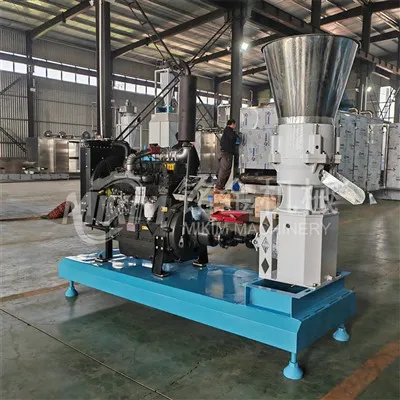
Ring Die Feed Pellet Mill for Livestock, Poultry and Aquafeed
Leave a message
What a Ring Die Feed Pellet Mill Does
A ring die feed pellet mill compresses conditioned mash into dense, uniform pellets between a rotating ring die and a set of pressing rollers. It is the core machine in feed lines for shrimp, duck, chicken, cattle, fish, poultry and pigs. Dry and wet processing are both supported, which lets the same machine family serve aquafeed and pet food lines with fully automatic, food-grade operation. By changing the die, producers can form pellets of different shapes and sizes to suit local market demand, working from meat powder, grains, beans and vegetables.
Model Specifications
The SZLH series covers outputs from small farm scale to large feed mill scale. The table below summarises the main published parameters.
| Model | Capacity | Main power | Conditioner power | Feeder power | Pellet size |
|---|---|---|---|---|---|
| SZLH250 | 1-2 t/h | 22 kW | 1.5 kW | 0.55 kW | 1.0-12.0 mm |
| SZLH320 | 3-5 t/h | 37 kW | 2.2 kW | 1.5 kW | 1.0-12.0 mm |
| SZLH350 | 5-8 t/h | 55 kW | 3.0 kW | 1.5 kW | 1.0-12.0 mm |
| SZLH420 | 10-12 t/h | 110 kW | 7.5 kW | 2.2 kW | 1.0-12.0 mm |
| SZLH508 | 12-18 t/h | 132 kW | 11 kW | 2.2 kW | 1.0-12.0 mm |
Common operating data for the series include a pellet shaping rate of at least 95%, pellet stability in water of 20 minutes or more, noise levels of 86-90 dB(A), roller working temperature below 85°C, steam working pressure of 0.1-0.4 MPa and steam temperature of 130-150°C.
Controlling Pellet Quality Through the Die
Pellet quality is governed mainly by the ring die. Changing to a die with a different aperture and compression ratio allows diameters from 1 to 20 mm and hardness from 30 N to 100 N. For example, 2 mm micro pellets suit poultry, while 10 mm large pellets suit beef cattle, covering the feeding needs of animals at different growth stages. Matching the compression ratio to the formula is essential, because high-starch and high-fibre formulas behave differently inside the die and require different opening geometry.
Feed Safety and Reduced Losses
High-temperature steam in the conditioning stage, combined with the frictional heat of extrusion, kills over 80% of harmful microorganisms such as mould and E. coli in the raw material, and also destroys anti-nutritional factors in soybean meal, lowering the risk of animal disease. Pressed pellets have a compact structure, with a solubility and scattering rate in water or air below 5%, against 15-20% for powdered feed. That difference reduces waste during transport, storage and feeding.
Scaling from Small Farms to Large Mills
A single unit can produce 0.5-20 tons per hour, which meets the needs of small farms at 0.5-2 tons per hour and large feed mills at 10-20 tons per hour, and it supports continuous operation. When selecting a model, match the rated capacity to the feeding schedule, confirm that the available power supply covers the motor ratings, and plan the steam supply carefully, because conditioning performance depends on adequate steam pressure and temperature.
Frequently Asked Questions
Q: What pellet sizes can a ring die pellet mill produce?
With interchangeable dies, standard configurations cover 1.0-12.0 mm, and the full die range reaches 1-20 mm for poultry, livestock and aquafeed.
Q: What determines pellet hardness?
Hardness is set by the die aperture, the compression ratio and the conditioning parameters, and can be adjusted between 30 N and 100 N by choosing the appropriate die.
Q: Why is water stability important for aquafeed?
Aquafeed pellets must stay intact in water so that fish and shrimp can consume them without excessive nutrient leaching, and a stability of 20 minutes or more is typical.
Q: How does steam conditioning improve feed safety?
Steam at 130-150°C combined with frictional heat kills over 80% of harmful microorganisms such as mould and E. coli and destroys anti-nutritional factors in soybean meal.
Q: Which model suits a small farm?
The SZLH250 at 1-2 t/h suits small farms, while the SZLH350 to SZLH508 models serve medium and large feed mills with outputs up to 18 t/h.
Q: Is the machine suitable for both dry and wet processing?
Yes. The machine family supports dry and wet feed processing, so one line can handle aquafeed, poultry feed and pet food with the appropriate dies and settings.