Prospects for Feed Pellet Production Lines: Modular Design and Automation
Leave a message
Why Feed Pellet Lines Keep Expanding
Global demand for consistent, efficient feed continues to grow, and the market for complete feed production equipment grows with it. As livestock operations become larger and more intensive, feed production moves toward higher efficiency and lower environmental impact. That pressure changes what buyers ask of a line: it must meet basic output targets and also perform better on energy use, dust control and waste. For farmers and investors, reading those trends correctly is what makes capacity planning and technology selection reliable rather than speculative.
Modular Design and Flexible Configuration
Modular design is the most practical answer to demand that shifts faster than a building can be rebuilt. A modular line combines standard modules, so configuration can be adjusted to match market demand without redesigning the plant. Three benefits follow directly:
Faster reconfiguration when the product mix or target species changes.
Lower production cost, because modules are built and tested as standard units.
Simpler maintenance and a longer line life, since each module can be serviced or replaced independently.
Modularity also makes later expansion realistic. Capacity can be raised by adding a module instead of replacing the whole line, which spreads capital cost across several investment rounds.
Environmental Protection and Energy Saving
Feed producers are expected to reduce emissions of waste gas, wastewater and solid waste during processing. Developing energy-saving and environmentally sound equipment is one of the clearest directions for future development. Practical measures include dust collection at receiving, grinding and packing points, efficient cooling that reduces both energy use and product loss, and process design that raises the utilization of each tonne of raw material. Companies that meet environmental requirements early gain a market advantage rather than only an operating cost.
Intelligent Farming and Automation
Intelligent livestock farming creates new demand for complete feed production equipment. Through data analysis and automated control, smart farming allows precise management of feeding, improves feed utilization and reduces feed cost. On the production side, automation stabilizes output quality: computer-controlled batching keeps formulas accurate, continuous operation reduces labour, and lines that produce, cool and pack in one flow cut handling losses. The combination of stable formulation and stable processing is what turns an automation investment into measurable feed conversion gains.
Reference Line Configuration
The reference configuration below illustrates a large feed factory line. A line of this scale serves a large commercial feed factory and can produce chicken, sheep, cow and shrimp feed.
| Item | Reference value |
|---|---|
| Application | Large commercial feed factory, multiple species |
| Formulas covered | Chicken, sheep, cow and shrimp feed |
| Manpower | About 4-5 workers |
| Shipping | 6 x 40 ft containers |
| Batching | Fully automatic intelligent batching with computer control |
| Pellet size | Selectable from 1 to 12 mm |
| Operation | Continuous, direct packaging at the end of the line |
| Floor area | Depends on land size and layout |
Core Equipment of a Complete Line
Hammer mill: processes crop straw, grain, soybean meal and similar raw materials into powdered feed.
Screw conveyors: sealed structure that carries grain and powder cleanly without residue.
Stainless steel mixer: fast, uniform blending of powdered materials.
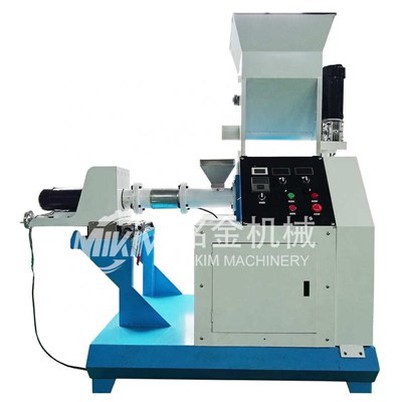
Feed pellet machine: simple structure, wide adaptability, small footprint and low noise, producing pellets of various specifications.
Countercurrent cooler: cools pellets fully and evenly so they keep their hardness in storage.
Packing machine: combines automatic weighing, conveying and sewing for quantitative packaging of granular and mixed material.
Because the line balances batching accuracy, cooling and packaging in one continuous flow, the limiting factor on realized capacity is usually the drying and cooling stage rather than the pellet mill itself. Buyers comparing quotations for the same nominal output should therefore check cooler capacity and batching accuracy as carefully as they check the pellet mill.
FAQ
Q: Do feed pellet production lines still have room to grow?
Yes. Demand for high-quality, efficient feed keeps expanding, and larger, more intensive livestock operations continue to replace on-farm mixing with dedicated feed production lines.
Q: What does modular design change for an operator?
Modules can be recombined to follow market demand, are cheaper to produce as standard units, can be serviced or replaced individually, and allow capacity to be added without replacing the entire line.
Q: How does automation improve feed quality?
Computer-controlled batching keeps formulas accurate and continuous operation reduces manual handling, so formulation and processing stay consistent and labour cost falls.
Q: What feedstock can a complete line process?
A complete line can handle crop straw, grain and soybean meal through the hammer mill, and can produce chicken, sheep, cow and shrimp feed with pellet size selectable from 1 to 12 mm.
Q: How much labour does a large line require?
A large commercial line of the reference configuration needs about 4-5 workers, since batching, cooling and packaging are automated and continuous.
Q: Which equipment should be checked most carefully in a quotation?
Batching accuracy and countercurrent cooling capacity, because these two stages set the practical ceiling on pellet quality and on realized output per hour.