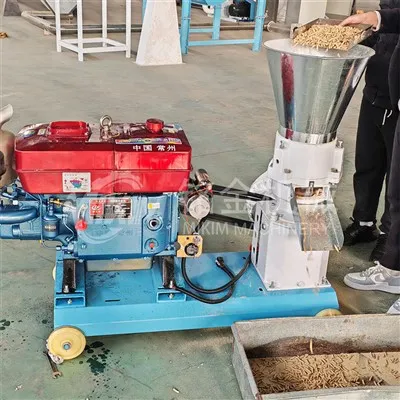
Double-Screw Fish Feed Pellet Plant for Floating Aquatic Feed
Leave a message
What a Double-Screw Fish Feed Plant Includes
A double-screw fish feed pellet plant is a continuous train rather than a single machine. Meal passes from the grinder into the mixer, then into the twin-screw extruder where it is cooked, expanded and shaped, and finally through drying, oil spraying, cooling and packing. Twin-screw extruders are used for aquatic feed because the intermeshing screws give positive conveying and a more uniform shear history than a single screw, which means the same formulation gives repeatable density and pellet shape from one batch to the next. The line is used for floating feed for fish, catfish and tilapia, and for slow-sinking feed for shrimp, crab and lobster.
The Equipment Train from Grinding to Packaging
The standard equipment sequence is grinding, mixing, extruding, drying, flavouring, cooling and packaging. Each transition is usually closed and mechanical, so material is not exposed between stages. Screw conveyors and pneumatic lines move the meal, and the dryer operates as a multi-pass belt unit so that the line footprint stays compact. The layout drawing is normally prepared against the actual factory dimensions, because the length of the dryer and cooler often determines whether the line fits the available hall.
Model Range and Capacity
Installed power and throughput scale together, but not linearly: the largest models carry proportionally more power per tonne because drying and conveying loads grow with line length.
| Model | Installed power | Working power | Capacity | Dimensions |
|---|---|---|---|---|
| DSE65 | 74 kW | 52 kW | 120-180 kg/h | 17 x 1.2 x 2.2 m |
| DSE70 | 95 kW | 70 kW | 200-300 kg/h | 20 x 1.5 x 2.2 m |
| DSE75 | 110 kW | 82 kW | 250-400 kg/h | 26 x 1.5 x 2.2 m |
| DSE85 | 139 kW | 104 kW | 400-800 kg/h | 28 x 3.5 x 4.3 m |
| DSE90 | 132 kW | 75 kW | 800-1200 kg/h | 28 x 3.5 x 4.3 m |
| DSE95 | 165 kW | 90 kW | 1500-2000 kg/h | 35 x 3.5 x 4.3 m |
| DSE120 | 469 kW | 380 kW | 2000-2500 kg/h | 45 x 20 x 22 m |
| DSE135 | 712 kW | 570 kW | 3000-3500 kg/h | 50 x 20 x 25 m |
Construction and Operating Features
Product-contact parts are stainless steel, and the whole line runs continuously without manual transfer between stages. Screw elements, die plates and knife assemblies are interchangeable, so pellet diameter and length are changed by swapping the die and adjusting knife speed rather than by rebuilding the machine. A basic formulation is normally supplied with the line as a starting point for the buyer's own least-cost formulation work. Pellet shapes are set by the die and by the cutting arrangement, and moulds in different sizes are supplied with the machine so that a plant can cover several pellet classes on one line.
Daily Output and Farm-Scale Matching
A medium-capacity line in this range produces roughly 15 to 30 tonnes per day on continuous operation. That output matches the feed demand of a large pond area and a substantial cage installation, and it removes the need for repeated small purchases of finished feed. Because the pellets are dimensionally consistent, they can be run through automatic feeders for timed and metered distribution, which reduces the labour needed per hectare of water surface and supports intensive operation.
Standards and Compliance Points
Machine design follows EN ISO 12100 for risk assessment and EN 60204-1 for electrical equipment, with guard design to ISO 14120 and safety-related control functions to ISO 13849-1. Feed hygiene obligations under Regulation (EC) No 183/2005 and feed additive rules under Regulation (EC) No 1831/2003 apply to the producing plant. Finished aquatic feed is commonly tested for moisture to ISO 6496, crude protein to ISO 5983-2, fat to ISO 6492 and crude fibre to ISO 6865, with Salmonella detection to ISO 6579-1. In China, GB/T 22919 covers aquatic compound feed.
Frequently Asked Questions
Q: Why choose a twin-screw extruder instead of a single-screw machine for aquatic feed?
A: Intermeshing screws convey material positively and apply a more uniform shear history, which gives repeatable pellet density and shape and better control of the expansion ratio needed for floating feed.
Q: What capacity ranges are available for a complete plant?
A: Models run from about 120 kg/h up to 3500 kg/h, covering small farm installations through to industrial aquatic feed plants. Installed power rises from 74 kW to 712 kW across the same range.
Q: Can one line produce both floating and sinking pellets?
A: Yes. Pellet density is set by the die, the screw configuration and the cutting arrangement, so a line can be switched between floating and slow-sinking feed by changing these components and the operating setpoints.
Q: What is included in the drying and coating section?
A: A multi-pass belt dryer followed by a spray or drum coating unit, then a cooler. The sequence lets oil or liquid additives be applied after drying so that heat-sensitive components are not degraded.
Q: Which standards apply to the finished aquatic pellets?
A: Moisture to ISO 6496, crude protein to ISO 5983-2, fat to ISO 6492, crude fibre to ISO 6865 and Salmonella to ISO 6579-1. Aquatic compound feed sold in China is checked against GB/T 22919.