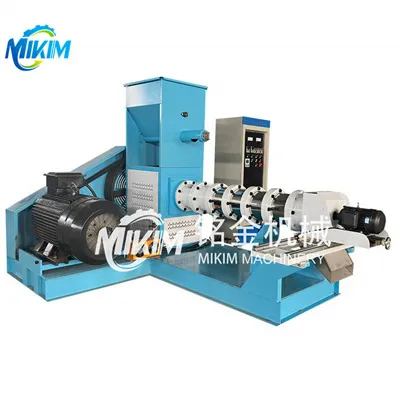
Pet Food and Floating Fish Feed Pellet Making Machine: Complete Capabilities and Selection Guide
Leave a message

Key Takeaways
- A twin-screw extrusion line produces both floating and sinking feed pellets (0.5–15 mm) for fish, shrimp, and crabs, and can be switched to dry pet food (dog, cat, bird) with a simple recipe and die change.
- Seven standard line capacities range from 150 kg/h to 5,000 kg/h; installed power scales from 80 kW to 290 kW, and floor space from roughly 17×1.5 m to 78×3.8 m.
- Extrusion adds real value beyond shaping: starch gelatinization rises dramatically (commonly from below 20% in raw mash to 80%+ in the extruded pellet), anti-nutritional factors are reduced, and water stability of 16–32 hours reduces feed loss in ponds.
- Match the model to your target output and recipe: floating fish feed, sinking feed, and dry pet food have different optimal screw configurations and die specifications.
1. What This Machine Can Produce
The extruded feed production line is designed to make both floating and sinking feed pellets for fish, shrimp, and crabs. Feed type varies with the species being farmed, and pellet diameter must match the age of the animal - fry require fine pellets while grow-out fish need larger sizes. By adjusting temperature, moisture, formula, and the die, the twin-screw extruder covers a pellet size range of 0.5 mm to 15 mm.
The same machine line is also used for dry pet food production, including dog food, cat food, bird feed, and other extruded companion-animal diets. The change from aquaculture feed to pet food is made through recipe and die selection rather than machine modification, which is why this equipment family is popular with producers who serve both markets.


2. Complete Production Line Configuration
A typical turnkey line is arranged as follows:
mixer → screw conveyor → twin-screw extruder → air conveyor (hoister) → 5-layer drying oven → single-drum flavoring line → cooling machine → packing machine (optional)

3. Product Parameters
| Model | 65 | 70 | 85 | 90 | 95 | 120 | 140 |
|---|---|---|---|---|---|---|---|
| Output | 150 kg/h | 250 kg/h | 500 kg/h | 1,000 kg/h | 1,500 kg/h | 3,000 kg/h | 5,000 kg/h |
| Installed power | 80 kW | 100 kW | 150 kW | 180 kW | 200 kW | 245 kW | 290 kW |
| Dimension (L×W×H, m) | 17×1.5×2.2 | 20×1.5×2.2 | 30×1.5×2.6 | 40×2×3.5 | 45×2×3.5 | 60×3×3.5 | 78×3.8×3.5 |
Values per manufacturer's specification sheets; confirm the final layout with your supplier, as drying and cooling stages can be sized independently of the extruder.
4. Product Advantages
- Reduced anti-nutritional factors - extrusion heat treatment improves digestion and absorption of feed and reduces excretion, lowering pond pollution load.
- High-temperature sterilization - the cooking step improves feed safety and helps prevent digestive-tract disease in farmed animals.
- Flavoring and coating options - the line can include a flavoring drum and oil sprayer; medicines or vitamins can be added to the coating to support animal health.
- Higher starch gelatinization - extrusion studies commonly report gelatinization rising from below 20% in raw mash to above 80% in the finished pellet (measured per AACC starch assay methods), which greatly improves starch digestibility.
- Better nutrient digestibility - fish have short digestive tracts and most farmed species lack a true stomach; finer, fully cooked particles are absorbed at a higher rate.
- Easier storage and management - expanded feed is dry, stable, and convenient for aquaculture management.
- Strong water stability - typical expanded pellets hold their form for 16–32 hours in water, minimizing pollution and feed waste; floating pellets allow visual monitoring of feeding behavior, while high-density sinking pellets retain water stability beyond 16 hours to ensure complete consumption.
5. FAQ
Q1: Can one line produce both floating and sinking feed?
Yes. Floating or sinking behavior is controlled by the formula, moisture, and die configuration; the same twin-screw extruder switches between them with adjustment time measured in minutes.
Q2: How do I choose the right model?
Estimate your annual output and daily operating hours, then select the model whose output (150–5,000 kg/h) leaves you at least 20% headroom. Confirm with your supplier that the screw configuration suits your main recipe (aquaculture vs pet food).
Q3: Can the line be converted from fish feed to pet food production?
Yes. The core process is the same; you change the recipe, die, and drying settings. Producers serving both markets typically run dedicated recipes on a shared line.
Q4: What determines water stability?
Gelatinization degree, moisture control, and formulation. Higher gelatinization and correct drying produce pellets that hold 16–32 hours in water; over-processing can reduce palatability, so settings must be balanced.
References
- AACC International - Approved Methods of Analysis: starch gelatinization and pasting property measurement (Method 76-21 and related).
- FAO - Aquaculture Feed and Fertilizer Resources Information System: extrusion processing of aquafeeds.
- AFIA (American Feed Industry Association) - Feed Manufacturing Technology: extrusion and drying process control.
- Manufacturer's specification sheets for twin-screw extruded feed lines - Tianjin Mikim Technique Co., Ltd (site data, feedpelletline.com).
Tell us your target output and recipes (floating fish feed, sinking feed, or pet food), and we will recommend the right model with a complete line layout and quotation.