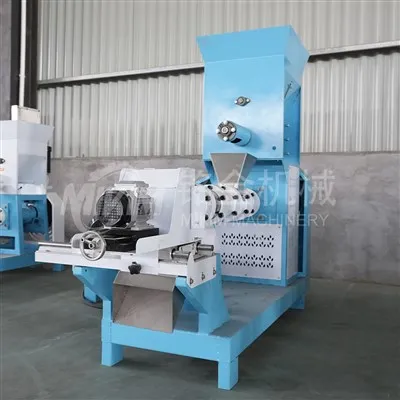
Pet Food Extruder Machine: Raw Materials, DGP Specs and Cutting System
Leave a message
What a Pet Food Extrusion Machine Is
The pet food extruder, also known as a feed pellet producing machine, is a processing device that makes pet food for dogs, cats, rabbits, fish, tortoises, birds, pigs and foxes, as well as feed for domestic animals and aquatic products. One machine therefore serves two markets at once: the expanding pet food market and conventional animal husbandry, which is why the same frame is often used for fish feed during one season and shaped pet food in another.
Raw Materials and Processing Steps
The primary raw materials used in the feed pellet manufacturing machine include amino acids, grains, fish meal, fat, whey powder, soybean meal, straw, green fodder and meat and bone meal.
Mixing – the ingredients are blended into an even mash so the nutrient profile is identical from the first pellet to the last.
Puffing – the mash is expanded under pressure and heat, which gelatinizes the starch and builds the pellet structure.
Roasting – the expanded material is finished at controlled temperature, improving flavour and digestibility.
Seasoning – coatings and flavours are applied for pet food, and flower-shaped products can be produced by changing the mould to the customer requirement.
DGP-100 to DGP-200 Technical Specifications
| Parameter | DGP-100 | DGP-120 | DGP-135 | DGP-160 | DGP-200 |
|---|---|---|---|---|---|
| Capacity (kg/h) | 500 | 600–700 | 800–900 | 1000–1200 | 1800–2000 |
| Main motor (kW) | 37 | 55 | 75 | 90 | 132 |
| Feeder motor (kW) | 1.5 | 1.5 | 1.5 | 2.2 | 3 |
| Cutter motor (kW) | 1.5 | 1.5 | 2.2 | 2.2 | 3 |
| Screw diameter (mm) | 100 | 120 | 135 | 160 | 200 |
| Machine size (m) | 2 x 2.8 x 1.2 | 2.2 x 2.9 x 1.2 | 2.2 x 3.1 x 1.37 | 2.3 x 3.15 x 1.38 | 2.35 x 3.45 x 1.65 |
| Weight (kg) | 1500 | 1800 | 2000 | 2500 | 3200 |
The DGP series covers capacities from 500 kg/h up to 1800–2000 kg/h, with main motor power from 37 kW to 132 kW and screw diameters from 100 mm to 200 mm, so a single model family spans a small farm unit and a mid-sized pet food plant.
Cutting System and Pellet Quality
The discharge port carries a frequency-conversion speed-regulating rotary cutting device, so cutting speed and pellet length are controlled simply by varying the blade rotation speed. The feed extruder produces clean, smooth pellets that float on the water surface for more than 12 hours without sinking, which reduces fish infections and does not contaminate the water supply. With its extended screw sleeve and built-in screw, the machine gives the material a smooth surface and a high degree of expansion, and both the barrel temperature and the output torque are adjustable.
Construction, Maintenance and Cost Advantages
Simple structure – the design is straightforward and easy to install, disassemble and operate.
Wear resistance – the screw and screw sleeve are made from wear-resistant, high-temperature alloy steel that is heat-treated for a long service life.
On-site production – extruding feed on the farm costs significantly less than buying finished feed, because raw materials are turned directly into pellets.
Storage stability – the pellets are stable enough to store without expensive additives.
Frequently Asked Questions
Q: Which animals can this extruder feed?
Pet food for dogs, cats, rabbits, birds and tortoises, plus feed for fish, shrimp, pigs and foxes, and conventional livestock feed.
Q: How is pellet length controlled?
By a frequency-conversion rotary cutting device at the discharge port; blade rotation speed sets the cutting speed and the pellet length.
Q: Which raw materials are used?
Amino acids, grains, fish meal, fat, whey powder, soybean meal, straw, green fodder and meat and bone meal are typical inputs.
Q: Can shaped pet food be produced?
Yes. Flower-shaped and other special pet food shapes are made by changing the mould, which can be built to the required form.
Q: What capacity range does the DGP series cover?
From 500 kg/h on the DGP-100 to 1800–2000 kg/h on the DGP-200, with main motors from 37 kW to 132 kW.
Q: Is on-site production cheaper than buying finished feed?
Yes. Processing raw materials directly into pellets avoids the margin on finished feed and removes the need for costly binders.