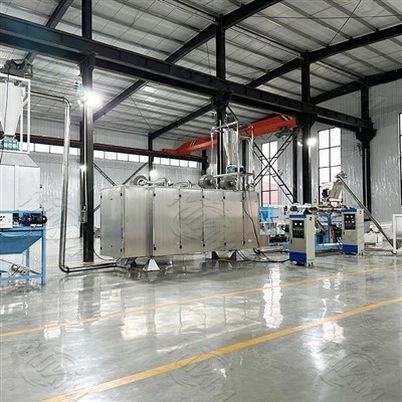
Fully Automatic Floating Fish Feed Extruder: Working Principle, Recipes and DGP Parameters
Leave a message
What a Fully Automatic Floating Fish Feed Extruder Does
A fully automatic floating fish feed extruder, also called a fish puffing pellet machine, is core equipment in modern fish farming. A stainless steel body resists corrosion and is easy to clean between batches, so continuous production stays hygienic. Inside the barrel the screw conveys, compresses and cooks the mash: starch gelatinises, the material expands as it leaves the die, a toasted aroma develops, and a large share of the harmful microorganisms carried in the raw materials is destroyed.
Because the finished pellet floats, it stays on the water surface and holds its shape for up to 12 hours. Feed that stays visible is eaten instead of sinking into the pond bottom, so waste falls and the feed conversion ratio improves.
Raw Materials, Binders and Additives
Recipes are built from locally available protein and energy sources, and the ratios change with species, fish size and target protein level.
Protein sources - fish meal and soybean meal, which supply essential amino acids
Energy sources - corn meal, wheat middling and rice bran
Fibre and bulk - wheat bran and rice bran, which support digestion
Binders - starch and gelatine-type hydrocolloids that keep the pellet intact in water
Additives - vitamin and mineral premixes and amino acids that complete the diet
Protein ingredients are normally ground finer than energy ingredients so that the pellet binds well and digests quickly. The same extruder therefore handles herbivorous, omnivorous and carnivorous formulas by changing the recipe, the die and the moisture setting.
DGP Series Technical Parameters
The DGP series covers the output range required from small farms through to commercial feed plants.
| Parameter | DGP-100 | DGP-120 | DGP-135 | DGP-160 | DGP-200 |
|---|---|---|---|---|---|
| Capacity (kg/h) | 500 | 600-700 | 800-900 | 1000-1200 | 1800-2000 |
| Main motor (kW) | 37 | 55 | 75 | 90 | 132 |
| Feeder motor (kW) | 1.5 | 1.5 | 1.5 | 2.2 | 3 |
| Cutter motor (kW) | 1.5 | 1.5 | 2.2 | 2.2 | 3 |
| Screw diameter (mm) | 100 | 120 | 135 | 160 | 200 |
| Machine size (m) | 2 x 2.8 x 1.2 | 2.2 x 2.9 x 1.2 | 2.2 x 3.1 x 1.37 | 2.3 x 3.15 x 1.38 | 2.35 x 3.45 x 1.65 |
| Weight (kg) | 1500 | 1800 | 2000 | 2500 | 3200 |
Capacity, screw diameter and installed power rise together, so the model should be chosen from the daily tonnage a farm actually consumes rather than from the largest machine the site can hold.
Correct Start-Up Sequence
Working through the following steps in order prevents barrel plugging and gives uniform pellets from the first batch.
Connect the power line and check the motor rotation direction before any material is loaded.
Add water to the powdered mash and mix it, aiming for a moisture content of about 20%.
Start the main machine and admit a small amount of water at the screw feed port.
Load the hopper, then start the feeder at a low rate with the cutter running at high speed.
Once discharge looks even, adjust cutter and belt speed to the pellet length required.
Stop the feeder, flush the barrel with water and clean the die at the end of each shift.
Running Cost and Daily Maintenance
Power, die wear and feed loss are the three cost items an owner controls directly. Pellet size must match the stock: fry take a fine crumb while grow-out fish take 2-4 mm pellets. Die and cutter wear should be inspected weekly, the transmission is lubricated monthly, and raw materials must be kept at a consistent moisture level so that the load on the main motor does not swing.
Frequently Asked Questions
Q: What decides whether a pellet floats or sinks?
The degree of expansion set at the die decides buoyancy. High expansion traps air inside the pellet and keeps it on the surface, while low expansion produces a dense pellet for bottom-feeding species.
Q: How much moisture should the mash carry?
Roughly 20% is the normal starting point. Too little water and the barrel blocks; too much and the pellet leaves the die soft and difficult to dry.
Q: Can the extruder run plant-based formulas?
Yes. Corn meal, wheat bran, rice bran and soybean meal can be blended into a floating pellet, with a small amount of fish meal added when a higher protein level is required.
Q: Which DGP model suits a small farm?
The DGP-100 at 500 kg/h and the DGP-120 at 600-700 kg/h cover most small and medium farms, while the DGP-160 and DGP-200 serve industrial output.
Q: How often should the die and cutter be replaced?
Inspect both weekly. Replace them when pellet edges become ragged, because worn tooling raises power draw and produces fines.
Q: How long does a floating pellet stay on the water?
A correctly expanded pellet stays intact and buoyant for about 12 hours, which gives the stock time to consume it without losses.