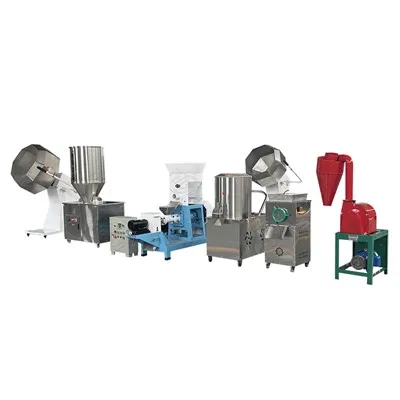
How can fish floating food production line increase profitability compared to traditional fish meal?
Leave a message
Many aquatic feed manufacturers are struggling with the choice: should they produce regular fishmeal or fish pellet feed? Some believe that pellet feed requires a large investment and carries high risk; however, the reality is that many fish pellet feed businesses are growing larger and more profitable. In fact, a floating fish food making production line can solve the pain points of fish farmers, control costs, and offer significantly higher profits than regular fish feed. A detailed analysis follows.
Three aspects
First, fish pellet feed helps fish farmers reduce costs and increase efficiency, allowing them to sell at higher prices. Ordinary fish meal has a high waste rate; it takes 10 jin (5 catties) of feed to grow 1 jin (0.5 catties) of fish. Fish pellet feed produced by a fish floating meal extruder line has good water resistance and a low waste rate; 8 jin (4 catties) of feed is enough to grow 1 jin (0.5 kg) of fish. For every jin (0.5 catties) of fish raised, farmers save 2 jin (1 catties) of feed (equivalent to 3 yuan per jin at 1.5 yuan per jin). Therefore, farmers are willing to spend an extra 0.2 yuan per jin on fish pellet feed rather than ordinary feed. For example, a feed supplier sells fish pellet feed at 1.7 yuan per jin and ordinary feed at 1.5 yuan per jin, earning an extra 0.2 yuan per jin. Selling 5 tons of pellet feed daily earns 2,000 yuan more than selling 5 tons of feed, resulting in an extra 60,000 yuan per month.
Second, mass production by a fish food processing line can reduce costs and increase profit margins. Although the initial investment for a fish pellet feed production line ranges from tens of thousands to hundreds of thousands of yuan, it allows for bulk purchasing of raw materials, such as corn and soybean meal, at wholesale prices, which are 0.1 yuan cheaper per kilogram than the retail price, saving 200 yuan per ton of feed. Furthermore, automated production means one person can manage one line, saving three workers compared to manual labor, resulting in monthly labor cost savings of 15,000 yuan. For example, one feed supplier, after using the production line, saw its feed cost per ton decrease by 300 yuan compared to manual production, producing 10 tons per day, saving 90,000 yuan per month. Lower costs naturally lead to higher profits.
Thirdly, fish pellet feed has a good reputation, fostering long-term partnerships and stable sales. Ordinary fishmeal feed has inconsistent quality, leading farmers to switch suppliers if dissatisfied; fish pellet feed, with its consistent quality and faster fish growth, encourages long-term partnerships with farmers. For example, after a feed supplier started producing fish pellet feed, the number of its regular fishpond partners increased from 20 to 50, and its monthly sales increased from 50 tons to 150 tons, tripling its sales volume. Moreover, it could customize feed for different fish species (grass carp, bass), charging an additional 0.1 yuan per kilogram, resulting in even greater profit margins. With stable sales, high selling prices, and low costs, the profit margin was naturally higher than when producing ordinary fish feed.


about Us
Customer visit

Certificate of Honor

FAQ
1. What is the price of the floating fish feed extruder production line?
The price ranges from approximately $10,000-$56,000
2. Do you provide maintenance services for your customers?
Yes, we offer comprehensive after-sales maintenance services to our customers.