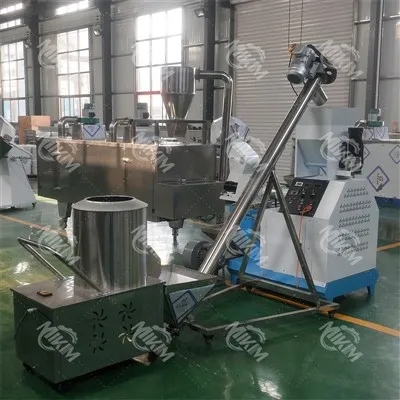
How can the noise issue with fish feed production equipment be resolved?
Leave a message
The first step is to accurately pinpoint the source of the noise using a three-step method: listening, observing, and touching. Listening: While the floating fish feed making machine is running, use a stethoscope to touch the motor, transmission components, feed hopper, and conveyor pipe to determine the loudest source of noise. A "humming" sound from the motor often indicates bearing wear or rotor failure; a "clunking" sound from the transmission components often indicates poor gear meshing or a loose chain; a "thumping" sound from the feed hopper and conveyor pipe often indicates material impact or blockage. Observing: Observe whether there is vibration or deformation of components during machine operation, whether the feed is conveyed evenly, whether there is any accumulation or blockage, and whether fasteners are loose. Touching: After stopping the machine, touch the motor, bearings, and other components to check if the temperature is too high (above 60°C) to determine if the noise is caused by overload or wear. Simultaneously, touch the machine body to feel the vibration intensity to determine if vibration damping is needed.
The second step is to categorize and address the noise by developing general solutions for four main categories of noise. Mechanical friction noise: The core issue is lubrication and component repair. Common methods include cleaning impurities from friction points, applying suitable grease (water-resistant grease for high-humidity environments, high-temperature grease for high-temperature environments), timely replacement of worn parts, and adding rubber or nylon buffers to metal friction points. Material impact noise: The core issue is reducing speed and buffering impact. Common methods include adjusting the conveyor angle (30°-45° is ideal), adding guide plates and buffer pads, controlling the feed speed to avoid accumulation, and using flexible materials (PVC, nylon) to replace metal conveyor components. Vibration resonance noise: The core issue is blocking vibration transmission. Common methods include adding shock-absorbing pads and elastic supports, using flexible connections instead of rigid transmissions, tightening loose parts, and attaching counterweights to resonant areas to change the vibration frequency. Motor noise: The core issue is motor maintenance and replacement. Common methods include cleaning foreign objects from inside the motor, replacing worn bearings, replacing old motors with silent types (such as DC brushless motors), and covering the motor casing with sound-insulating material.
The third step is to establish a long-term maintenance mechanism to prevent recurring noise. Develop a standardized maintenance manual, clearly defining daily inspection content (listening to operating sounds, checking component status, and removing residual feed), weekly maintenance content (tightening bolts, lubricating transmission components, and checking for wear), and monthly in-depth maintenance content (disassembling core components, replacing vulnerable parts, and thorough cleaning). Adjust maintenance priorities based on the characteristics of the farming environment: add rust prevention treatment in humid environments, strengthen sound insulation measures in indoor environments, and emphasize the coordinated operation of multiple devices in large-scale scenarios. Establish a noise monitoring system, using a decibel meter to measure equipment operating noise weekly, recording noise trends, and promptly investigating the cause when noise increases by more than 5 decibels to resolve problems in their early stages.
The core of the general framework is "first locate the problem, then solve it; first the basics, then upgrade." Prioritize solving problems through low-cost methods such as adjusting parameters, cleaning and maintenance, and tightening and lubrication. If noise levels still do not meet standards, then consider upgrade solutions such as component replacement and structural modification. Simultaneously, adjust solutions based on feed characteristics (particle size, density, fiber content) and the farming environment (humidity, space, temperature) to ensure a balance between noise reduction and feeding efficiency.
Related equipment


about Us
MIKIM's fish feed pellet production lines and supporting machinery offer excellent value for money. Not only are they affordable, eliminating middlemen markups and allowing small and medium-sized enterprises (SMEs) and fish farmers to purchase complete sets of equipment at reasonable costs, but they also boast exceptional efficiency. The fully automated process, from raw material crushing and precise ingredient mixing to extrusion pelleting and maturation, is completed in one continuous flow. This results in high starch gelatinization rates and uniform pellet formation, significantly improving production efficiency and feed quality, truly achieving "low cost, high output." Choosing a MIKIM fish feed pellet production line means enjoying comprehensive pre-sales and after-sales service, including 24-hour online customer support, a one-year warranty on the entire machine, professional on-site installation, commissioning, and maintenance, and a stable supply of spare parts. Customers can buy with confidence and use with peace of mind, with both excellent value and service quality!
Customer visit

Certificate of Honor

If you would like to learn more about MIKIM machinery, please contact us. We offer one-stop service and welcome your inquiries!!!