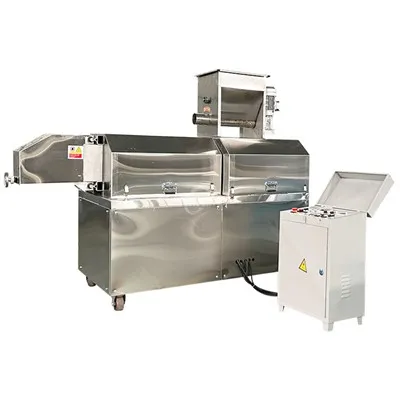
How does a best floating fish feed extruder machine work?
Leave a message
The best Floating fish feed machine (typically twin-screw, high-precision models like MIKIM's industrial-grade series) operates through a synergistic combination of mechanical shear, thermal processing, and precision control to produce high-quality, buoyant feed. Its advanced design ensures consistent nutrition, optimal floatability, and efficient production. Here's a concise breakdown of its working mechanism:
1. Precision Feeding & Preconditioning
First, a frequency-controlled screw feeder uniformly conveys pre-mixed raw materials (protein sources, starch, additives) into a dual-shaft preconditioner. Steam and purified water are injected via precision nozzles to adjust moisture (16-18%) and temperature (85-95°C). The best extruders feature extended conditioning time (3-5 minutes) and spiral mixing paddles, ensuring uniform heat/moisture distribution-laying the foundation for full starch gelatinization and nutrient integration.
2. High-Intensity Extrusion: Core Processing
The conditioned material enters a twin-screw barrel with intermeshing, wear-resistant screws (made of alloy steel). The screws rotate synchronously at adjustable speeds (100-600 rpm), generating intense shear force and pressure (5-10 MPa). Friction between the screw, barrel, and material raises the temperature to 110-130°C, fully gelatinizing starch (degree ≥85%) and denaturing proteins.
As the material moves toward the die, the best extruders use modular barrel sections (with temperature zoning control) to avoid overheating. When exiting the die's customized holes, the sudden pressure drop causes internal water vapor to expand rapidly, forming a porous, low-density structure (≤1 g/cm³)-the key to long-lasting floatability (12-24 hours).
3. Precision Cutting & Post-Processing Integration
A servo-controlled rotating cutter trims extruded strands into pellets of uniform length (0.3-10 mm), adjustable via PLC to match fish size. The best machines integrate a continuous dryer and cooler in-line: pellets are dried at 60-80°C to reduce moisture to 10-12% (preventing mold) and cooled to room temperature to maintain structural stability. Optional precision coating systems (for fish oil, vitamins) ensure nutrient retention without affecting floatability.
4. Intelligent Control & Stability Assurance
Top-tier extruders are equipped with PLC touchscreen controls to monitor and adjust temperature, pressure, screw speed, and feeding rate in real time. Sensors detect abnormalities (e.g., blockages, temperature spikes) and trigger automatic protections. MIKIM's twin-screw models, for example, feature self-cleaning screw designs and wear-resistant liners, reducing downtime and ensuring consistent production quality batch after batch.
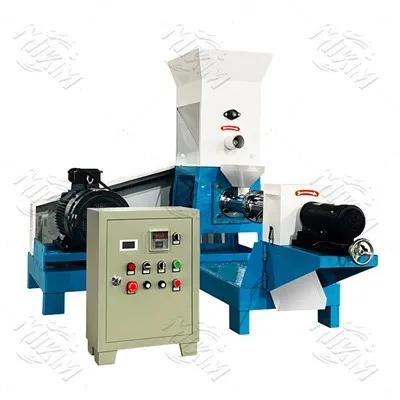
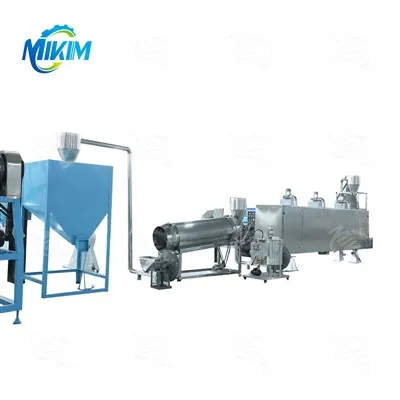
Related equipment


about Us
MIKIM's fish feed pellet production lines and supporting machinery offer excellent value for money. Not only are they affordable, eliminating middlemen markups and allowing small and medium-sized enterprises (SMEs) and fish farmers to purchase complete sets of equipment at reasonable costs, but they also boast exceptional efficiency. The fully automated process, from raw material crushing and precise ingredient mixing to extrusion pelleting and maturation, is completed in one continuous flow. This results in high starch gelatinization rates and uniform pellet formation, significantly improving production efficiency and feed quality, truly achieving "low cost, high output." Choosing a MIKIM fish feed pellet production line means enjoying comprehensive pre-sales and after-sales service, including 24-hour online customer support, a one-year warranty on the entire machine, professional on-site installation, commissioning, and maintenance, and a stable supply of spare parts. Customers can buy with confidence and use with peace of mind, with both excellent value and service quality!
Customer visit

Certificate of Honor

FAQ
1. What is the price of the fish feed machine?
The price ranges from approximately $3,500-$55,000
2. Do you provide maintenance services for your customers?
Yes, we offer comprehensive after-sales maintenance services to our customers.
If you would like to learn more about MIKIM machinery, please contact us. We offer one-stop service and welcome your inquiries!!!