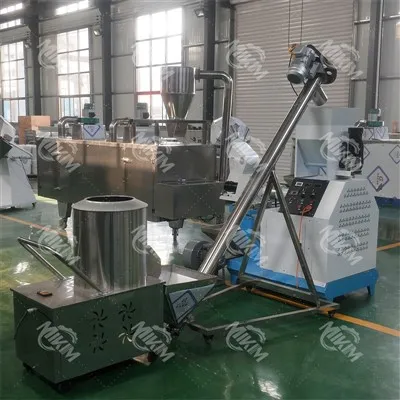
How Large-Scale Feed Production Equipment Has Developed into Automated Lines
Leave a message
What Large-Scale Feed Production Equipment Is
Large-scale feed production equipment is the core of modern feed manufacturing and plays a central part in improving feed quality, reducing production cost and raising the returns of a breeding operation. A complete installation integrates the key process links of feed manufacturing, including feeding, crushing, screening, drying, transportation, storage, batching, mixing, granulation, cooling, final screening and packaging, and drives them through automatic control systems that supervise the whole process. This class of equipment is intended for large breeding enterprises and feed factories that must meet a large, continuous demand at consistent quality.
From Separate Machines to Complete Automated Lines
The development of feed production equipment has moved from single fixed machines towards complete, automated lines. Early systems treated crushing, mixing and pelleting as separate operations with manual transfer between them; modern large-scale equipment links every stage with conveyors and a central control system. The result is precise control of parameters such as temperature, humidity and time during processing, which supports the consistency and stability of feed quality, raises production efficiency and sharply reduces labour requirements. Because the line runs from one control point, changing a recipe or a production target becomes a matter of software settings rather than reconfiguring machines.
Typical Machine Specifications in the Series
Machine classes inside a large-scale series are separated mainly by rated capacity, drive power and footprint. The table below lists the specifications as published for a representative series, so that the relationship between output, power and installed weight is visible at a glance.
| Model | Capacity | Power | Dimensions | Weight |
|---|---|---|---|---|
| 125 | 80-100 kg/h | 3 kW | 110 x 35 x 70 cm | 95 kg |
| 150 | 120-150 kg/h | 4 kW | 115 x 35 x 80 cm | 100 kg |
| 210 | 200-300 kg/h | 7.5 kW | 115 x 45 x 95 cm | 300 kg |
| 260 | 500-600 kg/h | 15 kW | 138 x 46 x 100 cm | 350 kg |
| 300 | 700-800 kg/h | 22 kW | 130 x 53 x 105 cm | 600 kg |
| 360 | 900-1000 kg/h | 22 kW | 160 x 67 x 150 cm | 800 kg |
| 400 | 1200-1500 kg/h | 30 kW | 160 x 68 x 145 cm | 1200 kg |
One caution applies to every published rating, including this series: a capacity figure is only comparable when the time unit and the reference formulation are stated alongside it. Capacity quoted for one product form should not be assumed to hold for another, and a single headline number without those two qualifications should be treated as incomplete rather than as a specification.
Automation and Complete Process Handling
Large-scale feed production equipment adopts advanced automation technology and precise mechanical design, which raises production efficiency and lowers labour cost. The automatic control system holds parameters such as temperature, humidity and time within their set bands, so quality stays consistent from batch to batch and from shift to shift, with fewer manual interventions and a complete process record that supports quality management and traceability.
On the input side, the equipment is fitted with a complete raw-material processing system covering bagging, feeding, crushing, screening and drying, which protects the quality and safety of the ingredients before they enter the process. The batching system uses electronic scales or microcomputer control to achieve accurate proportioning and automatic management of raw materials, and this is the basis of nutritional consistency in the finished feed. On the output side, the finished-product processing system includes cooling, grading and packaging to preserve the quality and appearance of the pellets. Because the line can store and recall multiple formulations, it can produce different types of feed for different livestock and poultry species, meeting specific nutritional needs without a machine changeover.
What Buyers Should Verify Before Purchase
Because the term large-scale covers very different machine classes, buyers should verify real numbers rather than rely on labels:
Confirm rated capacity together with its time unit and the reference formulation.
Check how many stages are automated and how the control system handles a recipe change.
Verify the batching method and its accuracy, since this sets nutritional consistency.
Review the finished-product chain from cooler through to packer.
Match the power supply and floor dimensions to the actual site before ordering.
Request the full line layout, because a complete line is only as productive as its slowest link, usually the dryer or the packer.
Frequently Asked Questions
Q: What defines large-scale feed production equipment?
It is a complete installation that covers feeding, crushing, screening, drying, storage, batching, mixing, granulation, cooling, final screening and packaging under automatic control.
Q: How has the equipment changed over time?
The main change is integration. Crushing, mixing and pelleting were once separate manual operations; they are now linked by conveyors and a central control system.
Q: Why does one series cover such different capacities?
Because a workshop and a commercial feed plant sit in different classes. Output ranges from 80-100 kg/h on the smallest model to 1200-1500 kg/h on the largest.
Q: Why compare power with capacity rather than capacity alone?
Power shows the energy needed to reach that output. Within the series, 200-300 kg/h is driven by 7.5 kW, while 1200-1500 kg/h needs 30 kW.
Q: Which part of a complete line most often limits output?
The slowest downstream link, usually the dryer or the packer. Matching those to the main process is what protects the rated capacity of the line.
Q: Can one line produce feed for different species?
Yes. The control system can store and recall multiple formulations, so feed for different livestock and poultry species can be produced without a machine changeover.