


How to choose the right mixing equipment for a Floating Fish Feed Extruder Line?
Leave a message
The core requirement for small-scale floating fish feed production lines (monthly output < 100 tons, hourly capacity < 1 ton) is "economical and practical," therefore, miniaturized, low-cost mixing equipment should be prioritized. These production lines are often family workshops or small feed mills serving local fish farmers, producing infrequent batches with simple formulas; a double-helix conical mixer is the best choice. Equipment with an hourly capacity of 0.5-1 ton is recommended, with a unit price of only 50,000-100,000 RMB and a mixing uniformity variation coefficient ≤ 7%, fully meeting the production needs of conventional feeds for pigs, chickens, cattle, and sheep. A small feed mill in Hebei province, after adopting a double-helix conical mixer with an hourly capacity of 0.8 tons, not only achieved a payback period of only 8 months for its equipment investment but also saw a significant improvement in feed reputation and a 30% increase in orders due to improved mixing uniformity. Furthermore, this type of equipment has a small footprint (approximately 3 square meters), requires minimal workshop space, and is simple to operate; ordinary workers can be trained and put to work in 1-2 days.
For medium-sized fish feed processing lines (monthly output 100-500 tons, hourly capacity 1-5 tons), balancing efficiency and flexibility is crucial. A double-helix conical mixer or a horizontal paddle mixer with an hourly capacity of 2-5 tons is recommended. For producing conventional livestock and poultry feed, the double-helix conical mixer is preferred due to its short mixing time (3-5 minutes per batch) and ability to quickly switch between multiple formulas, suitable for the "multi-variety, medium-batch" production characteristics of medium-sized plants. For producing ruminant feed containing large amounts of straw powder, distiller's grains, and other coarse fibers, a horizontal paddle mixer should be chosen, as its powerful shearing action ensures uniform mixing of high-fiber raw materials. A medium-sized feed mill in Shandong, with a monthly output of 300 tons, producing both pig and cattle feed, achieved efficient production of different feed types with an equipment utilization rate of 90% by equipping itself with one 3-ton-per-hour double-helix conical mixer and one 2-ton-per-hour horizontal paddle mixer.
The core requirement for large-scale fish feed pellet production lines (monthly output > 500 tons, hourly capacity > 5 tons) is "high efficiency and stability," making ribbon mixers the inevitable choice. These production lines are mostly used by large-scale feed companies, employing automated continuous production modes. Ribbon mixers can achieve an hourly capacity of 5-20 tons, and when combined with an automatic batching system, they can operate continuously for 24 hours with stable mixing uniformity (CV ≤ 5%). Although the investment for a single unit is 500,000-1,000,000 RMB, the overall cost per ton of feed is 15% lower than that of medium-sized equipment, making it suitable for the large-scale production needs of large-scale plants.
Related equipment


about Us
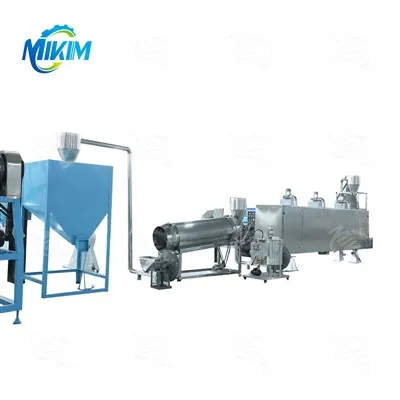
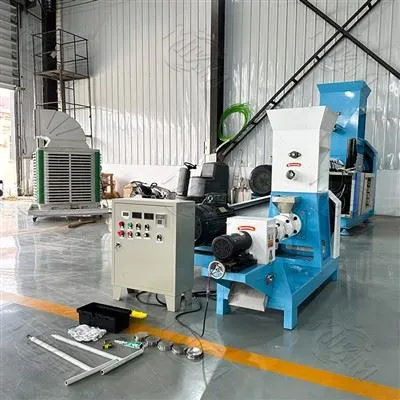
MIKIM's fish feed pellet production lines and supporting machinery offer excellent value for money. Not only are they affordable, eliminating middlemen markups and allowing small and medium-sized enterprises (SMEs) and fish farmers to purchase complete sets of equipment at reasonable costs, but they also boast exceptional efficiency. The fully automated process, from raw material crushing and precise ingredient mixing to extrusion pelleting and maturation, is completed in one continuous flow. This results in high starch gelatinization rates and uniform pellet formation, significantly improving production efficiency and feed quality, truly achieving "low cost, high output." Choosing a MIKIM fish feed pellet production line means enjoying comprehensive pre-sales and after-sales service, including 24-hour online customer support, a one-year warranty on the entire machine, professional on-site installation, commissioning, and maintenance, and a stable supply of spare parts. Customers can buy with confidence and use with peace of mind, with both excellent value and service quality!
Customer visit

Certificate of Honor

FAQ
1. What is the price of the floating fish feed production line?
The price ranges from approximately $3,500-$55,000
2. Do you provide maintenance services for your customers?
Yes, we offer comprehensive after-sales maintenance services to our customers.
If you would like to learn more about MIKIM machinery, please contact us. We offer one-stop service and welcome your inquiries!!!


