How to Optimize a Floating Fish Feed Pellet Extruder for High-Quality Pellets?
Leave a message
content
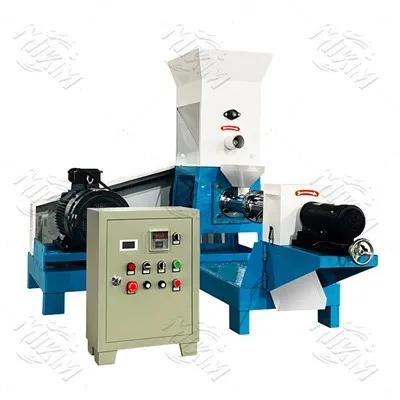
Core parameter control: Coordination of temperature, pressure, and speed. Temperature is fundamental to the puffing process in a small floating fish feed pellet extruder machine, and needs to be controlled between 120-160℃. Too low a temperature will result in insufficient starch gelatinization, leading to fewer internal pores, higher density, and inability to float; too high a temperature will cause the pellets to scorch, destroying nutrients. Pressure needs to be adjusted to match the temperature, maintained at 3-6 MPa. Insufficient pressure will result in insufficient moisture expansion, while excessive pressure can easily cause die blockage. Screw speed needs to be adjusted according to production capacity. For twin-screw extruders, it is typically controlled at 250-400 r/min. Too high a speed will shorten the residence time of the raw material in the extrusion chamber, resulting in insufficient puffing; too low a speed will cause localized overheating, affecting pellet quality. These parameter controls are completely synchronized with the twin-screw extruder, with the core goal of achieving "sufficient gelatinization and moderate puffing."
Auxiliary control of raw material moisture content and die parameters in the floating fish feed pellet making machine. The moisture content of raw materials during pretreatment needs to be controlled between 12% and 14%. Excessive moisture can cause the raw materials to stick to the screw, while insufficient moisture will result in insufficient frictional heat generation, requiring additional steam. During the drying and cooling process after discharge, the moisture content must be reduced to 12%-14% to prevent the particles from absorbing moisture, increasing density, and losing buoyancy. Die parameters also need to be adapted; the orifice diameter should be selected from 1-5mm (adjusted according to the size of farmed fish). Die thickness affects the discharge pressure; too thin a thickness will cause a rapid drop in pressure, and excessively large pores will cause the particles to easily break apart; too thick a thickness will result in insufficient pressure and poor puffing effect.
Common parameter problems and solutions: If the particles have poor buoyancy and sink quickly, it is usually due to insufficient temperature or low pressure. The temperature needs to be increased by 5-10℃, and the screw speed adjusted to increase pressure. If the particles have excessively large pores and easily break apart, it is usually due to excessively high temperature or an inappropriate die orifice diameter. The temperature needs to be reduced, and a die with a suitable orifice diameter replaced. If the particle surface is scorched and has poor palatability, it is usually due to localized excessively high temperature. The steam addition amount needs to be adjusted, and the screw speed reduced. The logic for addressing these issues is entirely consistent with that for producing floating feed using extruders, highlighting the commonality of parameters between extruders and fish food production machines.
Related equipment


about Us
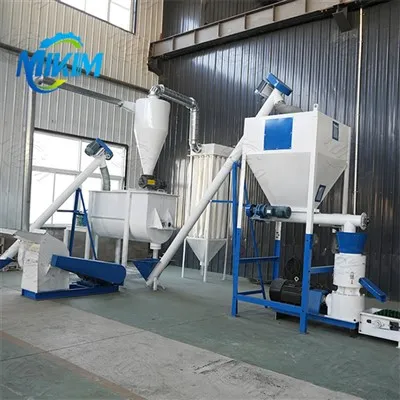
MIKIM's fish feed pellet production lines and supporting machinery offer excellent value for money. Not only are they affordable, eliminating middlemen markups and allowing small and medium-sized enterprises (SMEs) and fish farmers to purchase complete sets of equipment at reasonable costs, but they also boast exceptional efficiency. The fully automated process, from raw material crushing and precise ingredient mixing to extrusion pelleting and maturation, is completed in one continuous flow. This results in high starch gelatinization rates and uniform pellet formation, significantly improving production efficiency and feed quality, truly achieving "low cost, high output." Choosing a MIKIM fish feed pellet production line means enjoying comprehensive pre-sales and after-sales service, including 24-hour online customer support, a one-year warranty on the entire machine, professional on-site installation, commissioning, and maintenance, and a stable supply of spare parts. Customers can buy with confidence and use with peace of mind, with both excellent value and service quality!!!
Customer visit

Certificate of Honor

FAQ
1. What is the price of the small fish food pellet making machine?
The price ranges from approximately $1,500-$55,000
2. Do you provide maintenance services for your customers?
Yes, we offer comprehensive after-sales maintenance services to our customers.
If you would like to learn more about MIKIM machinery, please contact us. We offer one-stop service and welcome your inquiries!!!