Fish Feed Machines: Which Produce Floating Pellets?
Leave a message
What Makes a Pellet Float?
A pellet floats when it contains enough trapped air to be lighter than water. That air is created by starch gelatinization: when starch is cooked with moisture and pressure and then released suddenly through a die, it expands and locks small air pockets into the pellet structure. Machines that cook the material, extruders, can therefore make floating pellets, while machines that only compress cold or lightly conditioned mash, such as plain pellet mills, produce dense sinking pellets. The choice of machine is the first decision that fixes whether the product floats or sinks.
Three Machine Types and Their Floating Capability
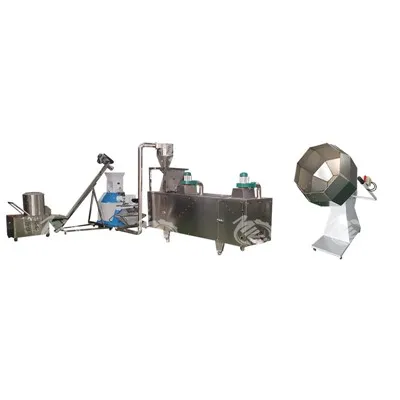
Twin screw extruder: two intermeshing screws cook the dough evenly and control the process precisely, achieving above 95 percent floating pellets under suitable conditions, and it handles sticky and high-fat formulas. Single screw extruder: one screw cooks and pushes the dough; it is simpler and cheaper but controls temperature and pressure less evenly, with the ordinary class reaching around 60 percent floating pellets in the reference comparison. Plain ring die pellet mill: it compresses conditioned mash into dense pellets without expansion, so it is used for sinking feed and for poultry and livestock pellets rather than floating fish feed.
Buoyancy Rates in Practice
| Machine type | Floating share | Typical product |
|---|---|---|
| Twin screw extruder | Above 95% | Floating fish feed, expanded pet food |
| Single screw extruder | Around 60% | Mixed floating and sinking feed |
| Plain ring die pellet mill | Mostly sinking | Sinking fish feed, poultry and livestock pellets |
Floating rates depend on formula starch content, moisture, and die design, so the figures are practical reference values.
Process Control for Floating Feed
Floating quality is decided by temperature and pressure stability in the barrel. Temperature should be controlled within plus or minus 3 degrees Celsius and pressure within plus or minus 0.2 MPa; wider swings make some pellets float and others sink in the same batch. Sinking feed, in contrast, targets a density of 1.2-1.5 g/cm3, which requires less expansion and a lower barrel temperature. For a floating line, check the control instruments before buying, because precise control is what separates a 95 percent floating batch from a mixed batch.
Capacity and Selection
Capacity follows machine type: twin screw extruders run at about 500 kg/h and above, while typical single screw machines produce 100-200 kg/h. A small farm producing feed for its own ponds can start with a single screw machine and accept a lower floating rate, or add a plain pellet mill for sinking feed. A farm or workshop that sells floating feed commercially should choose a twin screw machine, because the floating rate and throughput decide both product quality and revenue. Match the machine to the daily feed demand with a 20-30 percent margin, and budget for the dryer and cooler, which are mandatory for floating feed.
FAQ
Can a plain pellet mill make floating fish feed?
Generally no. A pellet mill compresses without cooking, so it produces dense pellets that sink; floating feed needs the expansion of an extruder.
How much floating feed can a twin screw extruder produce?
Under suitable conditions, above 95 percent of the pellets float, with capacities of about 500 kg/h and higher depending on the model.
Why do some pellets sink in the same batch?
Uneven temperature or pressure control, usually beyond plus or minus 3 degrees Celsius or 0.2 MPa, causes inconsistent expansion and a mix of floating and sinking pellets.
What density is typical for sinking fish feed?
Sinking feed is compressed to about 1.2-1.5 g/cm3, which makes it settle quickly for bottom-feeding species.
Which machine suits a small fish farm?
A single screw extruder producing 100-200 kg/h is an affordable entry point, while farms selling floating feed should invest in a twin screw machine for quality and throughput.