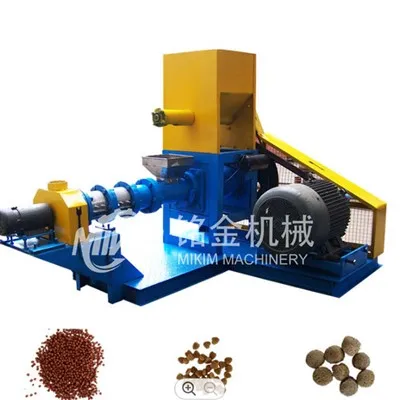
Diesel Mini Feed Production Unit for Poultry Pellets and Floating Fish Feed
fish pellet making machine
fish feed production machine
floating fish feed making machine
fish feed pellet making machine
1/0
Diesel Mini Feed Production Unit for Poultry Pellets and Floating Fish Feed
Diesel mini feed unit: hammer mill, stainless mixer, 8 HP flat die press and dry extruder make poultry pellets and floating fish feed on sites without three-phase power. French manuals.
A diesel mini feed production unit for poultry pellets and floating fish feed is four machines and a spares kit: a diesel hammer mill, a stainless batch mixer, an 8 HP diesel flat die press, and a diesel dry extruder. The mill, the press and the extruder run on diesel; the mixer runs on single phase power.
This unit exists for one situation: a site with no reliable three phase supply that still has to make two products. Poultry pellets come off the flat die press, floating fish feed comes off the extruder, and both share the same grinder and mixer.
The list below follows the buyer's own required scope, item by item, so that each line of the quotation can be checked against the specification that asked for it.
01
What Does a Diesel Mini Feed Unit Contain?
Four working machines, a set of tooling, and the documents that let a local technician maintain them. Grinding, mixing, pelleting and extrusion cover the process; the tooling and the documents cover the years after commissioning.
Group
Item
Purpose
Size reduction
Diesel hammer mill
Grain, cassava, soya, groundnut, dried fish
Blending
Stainless batch mixer
Homogeneous mash before forming
Pelleting
8 HP diesel flat die press
Poultry pellets, 2-6 mm
Extrusion
Diesel dry extruder
Floating fish feed, 2-6 mm
Tooling
Dies, screens, hammers
The product range
Documents
Manuals, drawings, commissioning guide
Local maintenance
Table 1: What the complete set is built from.
A fifth machine, a cooler, is optional. Both forming machines discharge warm product, and a unit that bags warm pellets without a cooler ends up with a soft sack and condensation inside the bag.
What the unit does not include
A building, a concrete floor, raw material storage and water. The set is machinery, and the site works are quoted separately because they depend on the ground and the roof, not on the machines.
02
Which Machines Run on Diesel and Which on Power?
Three on diesel and one on power. The hammer mill and the pellet press run on diesel engines, the extruder runs on diesel with a small generator for its controls and heaters, and the mixer runs on single phase power.
Machine
Drive
Starting
Hammer mill
Diesel engine, 15 HP
Manual or electric start
Pellet press
Diesel engine, 8 HP
Crank start
Extruder
Diesel engine, 12 kW
Electric start with battery
Mixer
Electric motor, 2.2 kW
Direct on line
Table 2: Drive type by machine.
A diesel driven pellet press needs a battery to start even though it does not need mains power, because the larger engines are electric start. That battery and its charging arrangement belong on the checklist, not on the day of commissioning.
Why the mixer stays electric
A batch mixer runs for ten to fifteen minutes and then stops, so its load is small and intermittent. Putting an engine on it adds a second fuel line and a second exhaust for no gain, and single phase power is available almost everywhere the unit is installed.
03
What Grinder Meets 100-200 kg/h on Diesel?
A 15 HP diesel hammer mill, which is the smallest engine driven unit in the range and carries more output than 100-200 kg/h asks for. The excess is deliberate: the mill is run against a small screen and a restricted feed gate, and the spare capacity absorbs fibrous material.
Model
Engine
Capacity
Weight
HM420-280A
15 HP
250-500 kg/h
370 kg
Table 3: The diesel hammer mill and what it carries.
Running a 250-500 kg/h mill at 100-200 kg/h is normal practice on a mixed feedstock. Maize and cassava run through at rate; dried fish and groundnut cake slow it down, and the reserve is what keeps the hour's output steady across the two.
Gravity feed and the gate
A gravity feed hopper with an adjustable gate is what turns a large mill into a controlled one. The gate sets the depth of material over the rotor, and the screen sets the finished particle size, so output is set by two adjustments rather than by engine speed.
Screens from 1 mm to 5 mm
A 1-2 mm screen serves fish feed and young poultry; a 4-5 mm screen serves coarse poultry mash. Screens are the cheapest way to change the product, which is why the set ships with more than one.
04
Why Mix in Stainless Steel at 50-100 kg?
Because the unit handles wet and salty ingredients, and a painted carbon steel shell rusts at the seam within a season. Stainless also cleans down without damage, which matters when the same mixer runs a fish formula and then a poultry formula.
Model
Batch
Power
Shell
LX-HY0.3
150 kg
2.2 kW
Stainless
Table 4: The batch mixer for the unit.
A 150 kg batch covers the 50-100 kg requirement with room at the top, and it matches the press and the extruder in one cycle. Filling a mixer to half its rated batch is normal; filling it to the top is how a mixer turns into a paste.
Homogeneity and the mixing time
Ten to fifteen minutes reaches a homogeneous blend on a ribbon or paddle mixer at this batch size. The check is a sample taken from three places in the batch, and the three samples should read the same for colour and texture.
Discharge and loading
A manual hatch is enough at 100 kg per batch, and it is the arrangement that survives a site without power. An automatic hatch adds a cylinder and a valve, and it needs air that a diesel site does not have.
05
Which Flat Die Pellet Machine Covers 60-100 kg/h at 8 HP?
A Flat Die poultry pellet machine on an 8 HP diesel engine, rated 60-100 kg/h with a 2-8 mm die range. That is the smallest diesel unit in the range and it matches the buyer's 60-100 kg/h requirement directly.
Model
Engine
Capacity
Die Range
Weight
BH-120A
8 HP
60-100 kg/h
2-8 mm
140 kg
Table 5: The 8 HP diesel pellet press.
The press ships with one die fitted and a set of rollers. Dies are changed for size, and a die and its rollers are replaced as a pair, because a new die against worn rollers loads one side of the plate.
Moisture before the die
The press wants material at 10-15 percent moisture. Below 10 percent the pellet crumbles at the die; above 15 percent it smears and the die blinds. On a diesel unit without a conditioner, the moisture of the mash going in is the whole of the control.
What the pellet looks like
A durable poultry pellet comes off a flat die with a glossy surface and a sharp cut. A dull pellet with a rough skin means the moisture is low or the die is worn, and both show up in the first handful from the spout.
06
What Makes a Pellet Float in a Diesel Dry Type floating fish feed making machine?
Heat and pressure inside the barrel, and a die that releases the melt into air. A diesel dry-type floating fish feed extruder cooks the mash above 100 deg C by friction and heater bands, the starch gelatinises, and the pellet expands as it leaves the die and keeps air inside its skin.
Model
Engine
Capacity
Feed Motor
Cutter
Heater
DGP-40 diesel
12 kW
40-50 kg/h
0.4 kW
0.4 kW
1.5 kW
Table 6: The diesel extruder for floating feed.
The unit ships with five screens and a tool box, and the screens set the pellet size alongside the die. A dry extruder needs no boiler, which is why it belongs on a site with no steam and no three phase supply.
Cooking temperature and the heater band
The heater band brings the barrel up to temperature at start, and friction holds it there once material is running. A barrel started cold and fed immediately plugs, because the first material meets a cold screw.
Fish feed and poultry feed from one extruder
The extruder makes floating pellets for fish and expanded pellets for poultry, and the change is a die and a temperature setting. It does not make a dense poultry pellet; that comes off the flat die press, which is why the set carries both.
07
Which Documents Must Ship With the Unit?
Four: the operation manual, the mechanical drawings, the electrical drawings, and the installation and commissioning guide. The manual is issued in French, and the drawings are issued as drawings rather than as photographs of a drawing.
Document
What It Has To Cover
Operation manual
Start, stop, die change, daily checks
Mechanical drawings
Assembly, wear part dimensions, tolerances
Electrical drawings
Panel layout, terminal numbers, motor ratings
Commissioning guide
Foundation, alignment, first run, acceptance
Table 7: The document set.
Drawings matter more than the manual on a remote site. A local machinist can copy a part from a dimensioned drawing; a photograph of a part gives him nothing to measure.
Language and the spare copy
The manual is issued in French with an English copy, and a second printed set stays in the site office. A single manual that lives in the operator's toolbox is a manual that is lost within a year.
08
What Spare Parts Keep a Remote Unit Running?
A kit built around what actually fails: hammers, screens, belts, bearings, filters, and the fasteners that hold the unit together. The list is short because every item on it is either a wear part or a part that cannot be bought locally.
Item
Why It Ships With The Unit
Spare hammer set
Wear part on the mill, and matched to the rotor
Screens, several sizes
The product range, and the cheapest change
Belts
First thing to fail on any belt drive
Bearings
Standard, but not stocked locally
Castors and fixing kit
The unit has to move and has to be anchored
Grease and lubricants
The right grade, in the right quantity
Filters and wear parts
Engine service, and the die and roller set
Keys and hand tools
Nothing is opened without them
Table 8: The spares and tooling kit.
The set also carries a pair of dies in the sizes that ship with the press, because a die is the one part that stops production completely when it cracks.
Consumables against spares
Grease, filters and engine oil are consumables and are bought locally after the first year. Dies, hammers, screens and bearings are spares and come from the factory, because their dimensions decide whether the machine runs at its rating.
09
How Much Power Does the Electric Side Draw?
About 5 kW on the electric side, split between the mixer motor, the extruder heater and the extruder control box. The diesel engines carry the rest, so the site needs single phase power rather than a three phase supply.
Load
Power
Mixer motor
2.2 kW
Extruder heater
1.5 kW
Extruder control box
1.0 kW
Lighting and small tools
0.3 kW
Total electric
5.0 kW
Table 9: The electric load of the unit.
Fuel, not cable
Two thirds of the drive power on this unit comes from diesel engines, so the site plan is built around fuel storage and exhaust routing rather than around a cable. Vent the exhaust outside the shed and keep the fuel store away from the mill dust.
Generator sizing
The extruder's own generator covers its controls and heater. If a site generator is used instead, it is sized against the heater and the control box together, and the engines stay on their own fuel.
10
How Is the Unit Commissioned and Taught?
Commission in three steps: a foundation and alignment check, a first run on the buyer's own material, and operator training on the same material. The commissioning guide sets the order, and the acceptance sheet records the output at each machine.
Alignment is the step that gets skipped and the step that causes most of the trouble afterwards. A hammer mill and a press bolted to a floor that flexes will throw belts and wear bearings, and no amount of spare parts fixes that.
Training that covers the two products
Training covers the mill screen change, the mixer batch, the die change on the press, and the die and temperature setting on the extruder. Those four operations cover the whole working week of a two product unit.
11
Can the Same Unit Make Poultry and Fish Feed?
Yes, and that is the reason for four machines rather than two. The mill and the mixer serve both products, the flat die press makes poultry pellets, and the extruder makes floating fish feed.
A single machine cannot do both well. A flat die press makes a dense sinking pellet, and an extruder makes an expanded floating one, and the difference is physical rather than a setting.
Sharing the grinder
Both products start with a ground mash, so the mill and the screens are shared. A fish formula wants a finer screen than a poultry formula, and the screen change is a two minute job between batches.
12
What Goes Into the Technical Proposal?
A machine list with model and capacity, the drive type for each, the die and screen range, the electric load, the document set, the spares kit, and the delivery schedule by item. Each line answers a line of the specification that asked for it.
The proposal also states what is not included: site works, foundation, raw material storage and water. A proposal that leaves those out reads as complete and arrives incomplete.
The raw materials actually used, the moisture of the mash, the pellet sizes sold, and whether the site has single phase power or only a generator. Those four answers fix the screens, the dies and the starting arrangement. Send them with the order and the proposal is built against your specification rather than a catalogue.
The set is four machines in a fixed order. Grain and cassava are ground, the mash is blended with protein meals and additives, the press forms poultry pellets or the extruder expands fish feed, and both products are cooled and bagged.
Two balances decide whether the unit works. The mill has to deliver a batch ahead of the mixer, which is why a 250-500 kg/h mill serves a 150 kg mixer. The mixer has to deliver a batch inside the forming cycle, which is why one batch covers one press run.
Start with the raw materials and the two products, then fix the screens and the dies. A diesel mini feed unit for poultry pellets and floating fish feed is four machines and a spares kit is four machines and a spares kit, and it works when each machine is sized against the batch cycle rather than against its own rating.
1
Can the unit run without three phase power?
Yes. The mill and the press are diesel driven, the extruder is diesel driven with its own generator, and only the mixer needs single phase power at 2.2 kW.
2
Does the Diesel animal feed pellet maker need a battery?
Yes. The press is crank start; the extruder is electric start and needs a battery and a charging arrangement on site, so a battery and a charging arrangement belong on the site checklist.
3
What pellet sizes can the unit make?
2-8 mm on the flat die press and 2-6 mm on the extruder. Size is set by the die, and both machines ship with a set of dies and screens.
4
How much power does the unit draw?
About 5 kW electric, split between the mixer, the extruder heater and the control box. The diesel engines carry the rest of the drive load.
5
Are the manuals in French?
Yes. The operation manual is issued in French with an English copy, and the mechanical and electrical drawings are issued as dimensioned drawings.
6
What is the smallest spare parts kit that works?
Hammers, screens in the sizes sold, belts, bearings, one die and one roller set. Those cover every failure that stops production.
7
Can one machine make both poultry and fish feed?
No. The Diesel poultry pellet making machine makes a dense poultry pellet and the Diesel Dry Type floating Fish Feed pellet making machine makes a floating fish feed. The mill and the mixer are shared, the forming machine is not.
8
How long is commissioning?
Three steps over two to three days: foundation and alignment, first run on the buyer's material, and operator training on the same material.