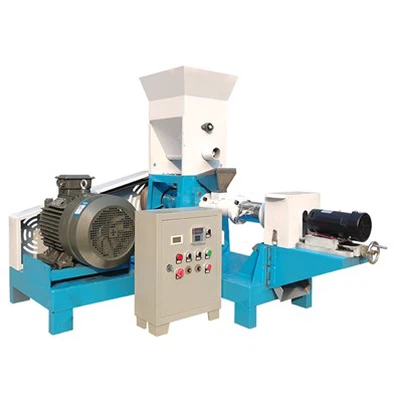
40–350 kg/h LX Series Dry Type Single Screw Fish Feed Extruder Machine

40–350 kg/h LX Series Dry Type Single Screw Fish Feed Extruder Machine

40–350 kg/h LX Series Dry Type Single Screw Fish Feed Extruder Machine

40–350 kg/h LX Series Dry Type Single Screw Fish Feed Extruder Machine

40–350 kg/h LX Series Dry Type Single Screw Fish Feed Extruder Machine
40–350 kg/h LX Series Dry Type Single Screw Fish Feed Extruder Machine
Capacity range: 40–50 kg/h (LX-45) to 300–350 kg/h (LX-85), suitable for small-scale production, pilot trials, and commercial feed production.
Dry process: No external boiler or steam system is required. Total installed power starts at 6.3 kW, including the feeder and cutter.
Compact footprint: The smallest LX-45 measures approximately 1.72 × 0.87 × 1.1 m and weighs 360 kg, making it suitable for workshops with limited space.
Versatile production: Interchangeable dies allow the machine to produce both floating fish feed and pet food pellets.
Applications: Suitable for aquaculture feed, including fish and shrimp feed, as well as pet food for dogs and cats.
Description
The LX Series is a Dry Type single screw floating fish feed pellet extruder machine for producing floating fish feed and pet food at 40–350 kg/h. "Dry type" means the machine needs no steam boiler: frictional heat generated inside the extruder barrel cooks the starch and expands the pellet at the die, which is what makes the feed float. Pellet diameter and shape are changed by swapping the die, so one machine can run both fish feed and pet food.
LX Series Dry-Type Single-Screw Floating Fish Feed Extruder machine: Technical Specifications
|
Model |
Output (kg/h) |
Main Motor (kW) |
Feeder Motor (kW) |
Cutter Motor (kW) |
Packing Size (L×W×H, m) |
Net Weight (kg) |
|
LX-45 |
40–50 |
5.5 |
0.4 |
0.4 |
1.72 × 0.87 × 1.1 |
360 |
|
LX-65 |
120–150 |
15 |
0.4 |
0.4 |
2.2 × 2.9 × 1.2 |
550 |
|
LX-75 |
200–250 |
18.5 |
0.55 |
0.55 |
2.2 × 3.1 × 1.37 |
650 |
|
LX-85 |
300–350 |
22 |
1.5 |
0.55 |
2.3 × 3.15 × 1.38 |
850 |


Actual output varies with formulation, grind size, moisture and die configuration - send us your recipe and we will confirm the realistic throughput for your material.
Not sure which model matches your target tonnage? Send us your formula and daily output target and our engineers will size the machine for you.
How a dry-type single-screw floating fish extruder machine Makes Feed Float
Understanding the process helps you buy the right machine - and troubleshoot it later. A dry-type single-screw floating fish feed making machine works in five stages:
- Grinding. Raw materials are milled to a fine, uniform particle size. Fine grinding improves starch gelatinisation and gives a smoother pellet surface. A hammer mill handles this step.
- Mixing and conditioning. The formula is blended and water is added. In a dry-type extruder, moisture is adjusted inside the machine's conditioning section rather than by steam injection - typically to the 20–25% range used for extrusion cooking of aquafeed.
- Extrusion cooking. The rotating screw conveys the mash through the barrel. Shear and friction raise the temperature (commonly 100–140 °C for aquafeed) and the pressure building ahead of the die, cooking the starch and denaturing anti-nutritional factors.
- Expansion at the die. When the melt exits the die, pressure drops instantly. Superheated water flashes to steam, the starch matrix expands and sets into a porous, honeycombed structure. This porous structure is what makes the pellet float.
- Cutting and post-treatment. A rotating cutter slices the extrudate at the die face; cutter speed sets pellet length. Pellets then go to a dryer/cooler to bring moisture down to storage-safe levels (typically below 10–12%) before packing.
That is also why the cutter motor is specified separately on the LX Series - pellet length is an independent, adjustable variable, not a fixed consequence of the extrusion step.
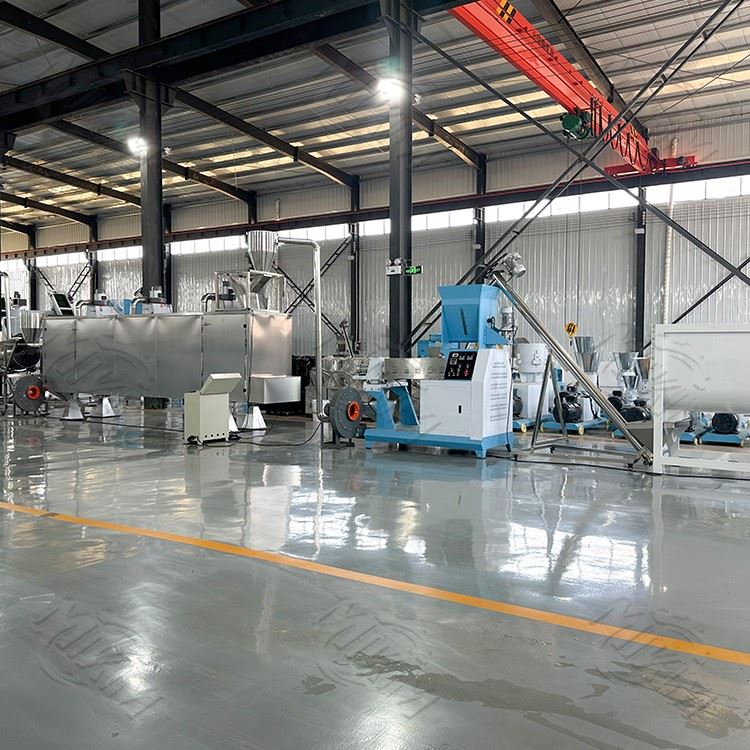
Dry-type single-screw floating fish feed pellet making machine text in our factory
I am interested in this product
Main Structure and Components of a Dry-Type Single-Screw floating fish feed pellet machine

- Feeding system - Feeding hopper. The feed enters through the Feeding hopper mounted at the top of the machine. Steady feeding at this point is the single biggest factor in consistent pellet quality - surges at the inlet show up immediately as uneven expansion downstream.
- Extrusion system - Puffing heating chamber (single screw inside). The core of the machine. The single screw and barrel sit inside the Puffing heating chamber, where shear and friction generate the heat that cooks the starch.
- Cutting system-Cutting device, Knife motor, handwheel, Sliding table. The Cutting device sits at the die face and is driven by its own Knife motor (0.4–0.55 kW depending on the model). Cutter speed sets pellet length. The handwheel adjusts the cutting geometry, and the Sliding table moves the cutter carriage to align it with the die and set pellet length precisely.
- Discharge system-Outlet + Feeding motor. The Outlet releases pellets from the cutting area into the downstream dryer/cooler, while the Feeding motor drives material delivery from the hopper into the extrusion chamber-it is a separate drive from the Knife motor that spins the cutter.
- Electrical control - control panel. Start/stop, motor protection, and operating status are centralized on the side-mounted control panel, so one operator can run the full machine from a standing position.
Terminology note: The discharge-side motor is the Feeding motor, which drives material delivery from the hopper - it is a separate drive from the Knife motor that spins the cutter. If you are comparing against another supplier's spec sheet, match parts by their position on the machine: feed inlet at top, expansion chamber in the middle, cutter at the die face, outlet below the cutter, control panel on the side.
Three Reasons Buyers Choose the LX series dry-type single-screw floating fish food pellet maker machine
1. Dry process: no boiler, lower initial investment.
Unlike steam-assisted extrusion, a dry-type extruder does not require a separate boiler, steam piping, or water-treatment system. Mechanical friction and shear generate much of the heat required for extrusion. This can reduce equipment requirements and simplify installation, especially for small and medium-sized fish feed plants or projects where boiler installation adds cost and complexity.
2. Compact design and straightforward operation.
The LX-45 has a floor length of less than 1.7 m and weighs approximately 360 kg, making it suitable for installation in workshops with limited space. Its relatively simple mechanical configuration also makes routine cleaning, inspection, and maintenance easier for operators to handle in-house.
3. A scalable capacity range on the same machine platform.
The LX Series covers approximately 40–350 kg/h across four models, allowing buyers to select a machine according to their current production requirements. When production needs increase, upgrading to a larger LX model provides a familiar operating concept and related spare-parts system, which can reduce the learning curve for operators.
Raw Materials and Formulation of a Dry-Type Single-Screw floating fish food extruder machine
The LX Series processes the standard ingredients used in aquafeed and pet food:
- Energy / starch sources: corn flour, wheat flour and wheat middlings
- Protein sources: soybean meal, cottonseed meal, rapeseed meal, fish meal
- Other: rice bran, and minor additives and premixes

Formulation guidelines for floating feed (general industry practice - validate on your own line):
|
Target |
Practical guideline |
|
Floating pellets |
Starch content of roughly 20% or more; adequate barrel temperature and die compression to fully expand the melt |
|
Slow-sinking pellets |
Reduce expansion - lower starch, lower temperature/pressure, larger die holes |
|
Protein level |
Around 25–40% for most aquafeed, set by species and growth stage |
|
Fat level |
Keep moderate (commonly under about 8–10%); excess fat lubricates the barrel and suppresses expansion |
|
Grind size |
Fine and uniform - coarse particles give a rough surface and weak expansion |
These are working ranges used across the industry, not machine-enforced limits. Send us your formula and we will advise on the die and process settings.
LX Series vs. Other Extruder Types
Choosing an extruder is mostly about capacity, recipe flexibility and budget. Here is where the LX Series sits:
|
Factor |
LX Series (dry, single screw) |
Wet-type floating fish feed extruder machine | Twin-Screw floating Fish Feed Extruder | |
|
Steam boiler required |
No |
No |
Yes |
Yes |
|
Capacity band |
40–350 kg/h |
40–2000 kg/h |
Typically larger plants |
Typically larger plants |
|
Recipe tolerance |
Standard aquafeed / pet food recipes |
Standard recipes |
Higher-handles high-fat, high-fresh-meat recipes |
Highest |
|
Investment |
Low |
Low to mid |
Higher |
Highest |
|
Best fit |
Small to mid-size plants, first production line, boiler-free sites |
Wide range incl. large plants |
High-fat or high-fresh-meat formulations |
Maximum flexibility, frequent recipe changes |
LX vs. DGP: how to pick between them
Both the LX and DGP Series are dry-type single-screw floating fish feed extruders. Some models offer similar production capacities and motor powers. For example, the LX-85 and DGP-80 are both rated at approximately 300–350 kg/h, depending on the raw material, formula, pellet size, and operating conditions.
One notable difference is the machine configuration. The LX Series features guide rails that allow the front-end cutter assembly to slide back and forth, making die replacement and screw cleaning more convenient from the front of the machine. This design can be particularly useful when the extruder is integrated into a complete fish feed production line.
Rule of Thumb:
-
Choose LX if you need a dry-type, boiler-free extruder with a convenient front-end configuration for integration into a complete production line, such as mixer → extruder → dryer → cooler → packing.
-
Choose DGP if you need a wider range of production capacities, from approximately 40 kg/h to 1,800–2,000 kg/h with the DGP-200, or if you prefer to operate the extruder as a standalone unit.
-
Consider a wet-type or twin-screw extruder for formulations with higher moisture or fat content, fresh meat, or more complex formulation requirements where greater processing flexibility is needed.
Recommended Production Line Layout
An extruder is only one station in the process. A complete aquafeed or pet food line runs:
Hammer mill (crusher) → Mixer → LX Series extruder → Dryer → Cooler → (Optional oil/flavour coating drum) → Packing machine
Each stage protects the final product: milling sets particle size, mixing sets formulation uniformity, the extruder cooks and expands, drying brings moisture to storage-safe levels, and cooling stabilises the pellet before bagging so it does not sweat in the bag. We size every station to the same throughput so no single machine becomes the bottleneck.
Operation and Wear Parts
The screw, barrel sleeve, die and cutter blade are the parts that wear. Their service life depends on how abrasive your raw material is and how many hours you run per day - not on a fixed number we can quote honestly without knowing your recipe.
Practices that extend service life:
- Purge and clean at the end of every shift. Hardened residue left in the barrel is the main cause of start-up difficulty the next morning.
- Screen out stones and metal. A magnetic separator ahead of the feeder protects the screw and die from catastrophic damage.
- Change the die as a set, and inspect it. A worn die hole changes expansion behaviour before it visibly changes pellet shape.
- Keep the cutter sharp. A dull blade tears pellets and generates fines instead of cutting cleanly.
- Follow the lubrication schedule on the drive and transmission components.
Stock a spare die set and cutter blade from the start - these are the parts most likely to interrupt production.
Applications
- Floating and sinking aquaculture feed - for fish and shrimp, with pellet diameter set by the die
- Pet food - dog and cat kibble, using pet food moulds on the same machine
- Feed mills and cooperatives supplying regional farmers
- Integrated aquaculture operations producing their own feed on site
- New market entrants validating a formulation before committing to a large line

Why Source Your Extruder From Us
- Factory-direct manufacturing - you buy from the builder, not a trading intermediary.
- Sizing support before you buy - send your formulation and target capacity; we recommend the model, die set and upstream/downstream equipment, and we will tell you honestly when a different series fits better.
- Dies and wear parts for the life of the machine - dies, screws and cutter blades stay available after installation.
- Full-line capability - crushing, mixing, extrusion, drying, cooling and packing from one supplier with matched capacities.
- Pre-shipment testing - machines are run and inspected before delivery.
Customer Case Studies
Customer Feedback on the 300–350 kg/h Dry-Type Single-Screw Floating Fish Feed Pellet Extruder Machine in Nigeria


FAQ
Q1: What is a Dry Type Single-Screw fish food extruder machine?
A dry-type extruder generates all the heat it needs from friction and shear inside the barrel, so it does not require a steam boiler or steam conditioning system. This lowers the initial investment, simplifies installation, and removes boiler operation and certification from your compliance list.
Q2: What capacity does the LX Series Dry Type Single-Screw floating fish food extruder machine cover?
Four models: LX-45 (40–50 kg/h), LX-65 (120–150 kg/h), LX-75 (200–250 kg/h) and LX-85 (300–350 kg/h). Output varies with formulation, grind size, moisture content and die selection.
Q3: Does the LX Series Dry Type single screw fish feed making machine need a steam boiler?
No. It is a dry-type machine - heat comes from mechanical friction inside the barrel. You need electrical power and a water supply for moisture conditioning, not a boiler.
Q4: Can it produce both floating and sinking feed?
Yes. Buoyancy is controlled by formulation and process settings: higher starch content and full expansion produce floating pellets, while reducing starch, temperature or die compression produces slow-sinking or sinking pellets. Send us your target and we will advise on the die and settings.
Q5: What pellet sizes can it produce?
Pellet diameter is determined by the die you install, and pellet length is set by cutter speed. Both fish feed moulds and pet food moulds are available for the LX Series, so diameters can be changed by swapping the die rather than buying another machine.
Q6: Can one machine make both fish feed and pet food?
Yes - this is one of the main reasons buyers pick the LX Series. Changing between the two is a die change plus a formulation and process-setting change, not a different machine.
Q7: What raw materials does it handle?
Standard aquafeed and pet food ingredients: corn flour, wheat flour and middlings, soybean meal, cottonseed meal, rapeseed meal, fish meal, rice bran and premixes.
Q8: What is the difference between the LX and DGP series dry-type single-screw fish feed extruder machines?
Both the LX and DGP Series are dry-type single-screw fish feed extruders. Some models offer similar production capacities and motor powers. For example, the LX-85 and DGP-80 are both rated at approximately 300–350 kg/h with a 22 kW motor, although their machine dimensions, weight, and screw specifications may differ.
The LX-85 has a larger overall footprint and higher machine weight, measuring approximately 2.3 × 3.15 × 1.38 m and weighing 850 kg, compared with approximately 2.3 × 1.7 × 1.4 m and 720 kg for the DGP-80. These differences are related to their respective machine designs and configurations.
The DGP Series offers a broader capacity range, with larger models such as the DGP-200 capable of producing approximately 1,800–2,000 kg/h, depending on the raw material, formula, pellet size, and operating conditions.
Q9: What power supply does a dry-type single-screw floating fish feed pellet maker machine need?
Total installed power is the main motor plus feeder and cutter motors-for example, the LX-45 totals 6.3 kW (5.5 + 0.4 + 0.4) and the LX-85 totals 24.05 kW (22 + 1.5 + 0.55). We confirm voltage and frequency (e.g., 380 V / 50 Hz three-phase, or your local standard) before production.
Q10: Which spare parts should I stock from the start?
A spare die set and cutter blade at minimum. The screw and barrel sleeve are longer-life wear items; we will advise on a recommended spares kit based on your recipe and operating hours.
Q11: Do you supply the complete floating fish food pellet making production line?
Yes-hammer mill, mixer, extruder, dryer, cooler, optional coating drum and packing machine, sized as a matched line to your target capacity.
Our factory


Quality Certificate

After-Sales Service and Shipping


Hot Tags: 40–350 kg/h LX Series Dry Type Single Screw Fish Feed Extruder Machine, China 40–350 kg/h LX Series Dry Type Single Screw Fish Feed Extruder Machine manufacturers, suppliers, factory, advanced fish feed extruder, professional aquaculture feed extruder, commercial fish feed making equipment, extruder pellet machine, fish feed pelletizer, professional aquaculture feed extrusion machine
Send Inquiry
You Might Also Like