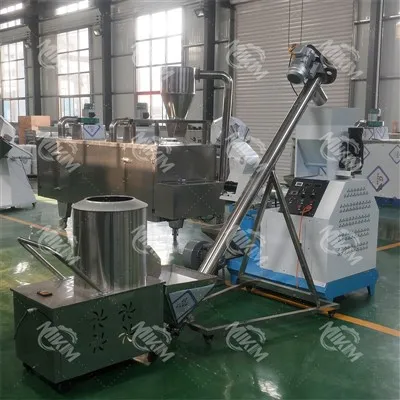
Aquatic Feed Kibble Line: Pet Food and Fish Feed
Leave a message
What Is an Aquatic Feed Kibble Line?
A pet food and aquatic feed kibble line processes feed for dogs, cats, and aquatic animals such as fish and shrimp. The finished kibble approaches human food in fineness, health index, and nutritional content, and some quality requirements are even stricter. In the extruder, ingredients are cooked under intense heat and pressure as the material moves toward the open end, where it passes through a shaping die and a knife that cuts the pellets to length.
Line Composition and Flow
Raw materials include soya flour, meat powder, corn flour, and fish meal. The standard flow chart runs from the mixing system through the extrusion system, drying system, flavoring system, and packing system. After extrusion, fish feed is dried in a multi-pass dryer until its moisture content is low enough to be shelf stable. The feed may then pass through a coating drum where animal fat and vitamins are applied. Different shapes of dog food can be produced by adjusting the molds on the extruder, and the same line can produce fish feed.
Model Specification Table
The table below lists three common line configurations for pet food and aquatic feed production.
| Model | Installed Power | Real Power | Output | Dimension |
|---|---|---|---|---|
| MK-65 | 81.5 kW | 53 kW | 150 kg/h | 21000x1200x2200 mm |
| MK-70 | 115 kW | 76 kW | 200 kg/h | 23000x1500x2200 mm |
| MK-85 | 180 kW | 117 kW | 300 kg/h | 28000x1500x4300 mm |
Expanding Raw Material Options
Some unconventional aquatic raw materials, such as fermented soybean dregs, algae powder, and shrimp shell powder, have low palatability and high fiber content when processed directly. Pellet production lines use steam heating to soften raw materials during conditioning, and physical extrusion during pelleting improves palatability. Adding a small amount of a binder such as sodium carboxymethyl cellulose allows these materials to be compacted into firm pellets, which broadens the raw material base for fish feed and reduces reliance on expensive fish meal and soybean meal. As a result, feed formulas can adapt to raw material price fluctuations.
Customized Pellets for Different Species
Different fish species have different feeding habits and nutritional requirements: sea bass is carnivorous and needs feed high in animal protein, while grass carp is herbivorous and tolerates higher fiber content. The production line can customize pellets by adjusting equipment parameters and the formula, such as the pellet mill die aperture, with roughly 1-2 mm for fry feed and 3-5 mm for growout feed, and pellet hardness matched to the species. For specialized practices such as low-temperature wintering, the line can produce high-energy pellets with added fish oil, and for organic aquaculture, antibiotic-free and organic raw materials can be used.
FAQ
What raw materials does the line use?
Typical raw materials include soya flour, meat powder, corn flour, and fish meal, with options to add vitamins, minerals, and unconventional ingredients such as fermented soybean dregs.
Why is a multi-pass dryer needed?
Fresh extruded kibble is hot and moist; the multi-pass dryer lowers moisture to a shelf-stable level so the product stores safely without spoiling.
What does the coating drum do?
The coating drum applies animal fat, vitamins, and other additives evenly onto the pellets, improving energy content, palatability, and nutritional balance.
Can the line make different dog food shapes?
Yes. Adjusting the extruder molds changes the shape and size of the kibble, and the same line can switch to fish feed production.
How does pelleting help use cheaper raw materials?
Steam conditioning and extrusion improve the palatability of fibrous or low-cost ingredients, so they can be included at higher levels in the formula, reducing feed costs.
What die aperture suits fry feed?
Fry feed typically uses a small die aperture of about 1-2 mm, while growout feed uses 3-5 mm; hardness settings are matched to the species being farmed.