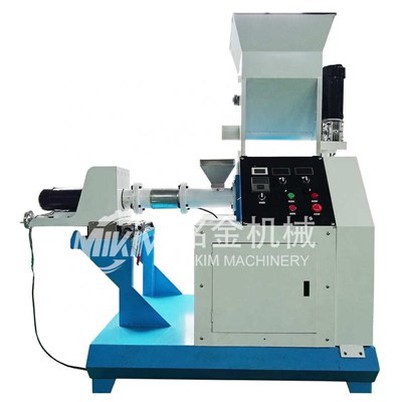
Stainless Steel Automatic Floating Fish Feed Processing Line: Extrusion Parameters and Line Design
Leave a message
Why Extrusion Is Used for Floating Fish Feed
Floating aquafeed cannot be produced on a simple ring die press. Buoyancy comes from an expanded, porous pellet structure created when a moist, starch-rich mash is cooked under pressure and then flashes off at the die. Extrusion gelatinises starch, denatures protein and expands the strand, so the finished pellet keeps 80-95 percent of its mass above the surface for a useful period. This behaviour lets farm staff see the feed and adjust the ration, reduces waste on the pond bottom and improves feed conversion.
Raw Materials and Grinding Fineness
Formulas combine fish meal, meat meal, soybean meal, wheat gluten, wheat flour, fish oil and vitamin and mineral premixes. Starch is the expander, and float grades are normally formulated with at least 20 percent starch-bearing ingredients. Grinding fineness before extrusion is finer than for livestock pelleting, typically passing a 0.5-0.25 mm screen, because coarse particles tear the extrudate and create weak, sinking pellets. Sieves used for verification conform to ISO 3310-1:2016 with ASTM E11 designations, where No. 40 is 425 um and No. 60 is 250 um. Moisture and protein are checked to ISO 6496 or GB/T 6435-2014 and to ISO 5983-1 or GB/T 6432-2018.
Extrusion Line Configuration and Operating Window
| Stage | Typical Setting | Purpose |
|---|---|---|
| Grinding | 0.5-0.25 mm screen | Fine, uniform mash for clean expansion |
| Mixing | CV 5 percent or lower, tracer test | Uniform nutrient and oil distribution |
| Pre-conditioning | 85-95 degrees C, steam | Pre-cook starch, raise mash moisture |
| Extrusion barrel | 120-150 degrees C, 22-28 percent moisture | Starch gelatinisation and expansion |
| Die and cutter | Die open area sets diameter, 1-12 mm | Pellet size and buoyancy control |
| Dryer | Moisture reduced to 8-10 percent | Storage stability and water stability |
| Vacuum coater | Oil added to 8-16 percent | Energy density, reduced leaching |
Buoyancy, Diameter and Sinking Grades
Buoyancy is controlled by die open area, screw configuration and the moisture and temperature of the melt. A high open area and a high melt moisture give a lighter, more expanded pellet; reducing open area and moisture produces a dense slow-sinking or sinking pellet from the same machine. Floating grades are normally supplied at 1-6 mm diameter, with 2 mm and 3 mm dominating nursery and grow-out tilapia and catfish programmes, while 4-6 mm covers larger fish. Pellet durability and water stability should be tested on each formulation because a formula that floats well but disintegrates in 10 minutes causes the same pond loading as a sinking crumble.
Stainless Steel Construction and Hygiene
Aquafeed lines are wet, salty and corrosive, so contact parts of the extruder, die, cutter head, conveyor and dryer are commonly made in 304 or 316L stainless steel, with food-grade seals. A magnetic separator and aspiration on the grinder, plus enclosed transfer, keep tramp metal and dust out of the product. Finished feed must meet the hygiene requirements of GB 13078-2017, and plants targeting export customers typically run a management system to ISO 22000:2018 or ISO 9001:2015. Machinery safety follows ISO 12100:2010 and IEC 60204-1.
Layout, Capacity and Utilities
A small floating fish feed line of 300-1000 kg/h is arranged vertically where headroom allows: grinding and mixing at the top, extrusion and drying at intermediate levels, coating and bagging at the base. Installed power for such a line is dominated by the extruder, which typically accounts for 45-60 percent of connected load, with the dryer and grinder next. Steam supply, compressed air for the cutter and a three-phase supply sized to the largest motor are the standard utilities.
Frequently Asked Questions
Q: Can a ring die pellet mill make floating fish feed?
A: Not properly. Buoyancy requires expansion of a cooked melt, which only extrusion provides. A ring die press produces dense sinking pellets.
Q: What grinding fineness is needed for floating feed?
A: Typically 0.5-0.25 mm, so the mash passes a No. 40 (425 um) or No. 60 (250 um) sieve to ASTM E11. Coarse particles create weak pellets that sink.
Q: What starch level supports floatability?
A: Formulations for floating grades usually contain at least 20 percent starch-bearing ingredients such as wheat flour or wheat gluten to drive expansion.
Q: What temperature is the extruder barrel run at?
A: Commonly 120-150 degrees C at 22-28 percent mash moisture, with pre-conditioning at 85-95 degrees C to start starch gelatinisation.
Q: Why is vacuum coating used after drying?
A: Drying to 8-10 percent moisture opens pores in the pellet. Vacuum coating draws oil, typically 8-16 percent, into those pores so it does not leach out in the pond.
Q: Which stainless steel grade is usual for contact parts?
A: 304 covers most applications; 316L is preferred where salt water and heavy marine oil contact accelerate corrosion.