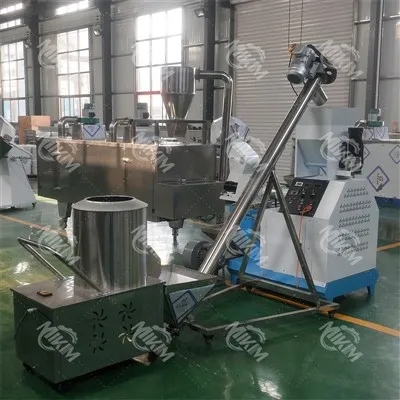
The Difference Between Single-Screw pet food extrusion machine and Twin-Screw pet feed extruder machine Working Principles
Leave a message
content
The working principle of a single-screw pet food extruder is relatively simple, relying on the "extrusion friction of a single screw" to achieve cooking and puffing. During operation, raw materials enter the extrusion chamber through the feed hopper. The single screw rotates at 300-400 rpm, pushing the raw materials towards the die end through the helical blades. As the screw pitch gradually decreases, the raw materials are continuously compressed during transport, generating a pressure of 2-5 MPa. Simultaneously, the friction between the raw materials and the screw and the inner wall of the extrusion chamber generates heat, raising the temperature of the extrusion chamber to 120-140℃, thus cooking the raw materials. The cooked raw materials are then extruded from the die orifice, instantly puffed into shape. The advantages of a single-screw extruder are its simple structure, convenient operation, and affordable price (5000-30000 yuan), making it suitable for small workshops, home DIY, or the production of basic pet food. The disadvantages are poor mixing effect, inability to adapt to complex formulas (such as formulas with large amounts of added oils and vegetable powders), and relatively low cooking uniformity.
The core working principle of a twin-screw pet feed extruder is the "meshing and synergistic mixing of two screws," resulting in a more complex but superior process. The two screws rotate in parallel or opposite directions (400-600 rpm). After entering the extrusion chamber, the raw material is not only pushed and squeezed by the screws but also subjected to shearing and stirring between them, achieving a mixing uniformity of over 95%. During extrusion, the raw material is compressed to a high pressure of 3-8 MPa, and the heat generated by friction and shearing raises the temperature to 140-160℃, resulting in more thorough maturation and a starch gelatinization rate of over 90%. Twin-screw extruders are typically equipped with a forced feeding device at the feed end, enabling them to handle raw materials with high moisture and high oil content (oil content can reach 8%-12%), making them suitable for producing high-end pet food and functional foods (such as grain-free and probiotic foods). Its advantages include uniform mixing, thorough maturation, and strong adaptability, making it suitable for medium-sized and larger pet food companies. Its disadvantages include complex structure, high operational difficulty, high price (30,000-500,000 RMB), and higher maintenance costs.
The core differences between the two types of extruders during operation lie in three aspects: mixing effect, maturation quality, and raw material compatibility. Regarding mixing effect, twin-screw extruders achieve thorough mixing of raw materials through meshing rotation, avoiding uneven nutrient distribution in certain areas; single-screw extruders rely on the flow of the raw materials themselves for mixing, resulting in poorer performance. In terms of maturation quality, the shearing action of the twin-screw pet pellet making machine ensures more even heating of the raw materials, resulting in more thorough maturation and a 15%-20% increase in pet digestibility; single-screw extruders may experience localized under-maturity. Regarding raw material compatibility, twin-screw extruders can handle complex formulas with high moisture, high oil, and multiple components; single-screw extruders are suitable for handling dry, single-ingredient raw materials. Understanding these differences is crucial for selecting the appropriate extruder type based on your production needs, ensuring both production efficiency and product quality.
Related equipment


about Us
MIKIM's fish feed pellet production lines and supporting machinery offer excellent value for money. Not only are they affordable, eliminating middlemen markups and allowing small and medium-sized enterprises (SMEs) and fish farmers to purchase complete sets of equipment at reasonable costs, but they also boast exceptional efficiency. The fully automated process, from raw material crushing and precise ingredient mixing to extrusion pelleting and maturation, is completed in one continuous flow. This results in high starch gelatinization rates and uniform pellet formation, significantly improving production efficiency and feed quality, truly achieving "low cost, high output." Choosing a MIKIM fish feed pellet production line means enjoying comprehensive pre-sales and after-sales service, including 24-hour online customer support, a one-year warranty on the entire machine, professional on-site installation, commissioning, and maintenance, and a stable supply of spare parts. Customers can buy with confidence and use with peace of mind, with both excellent value and service quality!!!
Customer visit
Certificate of Honor

FAQ
1. What is the price of the floating fish extruder machine?
The price ranges from approximately $1,500-$55,000
2. Do you provide maintenance services for your customers?
Yes, we offer comprehensive after-sales maintenance services to our customers.
If you would like to learn more about MIKIM machinery, please contact us. We offer one-stop service and welcome your inquiries!!!