Key Equipment in the Feed Pellet Production Process: Roles and Selection Points
Leave a message
What Counts as Key Equipment in Pellet Production
Pellet production is a chain of unit operations, and the key equipment is the machinery whose settings and condition directly decide pellet quality and line output. The chain starts well before the pellet mill: raw material has to be screened, ground, dried when necessary and mixed, because a pellet mill cannot repair problems created earlier in the line.
This review follows the process stage by stage, from raw material pretreatment to packing, and explains what each machine contributes and what has to be checked to keep it performing.
Pretreatment, Batching and Mixing Equipment
Raw materials arrive as powder, granules or lumps, and their particle size, moisture and impurity level directly affect the smooth operation of every later stage. Pretreatment equipment adjusts these properties to create a stable condition for mixing and granulation.
Screening machine: classifies raw material by particle size and removes both oversized pieces and fine impurities. Uniform particle size improves the efficiency of later processes and prevents blockages and production anomalies.
Pulverizer or hammer mill: breaks large particles or lumps into fine powder by impact or grinding so the particle size meets process requirements. A suitable degree of pulverization improves mixing and prevents uneven particle size in the finished pellets.
Drying equipment: reduces the moisture content of raw material. Highly moist material sticks and clumps, which destabilises the following stages. Drying temperature and time must be controlled to avoid over-drying, which changes the properties of the powder.
After pretreatment, ingredients are weighed and blended. A stainless steel mixer is common because it handles powdered materials quickly, mixes evenly and resists corrosion. Precision weighing and control software calculate the required ratios and release each ingredient in turn so every batch matches the formula.
Mixing quality matters because each pellet must carry the same proportion of nutrients. Poor mixing produces variation that no later step can correct, and the effect becomes visible only in the finished product, long after the batch has left the mixer.
| Equipment | Role in the process |
|---|---|
| Weighing hopper and batching software | Meter each ingredient to the recipe ratio and record the batch for traceability |
| Stainless steel mixer | Blend weighed ingredients into a uniform mash without segregating fine and coarse particles |
| Screw conveyor | Move mash and powder between machines in a sealed, dust-controlled path |
The Core of the Line: Conditioner and Pellet Mill
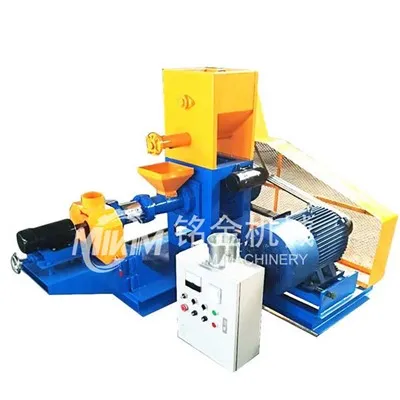
The pellet mill is the heart of the line. Its die hole geometry and roller pressure determine pellet hardness and durability, so the die has to be matched both to the formula and to the required pellet size. A simple structure, wide adaptability and low noise make modern pellet machines suitable for small, medium and large operations alike.
| Equipment | Role in the process |
|---|---|
| Conditioner | Adds steam to soften the mash, activate starch binding and raise temperature before pressing |
| Pellet mill | Presses the conditioned mash through a die with rollers, forming dense, uniform pellets |
| Die and rollers | Set pellet diameter, density and compression; the wear parts that affect quality most |
Cooling, Screening and Packing Equipment
Pellets leave the die hot and soft. A counterflow cooler cools them fully and evenly so they harden without cracking during handling. After cooling, a screener removes fines, and the packer, which combines automatic weighing, conveying and sewing functions, fills bags to a set weight and closes them. Conveyors between these machines keep the flow continuous; screw conveyors are widely used because their sealed structure keeps material clean and free of dust.
Every machine in the chain has to be sized for the same line capacity. If the hammer mill or the mixer cannot supply the pellet mill at its rated rate, the mill stands idle part of the time and line output settles at the level of the bottleneck. Spare dies, screens and rollers for the wear parts should be planned from day one, because these components wear fastest and stop the line most often.
Selection Points and Common Misconceptions
Misconception 1: the pellet mill alone determines pellet quality. In practice grind size, conditioning and cooling are equally decisive, and each of them can spoil the work of the others.
Misconception 2: a dryer is always required. It is needed only when raw material moisture exceeds the range the mill can handle; installing one unnecessarily adds energy cost and another maintenance point.
Misconception 3: the screener after the cooler can be skipped to save money. Doing so gives dusty bags and inconsistent particle size, which lowers the value of the finished product.
Frequently Asked Questions
Q: Which machines count as the key equipment of a pellet line?
The hammer mill, batching and mixing set, conditioner, pellet mill with its die and rollers, counterflow cooler, screener and packer are the units whose condition decides quality and output.
Q: When is a dryer actually needed?
Only when incoming raw material moisture is above the range the pellet mill can process without slipping or blocking. Drying below that range wastes energy and changes powder properties.
Q: How should the die be selected for a new formula?
Match hole diameter, effective thickness and taper to the formula and to the target pellet size, then verify compression by inspecting pellet hardness rather than by assuming a setting.
Q: Why plan spare dies, screens and rollers in advance?
These parts wear fastest and cause the most unplanned stoppages. Holding them as consumables keeps a scheduled order from being delayed by a single worn component.
Q: What is the most common capacity mistake?
Sizing the pellet mill above what the hammer mill and mixer can feed. The line then runs at the bottleneck's speed while the mill consumes more power than it produces output for.
Q: Does screening before grinding matter?
It does. Removing oversized pieces and fine impurities before grinding protects the mill, stabilises particle size and reduces blockages in later stages.