


What measures can be taken to address uneven particle size in fish feed production lines?
Leave a message
The buoyancy, water solubility, and particle size of aquatic feed pellets are closely related. If the pelleting process parameters (conditioning temperature, steam consumption, and barrel pressure) are not properly controlled, it will not only lead to uneven pellet size but also affect the stability of the feed in water (e.g., fine particles are easily dissolved, while coarse particles are difficult to sink). Many manufacturers adjust parameters based on experience without optimizing them in conjunction with the characteristics of aquatic feed, resulting in both particle size and performance failing to meet standards.
Problem Causes and Solutions
1.The conditioning temperature and steam dosage were not adapted to the characteristics of aquatic feed
Reasons: Aquatic feed contains a high proportion of protein (fish meal, shrimp meal). If the conditioning temperature is too high (>90℃), the protein will be excessively denatured, the viscosity of the feed will decrease, and it will easily break into fragments when squeezed. If the temperature is too low (<70℃), the starch gelatinization rate will be insufficient (<65%), the viscosity of the feed will be insufficient, and the particles will be loose and easy to break. Fluctuations in steam dosage (such as increasing the amount of steam added per 100kg of feed from 5kg to 8kg) will cause the moisture content of the feed to fluctuate, and the particle size will vary significantly with the change in moisture content.
Solution: Adjust the conditioning temperature according to the protein content of the raw materials-for protein content >40% (e.g., shrimp feed), control the temperature at 75-80℃; for protein content 30-40% (e.g., fish feed), control the temperature at 80-85℃ to avoid excessive protein denaturation; precisely control the steam usage using a steam flow meter, ensuring a stable addition of 6-7 kg per 100 kg of raw materials to guarantee a moisture content of 15-16% and a starch gelatinization rate of over 75% after conditioning; install a stirring paddle (35-40 r/min) inside the conditioner to extend the contact time between the raw materials and steam, improving the uniformity of conditioning.
2.Improper barrel pressure control leads to particle density differences
Reasons: Floating feed for aquaculture requires a stable barrel pressure of 0.8-1.2 MPa (ensuring a particle density of 0.9-1.0 g/cm³). If the pressure is too low (<0.8 MPa), the particle density is low, easily forming hollow, coarse particles; if the pressure is too high (>1.2 MPa), the particles are over-compacted, easily forming a "hard core," producing debris during cutting. Fluctuations in screw speed (such as decreasing from 300 r/min to 250 r/min) cause unstable pressure inside the barrel, resulting in uneven particle size and density.
Solution: Adjust the barrel pressure via the die head back pressure valve – control the pressure of floating materials at 0.8-1.2 MPa and sinking materials at 1.2-1.5 MPa, and monitor it in real time with a pressure sensor (fluctuation range ≤ ±0.1 MPa); adjust the screw speed according to the pressure, appropriately increasing the speed when the pressure is too low (e.g., from 300 r/min to 320 r/min), and decreasing the speed when the pressure is too high (e.g., reducing to 280 r/min) to ensure stable barrel pressure; install a particle density detector at the barrel outlet and measure it every 30 minutes to ensure the density meets the requirements (floating materials < 1.0 g/cm³, sinking materials > 1.0 g/cm³).
3.The cooling process did not take into account both particle size and water solubility requirements
Reasons: Aquatic feed requires controlled cooling rate (to prevent the loss of water-soluble components). If the cooling fan airflow is too high (>4000m³/h), the particle surface cools rapidly, and internal heat cannot be dissipated in time, resulting in a "temperature difference between inside and outside," leading to particle cracking (crush rate exceeding 12%). If the cooling time is too short (<10 minutes), the particle moisture content does not drop below 12%, making it prone to clumping during storage and forming fine particles after breakage. Uneven airflow distribution within the cooler results in some particles being over-cooled while others are under-cooled, leading to uneven particle size and moisture content.
Solution: Adopt a "gradient cooling" process – first, turn on 50% airflow (2000m³/h) for 5 minutes, then turn on 80% airflow (3200m³/h) for 10 minutes, for a total cooling time of 15-20 minutes, ensuring that the particle temperature drops to room temperature (±3℃) and the moisture content is 11-12%; adjust the angle of the baffle plate inside the cooler to ensure that the wind speed difference in different areas is ≤0.5m/s; after cooling, use a vibrating screen (screen mesh size matched to particle diameter) to separate the residue, and send the residue back to the mixer for secondary granulation to improve the particle size qualification rate.



Why Choose Us
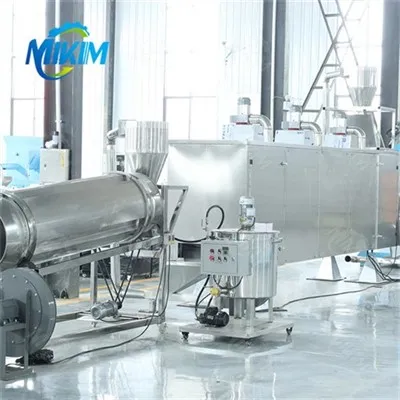
MIKIM boasts extensive experience in poultry feed pellet production lines, significantly reducing the incidence of poultry diseases. Its equipment is not only widely used across various industries domestically but also exported to Southeast Asia, Europe, Africa, and South America, earning a high reputation internationally. This global presence not only demonstrates the adaptability and competitiveness of its products, but also demonstrates the company's experience in adapting to diverse market standards and logistics conditions, enabling it to provide a stable supply chain for its overseas customers. Whether serving large domestic farms or cross-border feed companies, MIKIM can leverage its global service network to ensure a consistent, high-quality experience.
For more information on process flow design, equipment layout, factory construction plans, individual equipment pricing, or turnkey project proposals, please feel free to contact us!!!
FAQ
1. What is the price of the screw feed production line?
The price ranges from approximately $9,000-$32,000
2. Do you provide maintenance services for your customers?
Yes, we offer comprehensive after-sales maintenance services to our customers.


