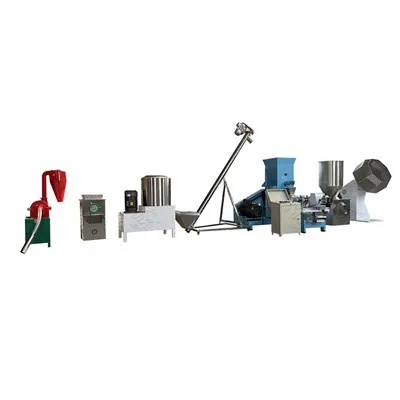
What might cause a blockage in a fish feed pellet mill?
Leave a message
A sudden "blockage" occurred during fish feed pelletizer production. The raw material could not be extruded from the die head, and the pressure in the barrel suddenly increased (over 1.5MPa). The feeder automatically shut down due to excessive load. If not promptly addressed, the raw material in the barrel would carbonize due to the high temperature (over 160°C). Cleaning required the disassembly of a large number of parts, taking more than 4 hours. This seriously affected production efficiency and shortened the service life of the barrel and screw.
Cause and Solution
1.Abnormal Raw Material Moisture and Particle Size
Causes: Excessive raw material moisture (over 19%) causes it to adhere to the screw surface inside the barrel, forming a "material layer" that accumulates with screw rotation, eventually clogging the barrel. Uneven raw material particle size (over 30% of coarse particles exceeding 4mm in diameter) results in high resistance to material extrusion within the die orifices, preventing smooth passage and gradually clogging the orifices, leading to material accumulation inside the barrel.
Solutions: Dry raw materials before storage using a three-layer dryer (60-70℃) to control moisture content to 14%-16%. Install an online moisture monitor in the raw material silo to monitor moisture changes in real time. Replace the crusher screen (e.g., use a 2mm aperture screen for Φ3mm granules) to ensure coarse particle content is ≤5% after crushing. Add a grading screen after the crusher to re-crush coarse particles, preventing substandard raw materials from entering the extruder.
2. Conditioning parameters and barrel temperature mismatch
Causes: Excessive steam usage in the conditioner (exceeding 8% of the raw material weight) leads to excessive moisture in the raw material (moisture content exceeding 18%), increasing its stickiness upon entering the barrel and easily clogging the screw and die orifices; Insufficient barrel temperature (expansion section below 110℃) results in insufficient starch gelatinization (below 70%), poor fluidity, and inability to form a "molten state" within the barrel, making it difficult to pass through the die orifices and causing blockage.
Solutions: Adjust the steam usage in the conditioner, controlling the steam addition to 5%-6% of the raw material weight using a steam flow meter to ensure the moisture content of the raw material remains stable at 15%-17% after conditioning; increase the temperature of the expansion section of the barrel to 120-130℃, and simultaneously wrap the barrel with insulation cotton (8-10cm thick) to reduce heat loss and ensure the raw material is fully gelatinized within the barrel, forming a fluid "molten state".
3.Improper operation or lack of equipment maintenance
Causes: Failure to perform "no-load preheating" before starting the machine or insufficient preheating time (less than 30 minutes); excessively low barrel and screw temperatures (below 50℃); raw materials immediately adhere upon entry; failure to clean residual raw materials from the barrel before shutdown; hardened residual raw materials upon restarting, which mix with new raw materials and clog the barrel; excessively rapid adjustment of the feeding speed (suddenly increasing from 20r/min to 50r/min); instantaneous accumulation of raw materials in the barrel, exceeding the extrusion capacity.
Solution: Before starting the machine, follow the procedure of "motor preheating for 15 minutes → barrel preheating in sections for 30 minutes (feeding section 60℃, compression section 90℃, expansion section 120℃) → no-load operation for 5 minutes" to ensure the equipment reaches the production temperature; before stopping the machine, turn off the feeder, introduce dry material (such as corn flour), run the machine no-load for 10 minutes to clean the residual raw materials in the barrel, and then turn off the heating device; when adjusting the feeding speed, follow the principle of "gradual increase", increasing by 5 r/min each time, observe the barrel pressure and motor current, and continue to increase if there are no abnormalities.



Why Choose Us
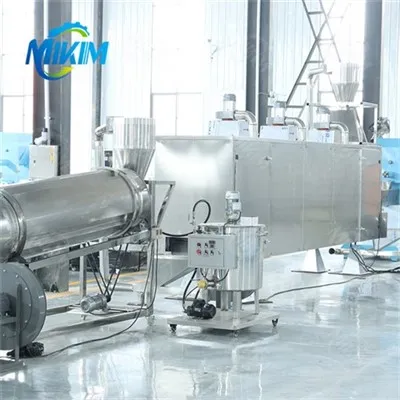
MIKIM boasts extensive experience in poultry feed pellet production lines, significantly reducing the incidence of poultry diseases. Its equipment is not only widely used across various industries domestically but also exported to Southeast Asia, Europe, Africa, and South America, earning a high reputation internationally. This global presence not only demonstrates the adaptability and competitiveness of its products, but also demonstrates the company's experience in adapting to diverse market standards and logistics conditions, enabling it to provide a stable supply chain for its overseas customers. Whether serving large domestic farms or cross-border feed companies, MIKIM can leverage its global service network to ensure a consistent, high-quality experience.
For more information on process flow design, equipment layout, factory construction plans, individual equipment pricing, or turnkey project proposals, please feel free to contact us!!!

FAQ
1. What is the price of the fishing pellet making machine?
The price ranges from approximately $3,000-$42,000
2. Do you provide maintenance services for your customers?
Yes, we offer comprehensive after-sales maintenance services to our customers.