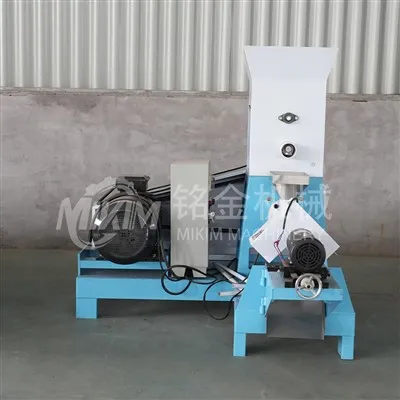
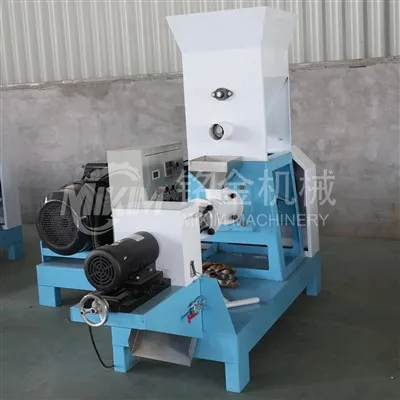
Which is more advantageous in terms of cost and maintenance difficulty: single-screw or twin-screw fish feed extruders?
Leave a message
When choosing an extruder, in addition to considering capacity and quality, you also need to calculate the "total cost"-such as the purchase price of the equipment, electricity costs, and maintenance fees. With these costs added up, which is more cost-effective, a single-screw or a twin-screw extruder? Some people say that single-screw extruders are "cheaper to buy," but twin-screw extruders are "more economical to use." You need to calculate the differences between the two in terms of initial investment and later maintenance before making a choice.
nitial Costs: Single-screw extruders are "cheaper," while twin-screw extruders are "twice as expensive."
Single-screw extruders: lower purchase price and simpler installation. Single-screw extruders have a simple structure, fewer parts, and a lower purchase price-for example, a 65mm single-screw extruder costs approximately 30,000-50,000 yuan, and an 80mm one costs 50,000-80,000 yuan. Installation is also simple; no complex foundation is needed, and two workers can install it in one day, with installation fees of only 2,000-3,000 yuan. For small factories with limited budgets, an extrusion production line (including a crusher and cooler) can be set up for 30,000-50,000 yuan.
Twin-screw extruders: High purchase price and complex installation. Twin-screw extruders have a complex structure with more parts (an additional screw, synchronizing gear, and feed inlet), making them significantly more expensive than single-screw extruders. For example, a 65mm twin-screw extruder costs 80,000-120,000 RMB, and a 120mm twin-screw extruder costs 150,000-200,000 RMB, which is 2-3 times the price of a single-screw extruder of the same diameter. Installation requires a specialized foundation (to prevent equipment vibration) and adjustment of the synchronizing gear (to ensure the two screws rotate at the same speed). Hiring a professional installation team costs 10,000-20,000 RMB and takes 3-5 days.
Long-term Costs: Single-screw extruders are "expensive to operate," while twin-screw extruders are "economical to operate."
Electricity Costs: Single-screw extruders typically have lower motor power, but due to the lower material conveying efficiency within the barrel, it takes longer to achieve the same output, resulting in higher cumulative electricity consumption. While twin-screw extruders initially have higher motor power, their unique meshing structure allows for rapid material delivery, increasing output by 30%-50% per unit time. This translates to lower electricity costs per kilogram of feed. For example, a production line with a daily output of 5 tons has a monthly electricity cost of approximately 12,000 yuan for a single-screw extruder, while a twin-screw extruder costs around 8,000 yuan, resulting in annual savings of nearly 50,000 yuan.
Maintenance and Repair: The screw and barrel of a single-screw extruder experience wear on only one side. With increased usage time, the gap widens, leading to uneven material plasticization. This necessitates more frequent screw and barrel replacements, with each repair costing approximately 3,000-5,000 yuan. Although twin-screw extruders have a complex structure, their modular design allows for the individual replacement of wear parts (such as threaded components and shear blocks), distributing maintenance costs and reducing replacement cycles. In the long run, this can reduce annual maintenance costs by more than 40%.
Raw material loss: Single-screw extruders have limited mixing capacity, often resulting in localized over-plasticization or under-plasticization, leading to the discarding of 1.5%-2% of raw materials due to substandard quality. Twin-screw extruders, through their strong shearing and self-cleaning properties, improve material mixing uniformity by 90%, controlling the raw material loss rate to within 0.5%. Based on a cost of 1800 yuan per ton of material, this translates to a reduction of nearly 200,000 yuan in raw material waste annually.
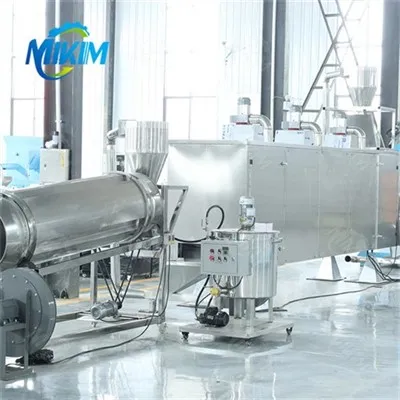

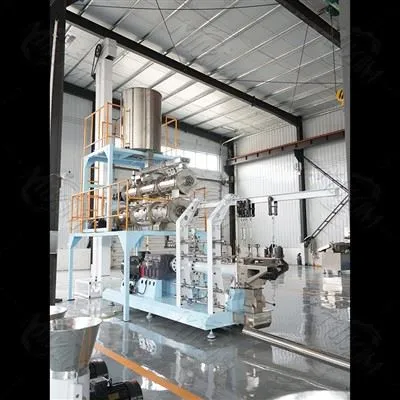

Impact of Structure and Principle on Fish Feed Production: Twin-Screw Extruders Are More Suitable for "Refined Needs"
For example, when making sinking feed for sea bass, high particle density and uniform nutrition are required. The shearing and mixing action of a twin-screw extruder allows fishmeal and starch to be fully integrated, resulting in better water resistance of the particles. However, when making floating feed for ordinary grass carp, the requirements are not as high, and the simple structure of a single-screw extruder can meet the needs, as long as the particles can be extruded.
Why Choose Us
MIKIM boasts extensive experience in poultry feed pellet production lines, significantly reducing the incidence of poultry diseases. Its equipment is not only widely used across various industries domestically but also exported to Southeast Asia, Europe, Africa, and South America, earning a high reputation internationally. This global presence not only demonstrates the adaptability and competitiveness of its products, but also demonstrates the company's experience in adapting to diverse market standards and logistics conditions, enabling it to provide a stable supply chain for its overseas customers. Whether serving large domestic farms or cross-border feed companies, MIKIM can leverage its global service network to ensure a consistent, high-quality experience.
For more information on process flow design, equipment layout, factory construction plans, individual equipment pricing, or turnkey project proposals, please feel free to contact us!!!

FAQ
1. What is the price of the machine for making fish feed?
The price ranges from approximately $5,500-$21,000
2. Do you provide maintenance services for your customers?
Yes, we offer comprehensive after-sales maintenance services to our customers.