Which Raw Materials Are Required for small fish food making machine?
Leave a message
content
Local miscellaneous fish meal is a high-quality, low-cost alternative to fishmeal, suitable for extrusion processing in various fish pellet making machines. Small-scale fish farmers can utilize small miscellaneous fish, shrimp, and crabs from local fishponds and rivers, drying and crushing them to produce miscellaneous fish meal with a protein content of 50%-60%, priced at only 1/2-2/3 of imported fishmeal. Under the extrusion environment of an extruder, the protein in miscellaneous fish meal undergoes thorough denaturation, achieving a digestibility and absorption rate of over 80%, and is rich in unsaturated fatty acids necessary for fish growth, thus improving fish quality. During processing, the miscellaneous fish must be thoroughly dried (moisture content ≤10%) and crushed to at least 80 mesh to avoid impurities affecting the extrusion effect. It can replace 10%-20% of imported fishmeal. For example, when producing floating feed for grass carp using a floating fish feed making machine, replacing 10% imported fishmeal with 15% local miscellaneous fish meal, combined with soybean meal and corn, results in a buoyancy rate of 92% after extrusion. The growth rate of grass carp is not significantly different from that using feed made entirely of imported fishmeal, but the cost is reduced by 15%.
Agricultural by-products (such as peanut meal and cottonseed meal) are low-cost alternatives to soybean meal, but they require extrusion processing to remove anti-nutritional factors. Peanut meal has a protein content of 45%-50%, is inexpensive, and widely available, but contains small amounts of anti-nutritional factors. Cottonseed meal has a protein content of 40%-45%, but contains gossypol, requiring high-temperature extrusion processing in automated fish food making equipment to destroy harmful substances. In the high-temperature environment of 120-140℃ in fish feed production equipment, the removal rate of anti-nutritional factors in peanut meal and cottonseed meal reaches over 90%, significantly improving protein digestibility and absorption. The proportion used should be controlled: no more than 15% when used alone, and 20%-25% when used in combination with soybean meal. For example, in the production of floating carp feed, replacing 15% soybean meal with 10% peanut meal + 10% cottonseed meal, combined with corn and fishmeal, and extruded using a twin-screw extruder, results in stable feed quality, normal carp feeding, and a 20% cost reduction compared to using pure soybean meal.
Potato by-products (such as sweet potato residue and potato residue) are a low-cost supplement to starchy raw materials and can improve feed buoyancy. Sweet potato residue and potato residue contain 30%-40% starch and are by-products of food processing, with extremely low prices, sometimes even free. After drying and crushing, these raw materials can be fully gelatinized in the extrusion environment of a small fish feed pellet making machine, working synergistically with corn starch to improve the looseness and buoyancy of the feed. During processing, the residue needs to be dried to a moisture content of 12%-15%, crushed to a finer mesh than 80, impurities removed, and its proportion controlled at 5%-10%. For example, when producing tilapia floating feed using a small extruder, adding 8% sweet potato residue, combined with corn and soybean meal, extends the feed's buoyancy time to 10 hours after extrusion, and the particle structure is stable. Tilapia digest this feed well, further reducing costs.
Related equipment


about Us
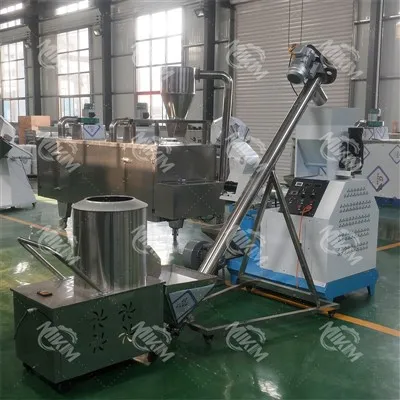
MIKIM's fish feed pellet production lines and supporting machinery offer excellent value for money. Not only are they affordable, eliminating middlemen markups and allowing small and medium-sized enterprises (SMEs) and fish farmers to purchase complete sets of equipment at reasonable costs, but they also boast exceptional efficiency. The fully automated process, from raw material crushing and precise ingredient mixing to extrusion pelleting and maturation, is completed in one continuous flow. This results in high starch gelatinization rates and uniform pellet formation, significantly improving production efficiency and feed quality, truly achieving "low cost, high output." Choosing a MIKIM fish feed pellet production line means enjoying comprehensive pre-sales and after-sales service, including 24-hour online customer support, a one-year warranty on the entire machine, professional on-site installation, commissioning, and maintenance, and a stable supply of spare parts. Customers can buy with confidence and use with peace of mind, with both excellent value and service quality!!!
Customer visit

Certificate of Honor

FAQ
1. What is the price of the Pet food manufacturing Machine?
The price ranges from approximately $1,500-$55,000
2. Do you provide maintenance services for your customers?
Yes, we offer comprehensive after-sales maintenance services to our customers.
If you would like to learn more about MIKIM machinery, please contact us. We offer one-stop service and welcome your inquiries!!!